Team Shrub goes to Curiosity Forest at Explorathon 2017

At the end of September (this semester has flown by, hasn’t it?), Team Shrub took part in the Explorathon – a weekend celebrating research in Scotland in the wider context of  European Researchers’ Night. We transplanted our shrub knowledge from the Arctic to the Curiosity Forest, where the public got to experience our research from different angles: from above and inside out!


Alongside us in this inviting, cheerful woodland were our friends from GeoSciences showing fossils, molecular biologists encouraging you to take a “cell-fie” photograph of your own epithelial cells, and several other groups from the physical and social sciences showcasing their research in interactive ways that got young (and not-so-young) participants drawing, making blueprints, controlling lasers with their voices, and much more.

Our stall took people through the journey we make collecting and processing data to investigate vegetation change in the Arctic. Participants flew highly successful missions on our drone simulator, then were shown what the pictures our drones take look like. They were then invited to have a much closer look at the shrubs we see as dots on our aerial pictures, by handling wood samples and looking at thin sections through the microscope.


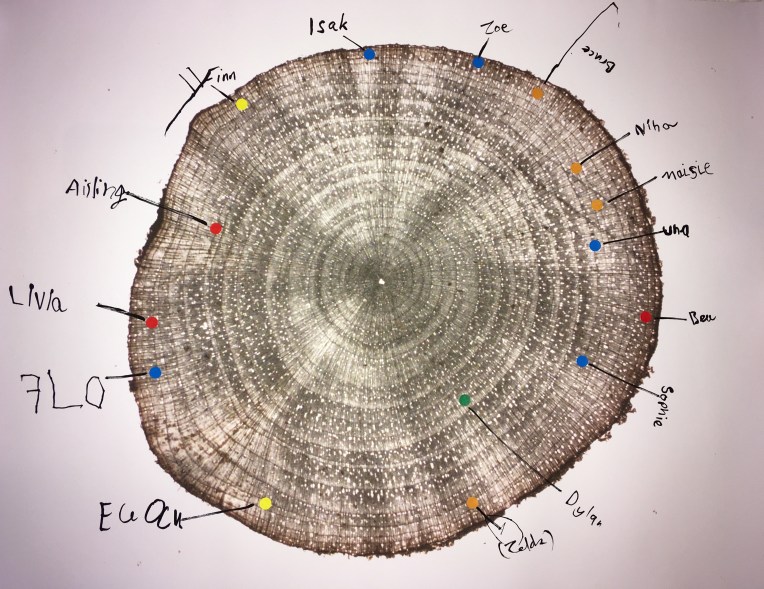
Before leaving, children were asked to find the ring corresponding to their date of birth on a giant print-out of a shrub stem section. Sadly I am too old to fit on this shrub!

dendro_outreach
This wee Arctic shrub was much older than most of our visitors!

Thanks to Lisa and the Explorathon Team for having us!

By Sandra


Team Shrub’s Tips: CVs & Job Applications

Last week we all applied for our own job.

Well, sort of.

phd071312s

In preparation for this week’s lab meeting on CVs and job applications, Isla asked us all to apply for the position of Team Shrub lab manager. The job is unfortunately fictional for all of you getting excited out there, but here is what we received in our inbox on Tuesday morning.

**********

Data/Field Manager position on Team Shrub

Team Shrub at the University of Edinburgh, a dynamic and friendly research group focussing on global change ecology, is hiring a lab and field data manager.  We are looking for someone with data management skills including experience programming in R and using statistics such as hierarchical modelling.  Experience in version control using GitHub would be an asset.  The position will also involve fieldwork in the Canadian Arctic.  Some outdoor experience is a requirement and any background leading or providing logistics to expeditions would be an asset.  We are looking for applicants familiar with computers, scientific data and ecological fieldwork.  Diverse applicants from a range of backgrounds are encouraged to apply.  To apply please bring a 1-page CV to the next lab meeting to be discussed by the job application committee.  We will be in touch with all qualified applicants to set up an interview.  Application deadline: Friday, 3 November 2017 at 2pm.  The job will be full time at a pay scale commensurate with the experience of the recruited applicant.

**********

And so we arrived, CV’s at the ready and slightly nervous, ready to discuss exactly what it takes to get your dream job. Here is a summary of our thoughts trying to encompass jobs from an undergraduate summer position, PhD or postdoc through to an academic job.

Some topics we didn’t necessarily all agree on – particularly with respect to the increasing importance of online content. But overall the general message applies across the board: you won’t get a job if you don’t apply, and putting in some advanced thought and work will put you in a much better position to submit a strong application when your dream job does come along.

Team Shrub’s Top Tips

1) The CV

The CV is the way that you communicate your skillsets and experience concisely to the rest of the world.  It can be a very important document making the difference for whether you get considered for a job or not.  Try to do your best to sell yourself in your CV.

  • Keep your CV/job applications as up to date as you can – because you never know when your dream job might be advertised.  You will never get a job or funding if you don’t apply, but try to put your “best foot forward” when you do submit those applications.  Sometimes it is better to not apply for everything and target your time towards the jobs you really want.
  • Update and restructure your CV/job application for every job that you apply for. Think about the key skills or set of experience that the job is looking for.  Make sure your application is tailored to those skills and the specific job.  Think about who is doing the hiring.  And use the actual words in the job ad in your application.  Make it clear that you have done your research and how specifically you are a good fit for the job.
  • When comparing CVs, we thought that the ones with the skills sets really clearly indicated on the first page were most successful for a field assistant/lab assistant type job.  This might be less important for an academic job when publications and funding might be most important.  Tailor the content of a CV and the structure and formatting to each job you apply for making sure that the most important stuff always comes at the top and on the first page.
  • You can format how you like but think about choosing an easy to read but nice font – feel free to choose something that you think does a good job of representing you!  Try to use headings, lines and formatting to cluster the text into different sections.  Use whitespace to your advantage – make sure you have a nice concise summary of your qualifications, but that you also don’t overwhelm your reader.  People mostly skim CVs so you want the important stuff to really stand out!
  • You should go back as far as seems relevant for the position you are applying for.  Try to tailor the content, but when in doubt it is probably better to include something rather than leave it out.  When you are in your undergrad, include your high school marks and awards.  When you are a PhD student include your undergrad marks and awards.  When you are a postdoc start to focus more on your PhD achievements and beyond.
  • Include the information that makes you look more impressive or will make you stand out from the other applicants.  You can include particularly high marks on courses or assignments that are relevant for the job you are applying for.  You don’t need to include everything, but you do need to sell yourself.  Never lie in a job application, but do be selective and edit your information to present the best version of you!
  • Keep your CV to the appropriate length: 1-2 pages for most jobs, but can be much longer for academic CVs depending on your career stage.
  • Don’t forget to include your name, email, address and other relevant contact information really clearly.  Your age/birth date, citizenships, whether you have a drivers license or other personal information could be appropriate depending on the job/application.
  • We thought that it is probably a good idea to include your referees on your CV, as this makes things more concrete and makes it look like you are confident about your referees’ assessment of you.
  • Do consider including some other interests or less conventional elements to your experience.  Are you an award-winning photographer?  Do you write a well-read blog?  Do you volunteer for a charitable organization?  If so include that information towards the end of your CV as that might make your application unique and allow you to stand out from the other applicants with similar skill sets to you.
  • Think about the file names for your CV and all other job application documents.  Make sure it is something that identifies you and the date and perhaps the job as well.  Submit all documents as PDFs, as the formatting of Word files can get messed up on different computers.  Try to combine multiple documents in one application package.  Include page numbers with the total pages (e.g., page 2 of 15) and put your name, the date, and other info in the header of each page, so that if anything goes missing it is easy to put your application back together again.

Shadow CVs: We all agreed that it’s very useful to look at other people’s CVs, especially as an undergraduate and early career researcher, to get an idea of what to include and what formatting to use for different types of job applications. Looking at other people’s achievements, though, can sometimes get you down, as we inevitably compare ourselves to others. A few years back, people started talking about shadow CVs as a way to show that people do fail sometimes, and that’s okay. A shadow CV is a record of all the positions you didn’t get, your unsuccessful grant applications, etc. Tenured scientists shared their shadow CVs online as a way to show early career people that failure is part of the process. Some have even went as far as suggesting we should have rejection goals – one can ask, if we are never getting rejected, are we aiming high enough?

An example of Haydn’s CV, applying to be on Team Shrub

TeamShrubCV_Haydn_Thomas.jpg

2) The Cover Letter

The cover letter allows you to express why you are applying, why you are passionate about the job, and why you are the best candidate out there.

  • Always submit a CV and cover letter unless you are explicitly asked not to, even for applications for PhDs or Postdocs.  It probably won’t hurt your application, and it might really help!
  • Write your cover letter on letter head or format it professionally.  Include your contact information, the date and an electronic signature.
  • Always address your cover letter in a gender neutral and appropriate way.  Try to address it to the specific person who is doing the hiring.  If in doubt, use something generic like “To whom it may concern:” or “Dear Colleagues,”.
  • Start the letter off with a very short generic paragraph explaining what you are applying for.  Indicate that there are 3 (or more) reasons why you are highly qualified for the position.
  • Have a series of short paragraphs with clear numbered headings on each of those reasons (e.g., “Track record of high-impact publications, Evidence of funding success, Commitment to teaching and mentorship” or “Experience with statistical programming, Three field seasons conducting ecological research, Evidence of leadership and independent working”, etc.).  You don’t have to follow this structure, but it is an effective way to structure a cover letter that can be easily skimmed for key content.
  • Finish with a short paragraph indicating your enthusiasm for the position and your willingness to answer any questions.

3) The online profile

A lot of the information about you that an employer, award committee or future colleague will access is now online. From LinkedIn, Google Scholar, Twitter, Facebook, and more we all have some sort of online profile now. Make sure you are in control of that online profile somewhat, putting out the content that you want people to associate with you.

  • Google yourself. Your web presence might surprise you. Make sure to put private browsing on, so that your search engine is not pre-trained to find content about you. Some people are more Googleable than others because their names are more unique or they have a larger online profile. Think about what content you want to be linked with your name and whether your different websites or social media sites do justice to you.  It is up to you how visible you want to be online with your own website and social media such as twitter.  Over time slowly work towards making your online presence stronger to sell your skills and career niche better.
  • A shout out to LinkedIn: we discussed LinkedIn and how it is a must for much of the business world, but isn’t used much in academia.  Therefore, it is probably worth maintaining a LinkedIn page if you don’t know what career you will end up in or just to be on the safe side.

4) The website

Websites are critical if you are aiming for an academic career and are thinking of applying for fellowships or academic positions.  We had some discussion about it, but some Team Shrub members feel that websites are now replacing the business card as the way people can find out your contact information and a bit about your job profile.  Alternatively, for careers with large companies, you might want to keep your online presence quite minimal.  If you are thinking about doing any independent consulting, starting your own business, getting involved in a start up, or going into communication in some form, your online presence is what will or will not get you the job/contract. Make sure to think about what you are putting on your website and online in general.  Many (if not most) people will google you when hiring, they are looking for content that will impress them about you, but might also be influenced negatively by what they see online.

The Academic website is becoming a more and more important part of your profile as a researcher.  I think that you should be looking to start to build your online content during your PhD, but potentially before.  Think about how you are branding yourself and your research interests. Make sure to format your website in an eye catching and not too busy manner.  Use beautiful photographs to illustrate the text.  Keep things simple but relatively comprehensive.  A website is always a work in progress.  It doesn’t have to be perfect when you first post it. Build your branding, profile and online content over time.

  • About page/team page: When building an academic website include a page about you with your professional contact information and a brief description about your research interests.  Include a photo that is recognisably you, but make sure it isn’t too large or overwhelming or too small and unidentifiable.  People will start to make assumptions about you from looking at your website, so you want to leave the right impression.  Include any other members of your research team if appropriate.  You want your website to appropriately reflect your career stage and to demonstrate the trajectory that you are on.  For example, if you co-supervise dissertation or PhD students, put that on your webpage.
  • Research: Include a page about your research interests – update this overtime to reflect your current interests.  Think about how you want to pitch your own research.  A lot of academic websites start with the statement “I am generally interested in a broad range of topics in ecology (and evolution).” This is a throw away statement.  If you weren’t generally interested, then you probably shouldn’t be in the field.  Start with a statement that is specific to you and sets you apart from other ecologists.  Don’t include too much text here and do include pictures, conceptual diagrams, etc.  Make it easy for someone skimming your webpage to know what your research is all about.  Indicate your funding somewhere, particularly if you applied for that funding yourself.
  • Publications: Include a page of your publications – try to provide some additional content here if you can about your papers and provide a link to your Google Scholar and ResearcherID/Orchid accounts, etc.  Try to make it easy for someone visiting your website to get to know what your research is all about and also your publication stats, particularly if they are impressive for your career stage. Consider making in prep or submitted manuscripts available via your website using pre-print archives such as BioRxiv (https://www.biorxiv.org/).
  • Code/Data: In the world of open science, you will get bonus points for making your code and data publically available. I am always looking for evidence that people are participating in open science best practices when assessing job applications or research grants.  Use your website to share this information with the world, though it is best to host your code in approved repositories (e.g., http://datadryad.org/) and your code in a version control platform such as GitHub (https://github.com/).
  • Teaching/Outreach/Media/Social Media: Include a page or more than one about your outreach, engagement and teaching interests.  These are becoming more and more important parts of the academic profile.  If this is an area you have invested time in, make sure you do justice to that on your website, as it could set you apart from the other applicants for a job.
  • Links/Networks: Consider providing links to relevant other groups that you are associated with – try and illustrate your professional network.  Link to your collaborators or large research projects that you are associated with.  Put your own track record into a larger academic context.
  • Other stuff: Consider including other stuff on your academic website that isn’t strictly academic.  If you do photography, if you make films, if you do art or music this can feature on your professional website if it contributes to your academic/professional profile.

5) Making contact

If appropriate, get in touch with the person doing the hiring in advance to ask about the position.  Set up a Skype call if appropriate to introduce yourself or meet in person for a quick chat.  Show your enthusiasm and demonstrate that you have thought carefully about the position and how you might fit into the group/business/organisation.  Always get in touch via email before applying for PhD positions or postdocs that you are well qualified for – this will put you at a major advantage and most academics are expecting some sort of contact in advance of the actual application.

Think about that first email contact and make sure you demonstrate your specific interests in the position, but keep things brief and to the point for the first contact.  Expect with busy people that you might not hear back right away.  Feel free to contact them once again if you hear nothing after about a week, but if you still don’t hear back, perhaps this is not the job for you.  Think about other ways to network with potential employers – like talking to people at conferences, meeting with the seminar speaker, getting in touch with lab members in the group, etc..  People are more likely to hire people they have met before or have some sort of established connection.

*

In summary, it is never too soon to start thinking about your academic or job profile and trying to put together that dream job application. There is still some debate out there about how best to sell yourself in our increasingly online world, but many things such as how to format your CV haven’t really changed much over time.  If you have put some thought into your job application in advance, you are in a much better position to apply for that dream job when it comes along!

Oh, and we all got the job.

By Team Shrub compiled by Isla Myers-Smith and Haydn Thomas
One year of Coding Club

CodingClub_logo2This November, we are celebrating Coding Club’s first birthday – one year full of workshops, lots of code and many moments of joy as we finally figure out how to get our code to work and improve our quantitative skills together! It’s been such an exciting year, and we are thrilled to see many new faces joining us, as well as familiar faces returning workshop after workshop.

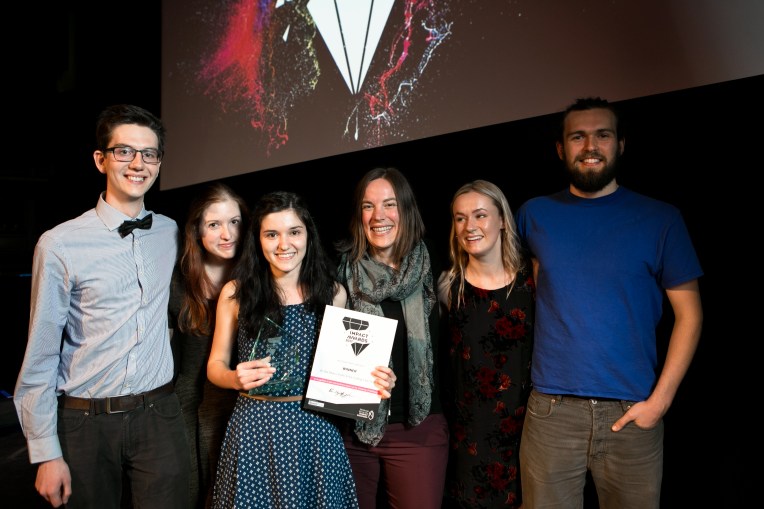
We have developed 19 tutorials for our website on topics such as mixed effects models, using Markdown, and following a coding etiquette. We went to Aberdeen to co-lead a workshop with Francesca from the University of Aberdeen, and we also made it to the University of Edinburgh Impact awards! But most of all, we are lucky to have many keen people, from different career stages and different disciplines, join us as we get better at coding by either coming to our workshops in Edinburgh or completing the tutorials online!

EUSA17-ImpactAwd17-eoin-carey_0987

It’s wonderful to have a supportive community where we can ask all of the R questions that pop into our minds, a place where we can all be learners and teachers, and help each other learn how to organise data, run models, make beautiful graphs and more!

Coding Club’s 1st year highlights:

1. That time that famous statistician Ben Bolker said that our mixed model tutorial written by Gabi Hajduk was not bad.

Screen Shot 2017-11-13 at 21.06.44

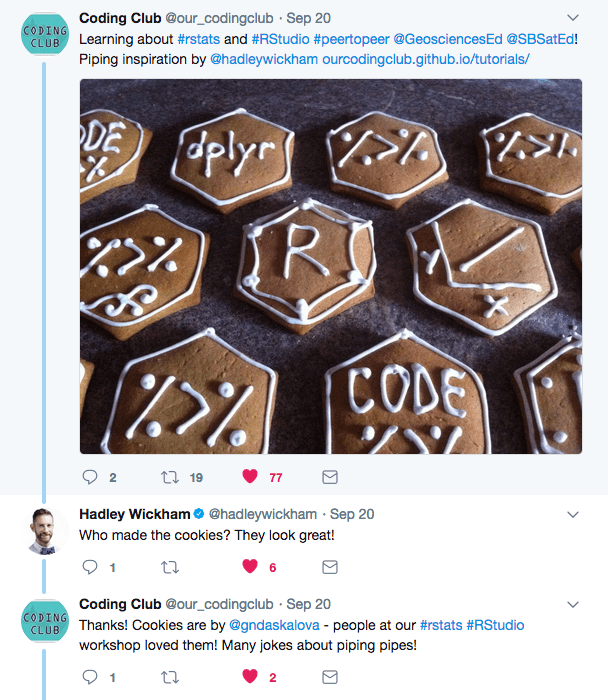
2. That time that Hadley Wickham liked our cookies on twitter!

Screen Shot 2017-11-13 at 21.16.56
Twitter fame for our trending tweet!

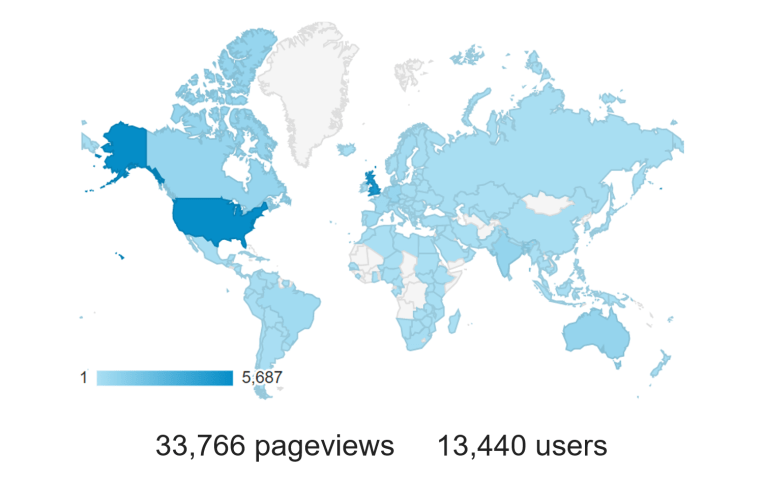
3. The fact that our popularity has grown from Ecology and Environmental Science students at the University of Edinburgh to political economists in Denmark and beyond!

CC_countries
A map of the visitors to our website!

We’ve been handing out stickers after our various coding challenges at our workshops. Although of course the real prize is getting the training to be as quantitative as one wants, the hexagon-shaped stickers and cookies are a fun bonus! We celebrated Coding Club’s birthday with a jolly meal, where we handed out our new Coding Club t-shirts to the coordinating team, and the nerdiest merchandise we have so far, the Coding Club measuring tapes! Though of course we love code, we do also need to actually collect the data we analyse. Gergana broke all of the little measuring tapes we had out in the Arctic (lots of active layer depth measurements!), so we needed new ones, and what’s better than a measuring tape – a measuring tape with the Coding Club logo!

One of the best parts of our workshops is seeing students put their new skills into practice on their own data! It’s so nice to see people come back and show us the graphs they’ve made, the Markdown reports they’ve produced!

We were also very excited to be invited to present at the signing of the University of Edinburgh’s Student Partnership agreement. The event was a great chance for us to share our experience with Coding Club and learn about other student-staff collaboration initiatives within the university.

We are so happy that our team includes undergraduates, postgraduates and staff, and we are excited for what the next year will bring for Coding Club! You can check out the Coding Club tutorials on our website, and you can follow our coding adventures on Twitter or you could even join the team!

Effect Size
If you are only going to eat one coding cookie make it the effect size cookie, as the most important statistical result is always the effect size (and it’s error)!

By Gergana and Isla

The start of a new chapter (or many)

Autumn has arrived in Edinburgh – leaves are turning bright colours, students are returning to the campus, some chapters have ended, whilst others have only just began. It’ll be an exciting year for Team Shrub as new students join in and we put our curiosity and love for science into practice.

IMG_2840
Inspiring words as we go up the stairs every day

Team Shrub welcomes two new PhD students! After a field season in Northern Scotland and a field season in the Arctic, Gergana is back in Edinburgh to delve into the world of biodiversity change and its drivers. Her project aims to quantify the effects of land use change on global and local patterns of species richness, abundance and composition, and develop a computational framework to facilitate answering ecological questions using big data and global synthesis of long-term observations. In particular, she will investigate whether: 1) changes in species richness, abundance and composition can be attributed to land use change over recent decades, 2) land intensification and land abandonment are both causing species homogenisation, and 3) biodiversity change processes are more pronounced in areas of high land use change rates.

Mariana comes to us after spending almost four years working in Brussels at the International Union for Conservation of Nature (IUCN), where she worked on different biodiversity conservation-related projects, with her main focus being the assessment of species’ extinction risk as part of the IUCN Red List of Threatened Species. With her PhD project she aims to inform conservation action through science, specifically by modelling how plant species distributions will shift under climate change at two extreme biomes – the tundra and the savannah. In addition, she will research which traits make species more susceptible to population change and extinction, and whether the responses to climate change are generalizable or biome-specific.

IMG_20170911_190446
First day of being a PhD student for Mariana and Gergana!

We also have three new honours students joining Team Shrub!

Claudia spent her summer in the Peruvian mountains studying plant traits, which inspired her to think about how biodiversity and species traits vary not just across latitudes, but also with different altitudes. It’s very cool to see how species change from tropical to more Mediterranean-looking to tundra-type ones! Snow in the tropics is not something we often imagine, or see! Claudia will aim to answer the research question: “How do traits and biodiversity change across altitude in the tropics and in the Arctic tundra?”

Matt had an exciting summer being a field assistant first in Honduras, and then in Kluane.  He collected data on bird species along elevation gradients in both regions, and will be investigating how feeding guilds vary across the tundra and rainforest, and along the elevation gradients.

In his honours project, Sam will focus on quantifying the above-ground carbon stored in Arctic ecosystems, in particular on Qikiqtaruk-Herschel Island Territorial Park. Over the summer, we collected biomass samples for Sam from several different species, we dried them over the fire in the Community House, and now that we are back in Edinburgh, Sam can start with his carbon and nitrogen analyses!

We have also led the first Coding Club workshop – exciting to see Coding Club back for a second year of coding and statistics inspiration and knowledge sharing! With Coding Club, we want to create a friendly environment in which we can learn about quantitative analysis together. Coding Club is for everyone – all students and staff are welcome to come along and participate, regardless of their current R knowledge. We were thrilled to see people returning to our workshops, as well as many new faces – with new students come new ideas, new research projects and new data presents to open. Ah, imagine the graphs!

DKJ4JLfXkAA1MHm
The Coding Club cookies, featuring some pipes we piped!

Coding Club will soon celebrate its first birthday – in one year there have been many lines of code, the majority of them working, plus many workshops, posters and emails to spread the word. Every week there is a little pocket of R magic in our university building, though with over 50 people coming to our two workshops last week, the pocket doesn’t feel so little anymore! We have ambitious plans for developing Coding Club further, sharing what we have learned so far, and forming new collaborations. You can check out our tutorials on efficient data manipulation, data visualisation, mixed effects models and more on the Coding Club website. We are also very happy to have other people use our tutorials to deliver Coding Club workshops around the world, and would also love to have more people contribute online tutorials. If you are interested, you can get in touch with us at ourcodingclub (at) gmail.com.

A particularly great aspect of Coding Club’s first week back was that the workshops were lead by Sam and Claudia – two of Team Shrub’s new honours students. We hope to spread inspiration and motivation to learn through our workshops, and we were definitely inspired by Sam and Claudia’s great work! Coding can be scary and intimidating, but among the occasional fear and many R errors, we are glad that there is a place where we can brave the errors together and get better at finding the answers to our research questions.

And so begins a new chapter and a new year here at Edinburgh. We’re excited about what’s in store and looking forward to sharing our successes, setbacks, and many many shrubs with you over the next year.

Team Shrub Lab Meeting 2

The end of a chapter (and the drafting of many)

Perhaps it was when I was waving to someone with a rusty hammer across a dusty runway, dragging a sledge full of dead leaves. Or perhaps it was when digging sunflower seeds out of the snow at 6am, while listening out for birdcalls and watching for bears. Or maybe when burying teabags on a wet mountainside, hoping they didn’t blow away in the wind. Whenever it was, I came to the realisation that this mad adventure called a PhD is soon to be over.

Version 2

After a total of six months, spread out over three different years, my time in the north is drawing to a close. The final measurements are taken, wet pages of my field book filled up with tiny scribbles. Mountains have been scaled and sampled, boots have been worn through, bags have been torn to tatters. Shrubs carried, cut, caressed, planted and replanted, grown and died and grown again. The last scraps of data have been pulled out of the ground and worked through the night that never grows dark.

In some ways this is a celebration. After three years of hard work, from my desk in Edinburgh to the snowy mountainsides of Canada, an end is in sight. The experiments have been successful, the science exciting, the chapters and manuscripts drafted. I can reclaim my summers: the friends’ weddings, the chaos of Edinburgh fringe, the lost time with my wife. This time, though it has been my shortest season yet, there is a real sense to homecoming. A departure with no promise of return. A clearly defined, bold and underlined, full stop.

Yet there is no doubt that I will miss this ridiculous and fantastic part of the world. The mountains that stretch from trees to sky, with the tundra almost (but not quite) out of reach. The endless expanse of…everything, as if the Yukon has simply never heard of the word ‘moderation’. The endless days, and occasionally dark nights lit up by the promise of the northern lights. I’ll even miss the mosquitoes, but not for very long. Most of all I’ll miss the people that have made me feel so welcome here, especially Sian and Lance at Icefield Discovery and the Yukon Parks Rangers on Qikiqtaruk.

And so I will sign off for this year, and leave you with the words of another that could say things far better than I ever could.

“I am one of you no longer; by the trails my feet have broken,
The dizzy peaks I’ve scaled, the camp-fire’s glow;
By the lonely seas I’ve sailed in — yea, the final word is spoken,
I am signed and sealed to nature. Be it so.”
Robert Service

SAB-0594

By Haydn

Qikiqtaruk perspectives by ranger Edward McLeod

Edward McLeod is a park ranger on Qikiqtaruk – Herschel Island from Aklavik, NWT.  Here he shares his perspectives on working as a park ranger and the collaboration between the rangers and researchers here on the island.

Working on the land

I started working as a Yukon Parks ranger on Qikiqtaruk – Herschel Island Territorial Park in 2008, so I guess next year I will have been on the island for 10 years. I always wanted a job out on the land, working outside, and I love being here. When I was younger, I used to spend my entire summers out in the bush – I love the bush life. I came to Qikiqtaruk and Shingle Point many times as a kid – I grew up here, and it was wonderful to be able to play around on the coast and see all the animals, as well as learn about hunting and fishing. I saw what was probably the first cruise ship coming to Qikiqtaruk.

DSCN5018
Coastal erosion near Pauline Cove this summer. Check out http://www.cbc.ca/news/canada/north/yukon-herschel-island-erosion-1.4253948 for the CBC article about it!

I remember there used to be more ground than there is now – coastal erosion has taken away big chunks of land, and beaches have appeared and disappeared through the years. Travelling the coast has always been a significant part of my life, and a key element of travelling is being able to adapt to change. There would be three-four boats travelling together, and sometimes we would get stuck in places for weeks – we have to make sure we have enough food, and know how to use landmarks to navigate once it is safe to move on. I’ve always heard you used to be able to predict the weather by looking at the clouds, but nowadays it changes so quickly, we always have to be prepared for everything. But, I’ve never gotten really lost on Qikiqtaruk, or in the Mackenzie Delta, I know these places like the back of my hand. Still, once I got caught in a storm and I had to sleep outside between my snowmobile and toboggan, with everything I carried wrapped in a tarp. It was a good thing I had a cozy muskox hind to sleep on to keep me warm. Before I made the shelter, I was going in circles for hours, and thankfully I was carrying a spot device, so my brother and two uncles noticed I was going in circles, and came and brought me back home to Aklavik before the storm got worse.

A ranger’s skillset

To be a ranger, you need traditional bush skills – hauling water and wood, making a fire, travelling with a snowmobile. If something goes wrong, you have to know how to take care of it without much help from the outside world. Having an education is also important, as we keep records including a daily journal, wildlife records and fill in data collection sheets for the Ecological Monitoring Programme. A good sense of humour is also key, especially when you spend such a big portion of your time with just one other person – the other ranger with whom you share your shift. We have to make our own life here on the island – you have to be easy going and go with what life throws at you.

During the winter months, I teach traditional bush skills in my community and beyond. There’s the Elders and Youth Programme as well, but it’s not enough for people simply to know about these opportunities – they have to take them up. My daughter is gaining bush skills, and I hope she keeps developing them. It’s important that youth are taught traditional bush skills.  Perhaps my daughter will follow in my footsteps and be a ranger out here on the island one day herself!

SAB-6079
Monitoring plant phenology plots on Qikiqtaruk

Ecological Monitoring Programme on Qikiqtaruk – Herschel Island

I was excited to find out that ecological monitoring is part of my job as a ranger, and to learn more about the plants and animals on Qikiqtaruk! But there are so many other ranger duties as well, so we have to learn how to balance everything. I started with surveying the plant plots, we now call the area Phenology Ridge, because there are three transects, one each for arctic willow, mountain avens and cottongrass.  This is where we record plant phenology – the timing of certain life events like the first opening of the leaves and flowers, the first yellowing leaves. I was surprised to find out how long some of this monitoring takes – for example during peak season we go to the cottongrass plots and count all the flowers, as well as measure the width of the tussocks, the ten largest and the ten smallest leaves. This monitoring has been taking place for 18 years, making it one of the longest running phenology records across the Arctic.

IMG_6590
Muskox walking along the beach

We also conduct permafrost measurements, as well as bird surveys and wildlife monitoring, which came to me naturally. We record the population numbers, behaviour and travelling patterns of the different wildlife species present on the island. Qikiqtaruk has the second largest black guillemot colony in the Western Arctic, and we collaborate with Cameron Eckert, Yukon Parks Biologist, to count the eggs, chicks and adults. We also ID the birds that are ringed and recaptured, which gives us an insight into survival rates and population changes of these birds.

IMG_5357
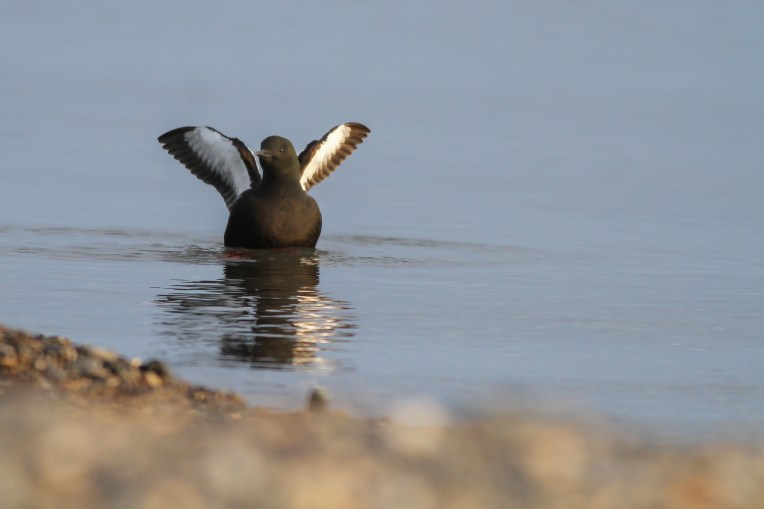
Black guillemot (Cepphus grylle) swimming near the Mission House

Contributions of the Ecological Monitoring Programme

I really enjoy working in close collaboration with the researchers and I especially value knowing why we are collecting the data and what is done with them. My first job on Qikiqtaruk was as a research assistant on the ArcticWOLVES project during the International Polar Year. I know that participating in research and understanding its findings can help motivate people to finish school and become more qualified for jobs. When I go back to my community, people ask me what the researchers are doing on Qikiqtaruk – that’s why I appreciate everything I have learned from our collaboration, because I get to pass on the knowledge.

I get updates from the researchers, including Team Shrub and the crew from the Alfred Wegener Institute, through presentations, reports and one to one chats. I also like following Team Shrub and the Permafrost Researchers through social media, such as Facebook, which keeps me up to date even during the winter months when we are all off the island. I think social media really helps with communicating research findings, but people also need to request the information and say what format is most convenient for them – not everyone in the communities use social media that much, so communicating science in different ways is important.

22050673_1924086127608210_1974399526_o
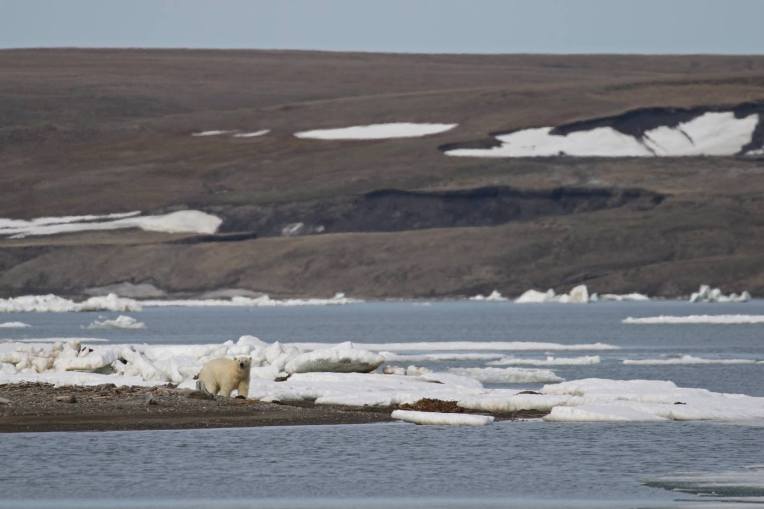
A mass of drift ice with about 300 Ringed Seals and a few Bearded Seals brought this Polar Bear to Qikiqtaruk on 13 June 2015. Photo by C. Eckert

I love the collaboration between the rangers and researchers and I am excited to see how it develops in the future. Perhaps we can do more to connect researchers with people travelling in winter and spring.  Usually researchers cannot be here during that time, so people travelling like me could collect valuable data that would not be available otherwise. It might also be worthwhile to extend the range of the surveys conducted in this region to include things like monitoring berries for example, which are a valuable resource to the Inuvialuit. Qikiqtaruk is definitely the right place for ecological monitoring and I hope we can continue to build on the collaboration between the park rangers and scientists and better involve the people of Aklavik.

By Edward McLeod

_______________________

You can read another guest blog post by Yukon Parks Ranger Ricky Joe here – Changes on Qikiqtaruk: Perspectives by ranger Ricky Joe.

The tundra is cold

August, 2017

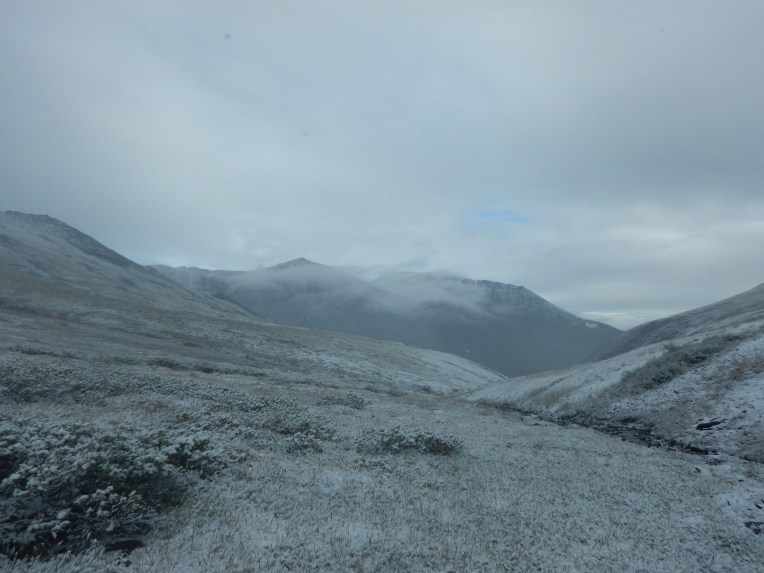
Up in the Ruby Range, beyond the treeline and where even the shrubby birches and rugged willows struggle to grow, it is snowing. The clouds are low, unfurling over the mountaintops, and thick snow is falling in fat flakes that rapidly turn the rocky ground white. Everywhere around the peaks have disappeared into a milky haze, earth and sky no longer distinguishable. It is a beautiful sight. Or at least, it would be if we didn’t still have eight hours of fieldwork to do.

DSCN8668.JPG

The tundra is cold. Perhaps that is stating the obvious just a little bit, but after two weeks working in blazing sunshine and working on our tan lines, it is helpful (though not at all pleasant) to be reminded of the fact. Right now Team Kluane is camped out in the Ruby Range to the east of Kluane Lake, and it is very cold indeed. We have to brush the snow off the tent to open it up, and leave a deep trail of footprints as we walk to ‘the pod’, the white (and growing ever whiter) dome of comfort left over from when Pika Camp was a bustling hubbub of research activity. Even as the kettle whistles and fills the room with a column of steam (or is that just our breath?) we realise that our research for the day is in jeopardy as the seeds Matt and Cameron have to find for Anna Hargreaves’ herbivory experiment are soon to be completely lost under the blizzard.

Up here there is little time to rest, and when you do it gets even colder. The solution is simply to get on with it. We warm up as the day does, and the snow gradually recedes from the mountainside as the sun climbs just a little higher. Soon the leaves emerge once more and it is simply chilly. I even take off my hat. Briefly.

There is respite in the afternoon as we rest against the pod wall watching the cloud billow through the passes and listen out for snowy owls on the hillside. But all too soon the evening creeps up – not quite day but not quite dark. We retreat inside where the wind can’t reach us and mugs of hot chocolate await.

When we wake the next morning things are looking up. Peeking out of the folds in the sleeping bag there seems to be no snow on the roof of the tent. Nor is the wind that somehow pierces our many layers blowing. In fact, the tent doesn’t seem to be moving at all. As we open the tent, a snap and crackle of crystals soon tell us why – it has frozen solid. As I said, the tundra is cold.

By Haydn

Qikiqtaruk Book Club Part IV: Theory and high-level processes in the Arctic

August, 2017

Page after page, we have been pondering patterns and processes in community ecology under the sounds of gusting winds and heavy rain. From one storm to the next, when our field days were cut short, we could sit by the fire in the Community Building (the oldest building in the Yukon) and delve in deeper into Mark Vellend’s “The Theory of Ecological Communities”.

DSCN0765
The Pauline Cove settlement with the Community Building reflecting in the water of the Arctic Ocean late at night in the transition from sunset to sunrise.

We talked about selection and the many selection-focused hypotheses of shaping and maintaining ecological communities, and singled out the ones most relevant to the tundra and our work. We then considered speciation, dispersal and drift, which still influence communities on the island, though they might not be as important relative to selection.

We have now wrapped up our field season and returned to Vancouver. Along with mailing away samples and inventorising equipment, we have also turned the final pages of Mark’s book. Here, we will share our final book club thoughts, with a particular focus on the theories, which relate most to our work in the tundra.

We see our study of vegetation change in the Arctic as being detective work – you figure out a question, gather evidence, open the data present, and interpret what it means. For us, explanation and prediction in ecology go hand in hand, and we aim to do both – you can’t make predictions without knowing how your system works. Although theory development is perhaps not the main motivation of our work, we don’t shy away from reading about different theories and seeing how they can inform our research. In fact, we go as far as playing “Guess the ecological theory” at breakfast – a stimulating start to the day!

We think of theory as a way to simplify complex ecological phenomena in order to make them generally applicable. The same rules don’t apply everywhere, though, and our goal is to find which rules are relevant for the tundra biome, not necessarily to extrapolate across the entire world. The same global change drivers have different impacts across the world’s biomes, making the drawing of universal conclusions even harder. Nevertheless, sometimes theory works, and here, we will present the Arctic edition of when that happens.

Table 1. Theories we consider relevant to tundra vegetation change and our work.

Theory Links to the tundra biome and our work
The competitive exclusion principle (Gause 1934) and R* theory (Tilman 1982) Competitive exclusion likely exists within the tundra biome with species competing for the limited resources of the tundra environment. Species have specific adaptations from forming tussocks to outcompete other species and form their own microclimate to having evergreen leaves allowing them to start photosynthesis as soon as the snow melts in spring. Each plant species has its own combination of traits to deal with the short growing seasons of the Arctic and those different traits likely promote coexistence. Each species likely does have its single resource for which it can survive at the lowest equilibrium level (R*), but figuring out which species are best adapted to exploiting which resource is a bit of a challenge.
Temporal and spatial storage effects (Chesson 2000b) – Selection spatially variable and negatively frequency dependent The spatial and temporal storage effect is likely at play in a major way the Arctic.  Species are specifically adapted to the harsh environmental conditions and can store resources for reproduction or growth during hard times that they can then use when conditions allow.  Some species are adapted to thriving under snow patches, others to coping with drought conditions, others to dealing with flooding and soil saturation yet all can cope with the cold.  These different sorts of adaptation can promote species coexistence and diversity across the tundra landscape.
Enemy-mediated coexistence (Holt et al. 1994) Enemies do exist in the tundra.  We have been monitoring herbivory sign for the past four years on the island and have found the rates of herbivory to be relatively low.  But the herbivores are out there and are a selective pressure in the landscape.  From leaf herbivores from caterpillars to lemmings to caribou, seed and fruit herbivores from fly larvae to humans, herbivores can take a bite out of the carefully allocated resources that tundra plants have invested in growth and reproduction. Likely herbivory is a bigger deal in places like the European Arctic or Northern Quebec where large herds of reindeer or caribou roam around munching on shrubs.  The main Porcupine Caribou heard doesn’t make it out to Qikiqtaruk and large animal herbivory rates are lower. How important is herbivory at sites across the Arctic?  Well that is something that the Herbivory Network is trying to figure out.
Priority effects (reviewed in Fukami 2010) Do initial colonists get an advantage in the tundra? Perhaps this is particularly relevant in the Herschel vegetation type where disturbance rates are lower and the species that invade first might be able to persist longer.
Multiple stable equilibria (reviewed in Scheffer 2009) Are there multiple stable states in the tundra?  This theory is probably quite relevant for the transition from sedge- or herb- to shrub-dominated tundra as tundra shrubification occurs as can be seen in repeat photographs on Qikiqtaruk.
Succession theory (Pickett et al. 1987) Succession is at play across the tundra biome where disturbance is likely the major factor shaping ecological communities.
Intermediate disturbance theory (Grime 1973, Connell 1978) The intermediate disturbance theory can be tested with our data – check out our plot of bare ground (a proxy for cryoturbation, a type of disturbance ) vs species richness at the plot level in 2017 (Figure 1).  Depending on how you look at it we either do or don’t see the expected hump-shaped relationship of species richness in relation to disturbance – in our case cryoturbation.
Metacommunities: species sorting (Leibold et al. 2004) – spatially variable selection, different species are at an advantage under different environmental conditions Species sorting and spatially variable selection due to different environmental conditions might explain the different plant communities that we see on the island. See the Book Club II blog post for more thoughts on selection.
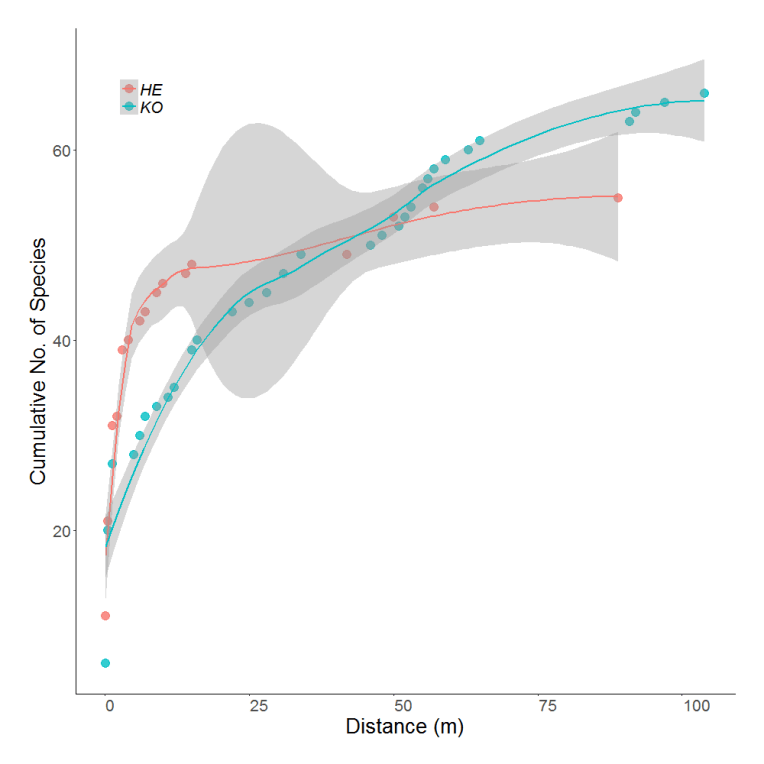
The species pool hypothesis (Taylor et al. 1990) Different species pools sizes on the island or at a larger spatial scale within the tundra biome likely do influence local richness.  Through the ArcFunc project we can test this theory further. You can also check out our species-accumulation curves (Figure 2).
Island biogeography (MacArthur and Wilson 1967) Island Biogeography can be tested using breakfast cereal, so it probably is at play in the tundra biome with distance from glacial refugia being a key factor.  Isolation could explain the species richness and ecological communities on Qikiqtaruk relative to the adjacent mainland.  And certainly, island isolation creates barriers limiting the expansion of tall shrub species within the Arctic at the biome scale.


QHI_SAC
Figure 1. Species-accumulation curves for the Herschel and Komakuk vegetation types. Distance refers to the distance away from our community composition plots. In Herschel, most of the species are found close to the plots, and the relationship quickly saturates, whereas in Komakuk, as we move further away from the plots, we continue to find new species.
Rplot02b
Figure 2. Species richness and bareground cover in the Herschel and Komakuk vegetation types of Qikiqtaruk-Herschel Island. Points represent mean species richness for 12 plots monitored from 1999 to 2017 ± standard deviation. Darker colours represent overlapping points. The Herschel vegetation type has very little bare ground (apart from that one plot!), whereas in Komakuk, bare ground is a defining characteristic of the vegetation type.

Our work on tundra vegetation change spans across several different levels of analysis, which together will hopefully shed light on how communities in the Arctic are responding to global change drivers. We are monitoring particular individuals for phenology, and surveying 12 x 1 m2 community composition plots on one Arctic island, four pairs of 100 m2 plots for our drone surveys (in the Herschel and Komakuk communities), large-extent sites part of the HiLDEN network, and finally the tundra biome, which we can study as a whole thanks to the ITEX and ShrubHub networks. We are investigating how community composition is changing by studying species and traits in collaboration with the Tundra Trait Team. Along the way, we often come across what Mark calls the “three-box problem” – there will probably always be silent or ‘lurking’ variables we fail to account for, and drawing the line between causation and correlation is rarely easy.

Do we observe different species in a particular place because the environment is different, or is the environment different, because the species are different? What is the trade-off between diversity and invasibility? This year, we recorded the same number of species (32) in both the Herschel and Komakuk plots, but the Komakuk plots are probably more susceptible to invasions, since with more bare ground patches, there is more room for new species to germinate and establish. Alopecurus alpinus has already taken advantage of this opportunity, and more species might follow soon, as from our species pool survey, we found that there are many more species found close by to our plots in both the Komakuk and Herschel vegetation types.

Having read “The Theory of Ecological communities”, spent many hours out in the field and conducted preliminary analyses of our collected data, we think that species sorting  and the metacommunity framework, applies best to Qikiqtaruk-Herschel Island. Here, we can observe very strong spatially variable selection, leading to the establishment and presence of distinct vegetation communities. Although of relatively less importance, patch dynamics could also be at play – spatial and temporal variation in selection could cause local extinction, and dispersal could lead to (re)colonisation of certain species. Such is the case with the grass species Alopecurus alpinus that colonised our Komakuk community composition plots between 2004 and 2009. The neutral framework, on the other hand, has little application in the Arctic context, because drift is not a dominant force shaping ecological communities here. Mass effects, whereby selection is spatially variable and not strong enough to prevent immigrants from establishing sink populations, is also likely of little relevance to the tundra, since selection here is very strong, potentially preventing new immigrants from establishing in the first place.

The Theory of Ecological Communities
Isla’s copy of The Theory of Ecological Communities that looks like it has been eaten by a polar bear! But it was actually partially eaten by a dog. Clearly a book you can really chew on – some ecological theory you can bite into… photo credit to Cameron who is reading the book next!

We thoroughly enjoyed reading “The Theory of Ecological Communities” whilst on fieldwork at our remote field site in the Canadian Arctic. There is particular charm in reading about a certain ecological process, be it high- or low-level, and then observing it in action moments later in the field. We look forward to continued discussions of the synthesis of ecological theory, but definitely agree with Mark that four high-level processes do shape community composition – selection, speciation, dispersal and drift.

By Gergana and Isla

_____________________________________

This blog post was written on Qikiqtaruk-Herschel Island in the Western Canadian Arctic as part of Team Shrub’s island book club, aiming to read and discuss Mark Vellend’s 2016 book “The Theory of Ecological Communities” while we are out in the field, right next to the communities we study.  Team Shrub are a group of plant ecologists who often work in high-latitude tundra ecosystems on topics in community ecology.

The team’s book club discussions are summarised in four blog posts:


Qikiqtaruk Book Club Part III: Speciation, dispersal and drift in the Arctic

August, 2017

In the book ‘The Theory of Ecological Communities’ by Mark Vellend speciation is one of the four high-level processes explaining local community patterns and dynamics.  Mark discusses the influence of regional species pools and speciation rates on local diversity.  In many temperate and tropical locations speciation has happened in situ over evolutionary timescales, but the Arctic is different.  Here, long-term dynamics are controlled by glacial and inter-glacial cycles.  More than twenty thousand years ago at our field site Qikiqtaruk – Herschel Island, there probably was no island at all and instead just the terminus of the Laurentide ice sheet.

IMG_4678
Pauline Cove surrounded by ice at the start of the summer

What determines regional richness today at least for plants in much of the Arctic is the distance to glacial refugia and time since de-glaciation.  Here on Qikiqtaruk, we are located pretty much right at the edge of Beringia – the unglaciated region in the Yukon, Alaska and Eastern Siberia during the last ice age. We are also close to one of the northern most extents of the treeline around the circumpolar Arctic, such that the boreal forest species pool is only about 100 km away.  This means that potentially species diversity will be higher here than in other similar environmental conditions in other parts of the Arctic.

IMG_5830
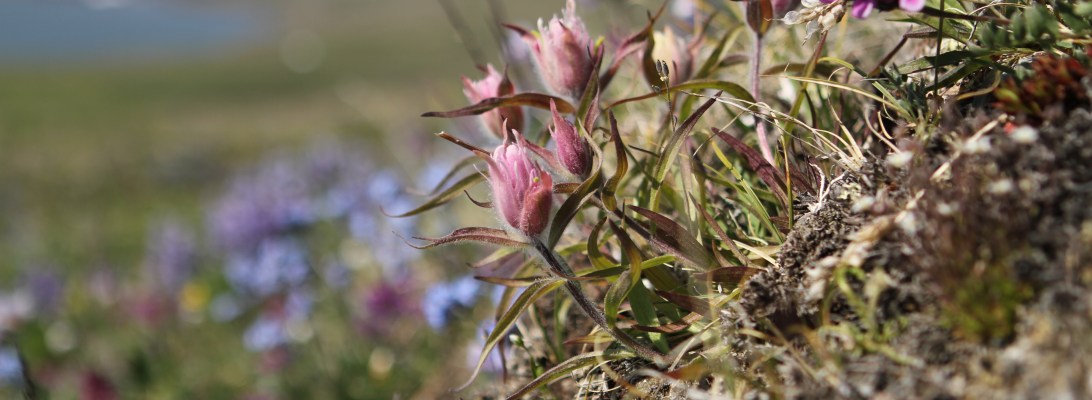
The colourful variety of flowers on Qikiqtaruk-Herschel Island in spring is a sight to be seen.
QHI Phylogenetic Tree
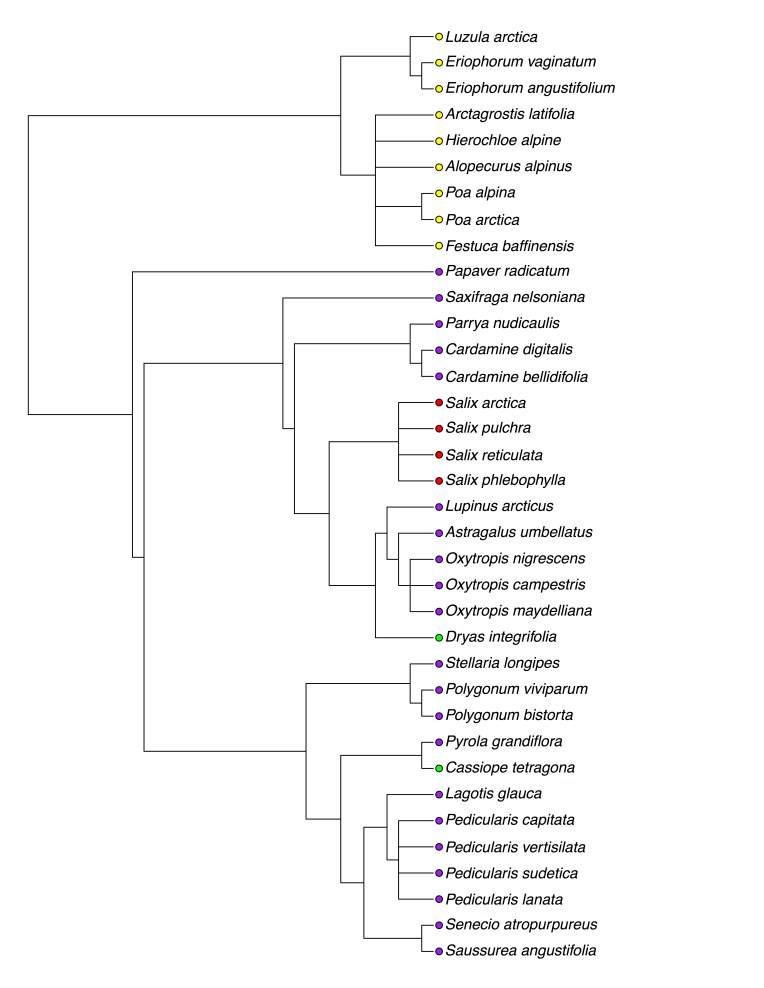
Figure 1. A phylogenetic tree of many of the plant species on Qikiqtaruk-Herschel Island. Yellow are grass species, purple are forbs, red are deciduous shrubs, and green are evergreen shrubs. The tundra is more diverse than you might think!

If we are thinking about the diversity of other species, most of the birds are migratory here and spend their winters thousands of kilometers farther south, some as far south as the neotropics or even the southern hemisphere.  What determines local avian diversity is therefore migratory dynamics.  Presumably Arctic bird species did not speciate here in the Arctic, but in their winter ranges and then over time explored further and further northward breeding grounds.

DSCN5441
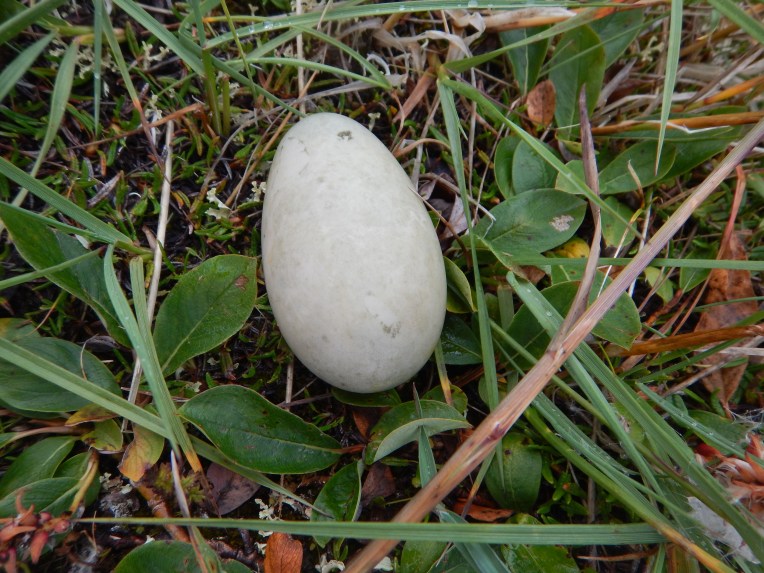
A sandhill crane (Grus canadensis) egg we found just laying on the tundra!

We have enjoyed tag team birding with Cameron Eckert, Yukon Parks biologist, and hearing about or seeing the regular rare sightings of birds outside of their normal ranges from the Calliope hummingbird, tufted puffin, short-tailed shearwater to the gyrfalcon that we documented ourselves as it came through camp.  The bird species pool is a dynamic one, with more and more sightings of southern birds blowing up on the winds of storms.  It is good to reflect on communities of species that are far more mobile than the perennial tundra plants that we study.

At the end of August, we conducted an additional protocol as a part of the International Tundra Experiment to document the size of the tundra plant species pool around our long-term monitoring plots.  By tromping around in concentric circles we were able to identify 36 additional species within 100 m of our plots.  These species could be invading into the ecological communities in the future.  The closest observed new species were Parrya naudicaulis, a pretty brassica a mere 2 m away from the ‘Herschel’ vegetation plots and a Papaver radicatum, a lovely bright yellow poppy about 5 m away from the Komakuk vegetation plots.


QHI_SAC
Figure 1. Species-accumulation curves for the Herschel and Komakuk vegetation types. Distance refers to the distance away from our community composition plots. In Herschel, most of the species are found close to the plots, and the relationship quickly saturates, whereas in Komakuk, as we move further away from the plots, we continue to find new species.

It is very likely that new species will be entering into the plots in the future, but perhaps also likely that other rare species within the plots will disappear over time – representing the dynamics between dispersal, ecological drift and local extinction.  But overall will these plots become more diverse as the growing seasons continue to lengthen and the permafrost-related cryoturbation disturbances decrease?  With one major species invasion in the first 18 years of the ecological monitoring programme, perhaps increasing diversity is the prediction that I would make for these plant communities.

DSCN1203
Alopecurus alpinus (foxtail grass)

Very slowly over time in these perennial plant communities, evolutionary selection is occurring and perhaps new species are forming in situ adapting to the changing environmental conditions.  One of the goals of Team Shrub’s research is to identify how much local adaptation occurs between populations of shrub species along large elevational gradients and to test whether Arctic shrubs have genetically limited growth rates and canopy heights relative to the same species growing further south.  Perhaps we are observing speciation in action – though we probably won’t be around to see the outcome of natural selection in the Arctic, unless we will???

DSCN1797
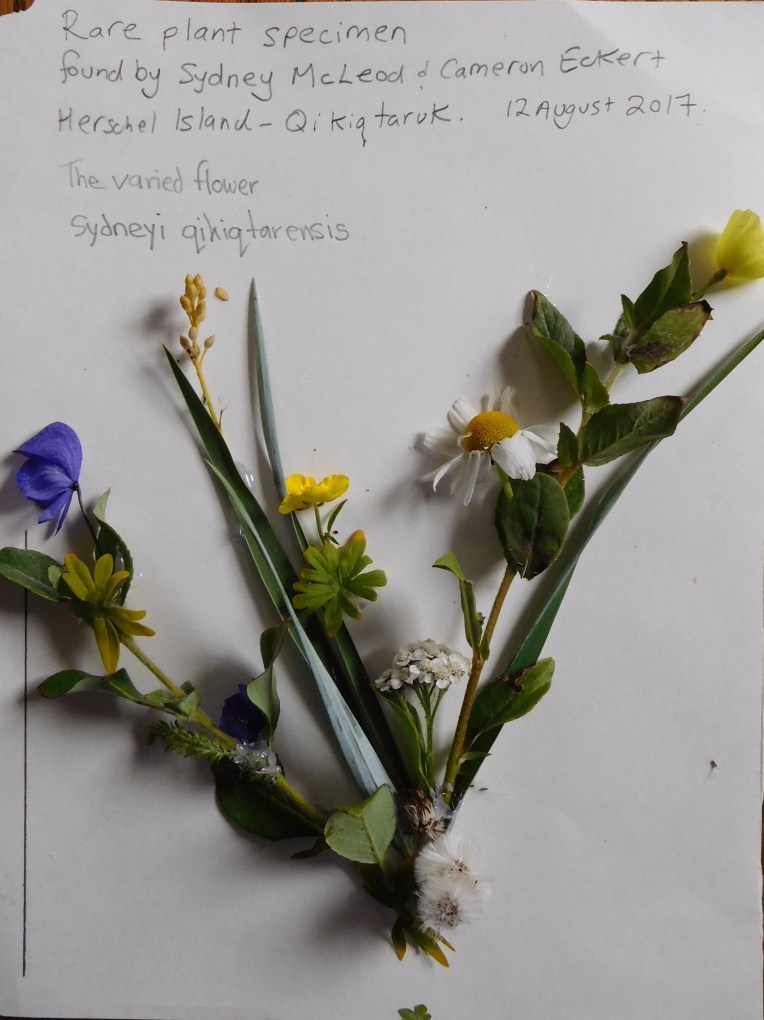
Sydneyi qikiqtarensis – a lovely herbarium specimen prepared during the Elders and Youth Programme 2017!

By Isla and Gergana

_____________________________________

This blog post was written on Qikiqtaruk-Herschel Island in the Western Canadian Arctic as part of Team Shrub’s island book club, aiming to read and discuss Mark Vellend’s 2016 book “The Theory of Ecological Communities” while we are out in the field, right next to the communities we study.  Team Shrub are a group of plant ecologists who often work in high-latitude tundra ecosystems on topics in community ecology.

The team’s book club discussions are summarised in four blog posts: