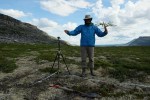
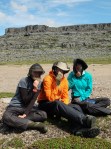
Farewell Kluane or Well done Team Shrub!

Tired, but well we left Kluane yesterday morning. After a legendary effort over the last week all work is finally done, all gear packed up and all boxes safely stored away for the winter.

It was sad to wave goodbye to the old and newly found friends and it would be a lie to say that there was not a tinge of nostalgia in our truck when we pulled out onto the highway.

Three hours later we were back in Whitehorse and it was time for the first of our big Team Shrub goodbyes. With few minutes to spare we dropped off Joe and Haydn at the airport for their flight to Vancouver and into their well deserved holidays.

Isla, Santeri and I are staying behind in Whitehorse for the weekend; letting ourselves drift into the hum of the city, marvelling about the simple things that have become so unfamiliar to us: busy streets, hot cappuccinos and bustling pubs.

It was an epic summer, full of adventures, breath-taking nature and wonderful people. We will cherish our memories for a long time.

Text by Jakob
Photos by Team Shrub (edited by Sandra) and Joe

Time to fly

Ullakut everyone,

Autumn is fast approaching in Salluit and just as the geese start their long journey south, we are about to board our flight to Québec City, which will be stopping in each of the remote communities that dot the Ungava coastline : Kangiqsujuaq, Quaqtaq, Kangirsuk, Kuujjuaq and Schefferville, for a total journey time of 9 hours.

I arrived in Salluit ten days ago to sample my very last study sites. There I met up with my good friend and former field assistant Clara and just like in good ol’ times we set out exploring the hills, trying to cram a whole year’s worth of news in a day (it actually took two before we could stay silent for longer than five minutes).

We spent a great deal of our time playing hide and seek with the shrubs around Salluit, and at first it seemed the shrubs would defeat us. Looks like they have not yet come to rule the whole  tundra after all! After a few days of hopeful searching for Shrub Eden (“Maybe beyond that hill? Or surely that next one?”), fortune smiled upon us and we finally set down to work extracting root collars.

One highlight of our stay was to talk on the Inuit radio to introduce ourselves and our research to the community – and especially to hear it translated to Inuktitut seconds after by the man in charge of the radio!

Clara on the air of Radio Salluit!

It is now time to pack up samples and bags and breathe in the cold, crisp air one last time before returning to the hot and busy South. The rest of Team Shrub, I gather, is doing much the same thing on the other side of Canada. The summer has flown by so quickly and I will be returning to Edinburgh full of happy Arctic memories to keep me company during the long hours of sample processing. Thanks for letting me share some of them over the blog this summer.

By Sandra

Autumn is coming!

Santeri and Jakob at the top of the plateau. Check out the autumnal tundra colours!Blustery winds were howling through our cabin this morning. Dreading the cold we pulled our sleeping bags tighter around our necks and hit the snooze button once more.
We’re back in Kluane and autumn (or fall for the North Americans among us) is not far away. The colours are starting to turn and the Yukon’s mountains have become even more stunning.

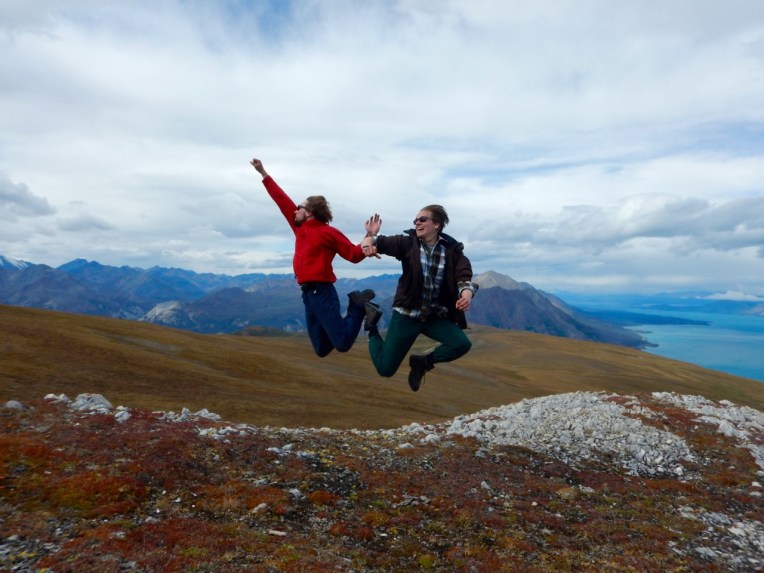
A couple of days ago we hiked up to the Kluane Plateau. Climbing meter by meter it felt like going forward in time: the higher we went the more yellows, oranges and reds surrounded us. Up on the plateau we prepared Haydn’s tea bag experiment for the winter, dug out the tea bags for his summer decomposition experiment and collected last-minute dwarf birch and arctic willow samples for the common garden. At the very top we were rewarded once more with epic views of the lake and the St. Elias range.

Back at base life is busy, little time remains before we leave and a lot needs to be done before packing up. While Isla and I are planting the birch and willow in the common garden, braving the rain and wind, the rest of the team is patiently preparing the over 900 litter bags that are need to be assembled for Haydn’s litter decomposition experiment.

Luckily, the long working hours are balanced out by the wonderful people and comforts of the Kluane Lake Research Station. Running water, hot showers and delicious dinners – what more could one ask for? After the long time up North, the arrival back at base felt like coming home… and indeed, if we close our eyes a little bit the autumnal mountains look just like the Scottish Highlands.

Post by Jakob
Video by Santeri
Pictures by Team Shrub

A guide to surviving a big CATT encounter or ‘a Love Letter to Tundra Protocol’

The hours we got to spend on the stupendously remote Arctic island of Herschel-Qikiqtaryuk were sometimes spent discussing Frontier Science in the warm comfort of our cabin, or cavorting around Simpson Point engaged in a game of American base-foot-softball. But most often our time was spent in the arctic embrace of the island tundra; immersed in various data collecting, recording and sampling tasks. 

The following paragraphs have been devoted to two protocols most enthralling and alluring; my second & third loves in all of this world: the CATT (Carbon in Arctic Tussock Tundra) & the PFEM (Point Framing for Ecological Monitoring) protocols. Assuredly, before the end of this post you all will have joined me in my enthusiasm toward ecological fieldwork and its brilliant intricacies. 

The CATT protocol aims to estimate the carbon locked in the tussock tundra biomass (the clue is in the name). More specifically, CATT wants to know the C content within the dead-leaf mounds formed by Eriophorum vaginatum; recently an increasingly expansionist sedge (yet an old native inhabitant) in tundra ecosystems.

“Blimey, how could one ever hope to quantify all the carbon sequestered by just one species”, you may ask yourself. If by now you’re having a pretend conversation in your head and the answer to your own question is: “Gee, I suppose one could do it by measuring the dimensions of all of the tussocks on Herschel Island in EVERY single compass point, henceforth generating a fair estimate of the volume -> biomass -> C content of each tussock.”, you are correct (and perhaps from the University of Notre Dame). Because that is exactly what Team Shrub did. Almost exactly that. 

By laying down a large transect (200m in length) the valiant comrades of TS shouldered a massive 2-day effort in quantifying the Carbon in Arctic Tussock Tundra. And although some members of the team periodically visited the realms of apathy, delirium and even feral aberration, yours truly was breathing in every second of it. See, the CATT protocol is not about how long it takes, or how many height measurements and soil cores you take, or how well you account for observer bias while trying to figure out what a tussock actually is, or how many times you average soil moisture measurements in a bog… it is about the commitment. the sweat and the data. the mystifying bond between man and tussock. 

However, before CATT there were others… Other protocols that I to this day hold dear, and the memories of which still occasionally keep me up at night. One of the more intense of these experiences on Qikiqtaryuk was Point Framing. This tundra protocol involves a 1m x 1m frame (divided into a hundred ten-by-ten centimetre cells by using dead fashionable pink thread) being carefully placed on an Ecological Monitoring plot; a piece of tundra with a history of being looked at very intensely for a couple of hours every year to few years for the past two decades. In each thread intercept a flag is dropped and the plant species / litter & ground type touching the flag pin is recorded. 

‘This ‘recording’ involves one person uttering an enigmatic mix of species abbreviations, canopy height measurements and leaf/stem/flower numbers to an unsuspecting field assistant armed with but one finger and an iPad. And that, in essence, is the best thing about Point Framing: conversation is an effort in futility. Only the most courageous attempt it. The second best thing about point framing is that Ecological Monitoring plots are multiple & wonderfully diverse. So the PFEM is repeated time after time, the species forever changing — with unwavering enthusiasm as the day pushes on. This long-term engagement makes the effort of course all the more rewarding and the data present sweeter than Kirkland Fruit Trail Mix. 

One might think this post sarcastic — tongue-in-cheek at best. However, the things described here are most genuine, and radiate straight from the heart. I, like all the members of Team Shrub feel nothing but love and affection toward our wonderful field days, which are always full of laughter, tomfoolery and friendly wrestles, however wet, muddy, buggy or catty it ever gets. 

Yet, I have one love over CATT & PFEM, and that is telling people how much I love CATT & PFEM. 

We’re back!!!

Team Shrub touched down at the Inuvik Airport at around 11:30 am on Thursday 13 August.  It seems both surreal that we are no longer on Qikiqtaruk-Herschel Island and totally strange to be back to the land of internet connectivity and modern conveniences.  I think we all have mixed feelings about the return: happy to be back in touch with family and friends, but sad to leave our Arctic fieldwork home.

The final days on Qikiqtaruk were pretty epic.  In our last days, the weather deteriorated to high winds and rain, culminating in a storm.  This meant no fieldwork and TeamShrub trapped in doors in the Trappers cabin trying to do computer work.  As the winds continued to blow with rain and near freezing temperatures, our cabin fever increased.  All we wanted was one more day of fieldwork, to collect the last of the drone data and to do a bit more point framing.

Yukon North Slope
Our final day on Qikiqtaruk-Herschel Island was glorious sunshine again.

On our final full day on the island, the clouds parted.  So instead of finishing our packing we went out for a final data collection session.  Haydn and myself headed up to the long-term ecological monitoring plots to finish our data collection looking at variation in plant biomass estimates across the growing season.  Up on Herschel the tundra is looking very brown and yellow now.  Winter is coming.

Qikiqtaruk was looking a lot more yellow and brown than green by the end of our trip.

The rest of the crew were on team drone and headed out to conduct the last flights over the phenology plots and Collinson head.  These final flights give us imagery across the growing season from before the peak of the summer into the autumn.  The drone fieldwork has become pretty efficient over time with Jakob flying 45 different flights and over 6 hours in the air in total. Joe and Santeri have also become very proficient at hiking around with the huge landing pad.  There was only one minor mishap involving Joe, a gust of wind and a puddle.

When we returned to camp it was time for the French feast, a feast hosted by the French members of the Alfred Wegener Institute crew and involving savoury galettes and sweet crêpes.  Delicious!  Then some tunes were played and a bit of dancing ensued.  Finally, in the wee hours of the morning Team Shrub agreed that it was time to finish off our packing for our flight the next morning.

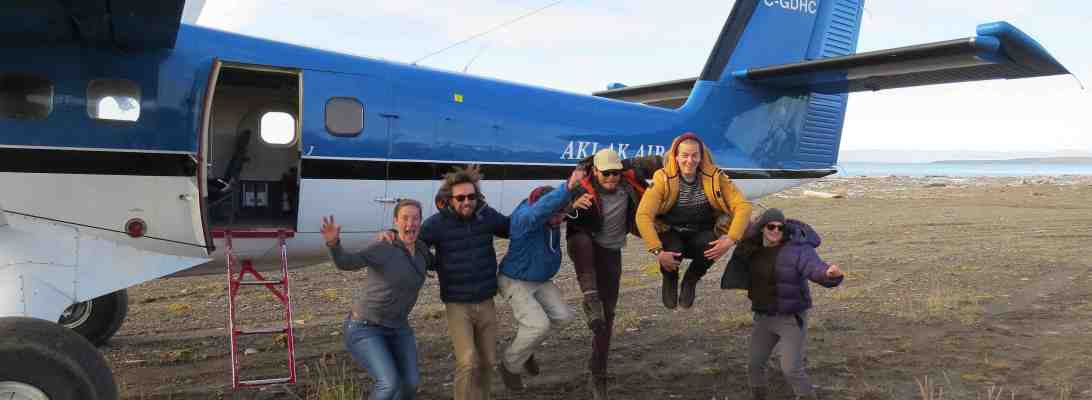
Our final hours on Qikiqtaruk were a mad rush of packing surrounded by a beautiful pink sunset-sunrise.  By 10:05am when the plane landed we were packed and ready to go and everyone had got at least one restful one hour of sleep.

Back in Inuvik, we have been internetting, showering, doing laundry, and catching up on life after a month away from the outer world.  Next we head down south to Kluane to plant our Herschel shrub samples in the common garden, set up Haydn’s decomposition experiment, and collect the last of the plant trait data.  Only one more week of fieldwork for the Team Shrub 2015 field crew.

By Isla

Plaque
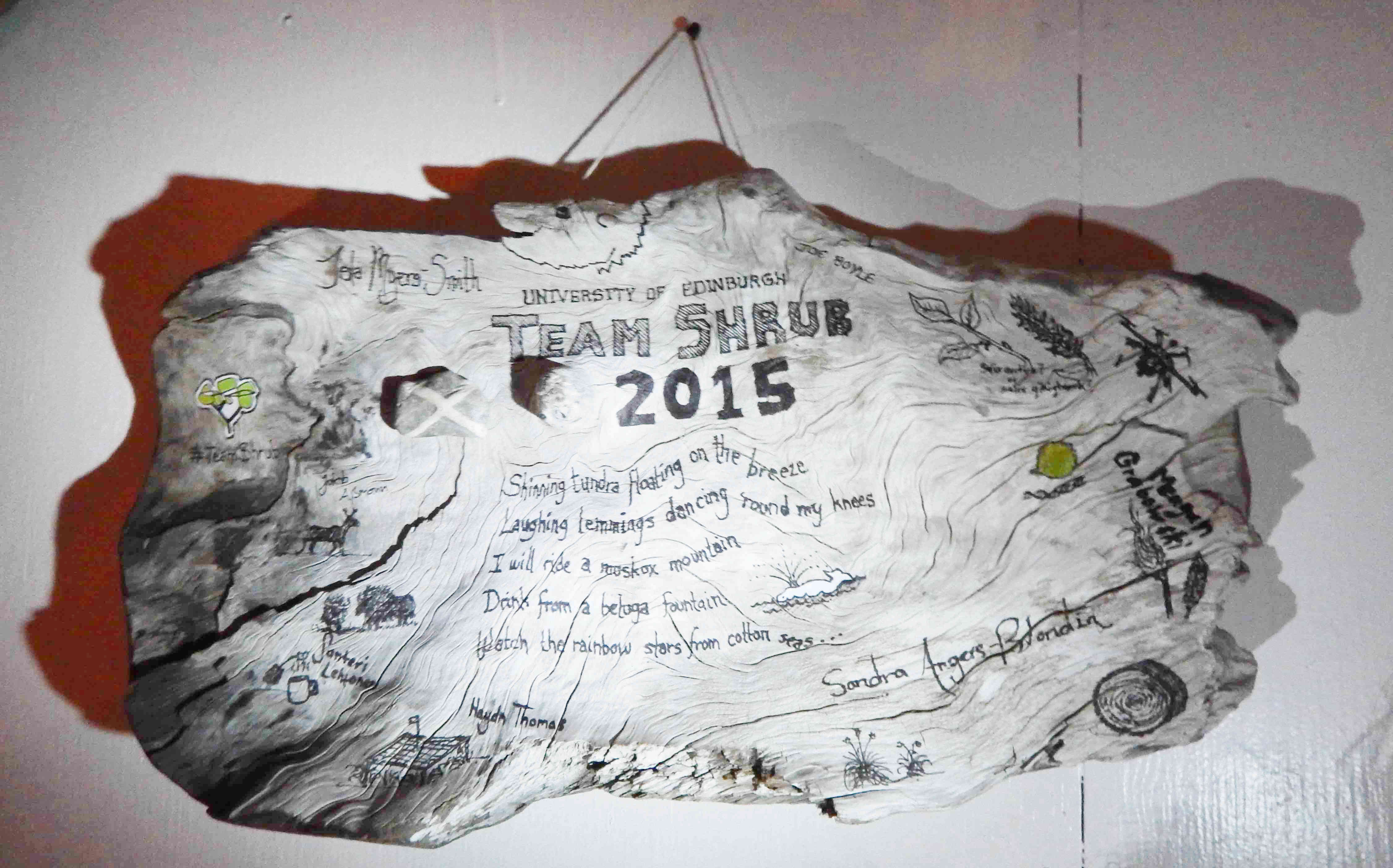
The Team Shrub 2015 plaque that is now displayed on the wall of the Hunter and Trappers Cabin on Qikiqtaruk.

News Flash – New tallest shrub on Qikiqtaruk-Herschel Island

The famous 120 cm-tall Günther the shrub has been upstaged by a new tallest shrub on Qikiqtaruk-Herschel Island: Bjørn who is a whopping 136 cm tall.  Also a Salix Richardsonii like his (or her we aren’t quite sure yet) shorter neighbour.  Here Joe expresses his shock and surprise at the impressive height of Bjørn.

Arctic Memories

Qikiqtaruk-Herschel Island is less a discrete event and more a blur of experiences that is difficult to distil into a single entry. Instead I have compiled a few of my thoughts at the time, taken from my letters and diary entries. 

We have arrived on Qikiqtaruk. It is hot and sunny as we unload the plane. The small camp stands out against the mass of the island, ringed by waves. It is both bleak and incredibly beautiful.

Silence on the tundra, but for the wind and the distant waves. There is an immense feeling of solitude.

Walked a fair distance today looking for sites to bury teabags for the decomposition experiment. Found five suitable sites but lost one radio. I should be able to get away with blaming Joe once we get back to base. One site was hidden in an ice creek, and we stumble upon a family of cranes limping away hastily before taking to the skies.

Time moves slowly when you are collecting samples. To help it pass I have been writing songs about the vegetation.

We keep our eyes on the sky as we head out along the coast –  several of our sites are beyond a steep creek closely guarded by rough legged hawks. We collect root collars and leaves and flowers to the sound of their screeches as they wheel overhead.

Paden has taken us on a boat trip around the island to find a new drone site. Joe and I climb the ridge behind the landing site to uncover the view. In front of us, framed by the hills, a herd of around ten muskox are grazing, black and shaggy, refusing stoutly to respect the passage of time. Behind us, a scatter of icebergs of the most incredible blue, rising in anvils and needles and grand pianos. We end the trip with hotdogs on the beach and skimming stones.

A day clouded in mist as the float plane attempts to land, eventually splashing down in the bay to much relief. We watch from Collinson Head, taking a break from point-framing. A radio message comes through that a pod of Belugas are moving along the shore, so we head over to the cliffs. Something explodes out the water, and before long we are amongst a multitude of white bodies rising and falling through the waves, clouds of spray rising with each breath.

Joined briefly on the island by some Government ministers. They are slightly confused by our schedule – perhaps it is not normal to have lunch at 7pm. It is still raining heavily here. All my clothes are very wet and there is a pool of water in my tent. It is supposed to freeze tomorrow.

A beautiful morning. The mountains on the far shore jut out through the mist and are awash in a pink-orange light that shines through the storm.

Out in the tundra collecting plant samples. The bags disintegrate too quickly. More rain rolls in and we must return to camp. The opposite shore disappears as a thick sleet blows in from the sea. Everything is very wet and very cold.

Sat in the lab for much of the remainder of the day. My breath rises in clouds as I try to process all the plants, weighing and scanning the tiny leaves. Discovered that the canopy height in our plots has increased by a factor of five in the last fifteen years. The Arctic changes quickly.

The storm is setting in. Wind is tearing through the camp; were it not for the weather shelters the tents would be blown away. Even within the wall of logs the tent shakes and I can feel it lifting around me. Not far away the waves are slowly eating up the beach. The sea is already in the camp and it is possible the runway will be topped, leaving us stranded. Most of all, the storm is loud – the wind and the sea and the rain.

Was lucky enough to be offered a helicopter ride this evening. A strange feeling as we took off almost without movement, and stranger still to see the tracks and landscapes we had been exploring from the air. We hug the coastline before turning inland, looping around lakes, permafrost slumps, and a retreating grizzly bear. I can see the tired bodies of the rest of Team Shrub in the distance as they return home from fieldwork. They give us a friendly wave. I am in slight fear of being ostracised by the rest of Team Shrub once they find out I am on board.

Passed two Muskox butting heads on the beach. They are not really bothered by our presence and eventually move off back up the hill.

Another boat trip, this time perched on the edge of the Zodiac as we speed over to Slump D. We spend a few hours exploring that cathedral of ice and soil, throwing clods into its mysterious depths, and trying (and almost failing) not to lose our footwear. Only a few short mud-fights later we emerge caked and dripping onto the crest and eat lunch staring down the icy walls. By the time we leave the wind has picked up and we must be rescued by George and Sammy in the boat, fighting the waves so we may jump aboard once more.

Belugas in Pauline Cove. Both teams stand in silence watching them for fifteen minutes. Isla puts her head in the water to see if she can hear their song. All she gets is a wet ear.

The last sound of Qikiqtaruk is the roar of the twin otter before it comes into view. All storms have passed and the sea is calm. We load the plane and say our goodbyes, and the silhouettes on Simpson Point fade behind us.

By Haydn

The Qikiqtaruk Scottish Feast – och aye!

“Ahoy!” they shouted as they clanked the chipped mugs together. Somewhat removed from the “och aye!” that we started the evening with – but with the sentiment, if not the words still intact – we tucked into our caribou, neeps & tatties, and the 2015 Qikiqtaruk Scottish Feast was fully underway.

The Feast 2
The feast of faux haggis, caribou, neeps and tatties.

The speeches came thick and fast, starting with some of the classics, including Grannie’s favourite: the Selkirk Grace. The haggis was piped (hummed) in, and treated to Isla’s rendition of Burns’ “To a Haggis”. Finally, George from the AWI crew, our Prince George of Qikiqtaruk, toasted to the Queen and her heir Prince George of the Commonwealth in the Robbie Burns Day tradition.
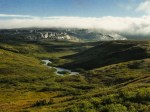
After the food, Hugues made excellent use of the Scots dictionary we provided in his speech to the Immortal Memory of Burns, even if he didn’t understand the meanings of all the words. Especially timely after such a feast was the toast of appreciation to cooks and dishwashers, and followed by an expression of gratitude for the logisticians and planners who made our field expeditions happen.

Feast
The speech to the immortal memory of Robert Burns.

The toast to the lassies was made and responded to, followed by some traditional Inuvialuit dances from one of the rangers (and even some of the AWI crew at points). Inspired by this, we ran outside for a short and impromptu intro to ceilidh, which fortunately didn’t lead to any twisted ankles and a med-evac. We returned to the warmth of the Community Building for a speech in honour of the fantastic Herschel Island-Qikiqtaruk Park rangers, after which was the ode to the bear (though we hoped there weren’t any close enough to hear it).

The most inspirational monologue of all was that of the manifestation of cryoturbation processes (and a note to permafrost); there was laughter, there were tears, but we got through it as a group, and are now all the stronger – and more knowledgeable on the topics of the manifestation of cryoturbation processes and permafrost – for the experience.

In an attempt to diffuse the excitement after the manifestation of cryoturbation processes (and a note to permafrost), we had a beautifully poetic ode to the glorious flora, featuring some well-chosen Scots, and even some Finnish. The only appropriate response to this was an ode to the noble nation of Finland, which led on to an ode to the superior nation of Sweden from Team Shrub’s own resident Finn, Santeri. A bescarfed Jakob overrode any nationalist tensions by celebrating continentality: that refined boldness that separates us awkward Brits from the rest of Europe.

The evening was rounded off with a toast to the magic and mystery of the glorious Yukon Territory by Meagan, Team Shrub’s official Yukon representative:

There are strange things done in the midnight sun,

by the men who moil for gold;

The Arctic trails have their secret tales

That would make your blood run cold;

The Northern Lights have seen queer sights,

But the queerest they ever did see

Was that night on the marge of Lake Lebarge

I cremated Sam McGee.

Excerpt from the Cremation of Sam McGee by Robert W. Service’s (1874–1958)

Music
Haydn playing the spaghetti and cardboard box in the jam session.

Once all the talking had finished, those of us fortunate enough not to be washing up descended into playing music on our guitar, ukulele, fiddle, bells, spaghetti noodles and cardboard box. Then as the sky started to brighten again and the sun to rise above the island, one by one we drifted off to greet the following afternoon with a fresh face.

By Joe

Sunset
Solar minimum on Qikiqtaruk-Herschel Island.

Sites and sights in Northern Québec

Bonjour! It’s Sandra here to give you a wee update on what I’ve been up to since I parted with the rest of Team Shrub on Herschel Island two weeks ago. I left with a heavy heart but with the cheering prospect of reuniting with my old research team from Université Laval (the « other Team Shrub », led by Prof. Stéphane Boudreau) for the second half of my field season.

A “get-to-know-your-fieldmates” 18-hour scenic drive and a couple of flights later, we got to Umiujaq, an Inuit village of about 350 people on the coast of Hudson Bay in Northern Québec. The name of the village means « which resembles a boat » because of the cuestas shaped liked traditional Inuit canoes.

I have been continuing my quest for root collars here on the other side of Canada, where dwarf birch (Betula glandulosa) is the one and only king of the tundra. My devoted helpers Marianne and Marc-André have valiantly struggled through temperatures ranging from freezing cold to much, much too hot, with continuous clouds of black flies and mosquitos that forced us to eat our lunches in our bug nets.

The great thing with Umiujaq is that your efforts are often rewarded tenfold, and two nights ago the skies glowed green with a spectacular display of the northern lights. There’s no better end to a long day out!

SAB-6711
The northern lights over the Hudson Bay.

I am now off to Salluit, one of the northernmost communities of Northern Québec, for the last stretch of my fieldwork campaign. Meanwhile, Team Shrub will be getting out of Herschel (on the 13th if the weather allows – keep your fingers crossed for them!) and I am sure they will be updating the blog with crazy tales of muskoxen and helicopter rides.

Au revoir!

By Sandra