Now that we (Team Kluane) are back at Kluane and ploughing through our work schedule, I (John) feel it is time to reminisce about a little experiment we completed earlier in the season, which investigated how herbivory patterns change with elevation.
We carried out the experiment for Dr. Anna Hargreaves as one of those favours that I’m told academics do for each other from time to time. Anna has orchestrated a whole suite of these experiments from as far South as Ecuador right the way up the North American continent to the Yukon, where we are.
Anna Hargreaves seed herbivory transect. Kluane is the northern most site!
At Pika Camp, while Haydn and El collected even more plant trait data, Sandra and I tromped off down into the valley, sunflower seeds in hand, to try and entice all sorts of animals out for a feast. Then we tromped all the way back up the valley, laying out caches of seeds as we traversed a roughly 1km elevation range.
The next day, after more tromping, we found that many of the seeds had been nibbled on and some had been eaten entirely. But what was possibly even more interesting, is how much the little rodents loved flagging tape and popsicle sticks! Probably it was marmots, they’ll eat anything I reckon.
A sunflower seed cache.
Mangled flagging tape.
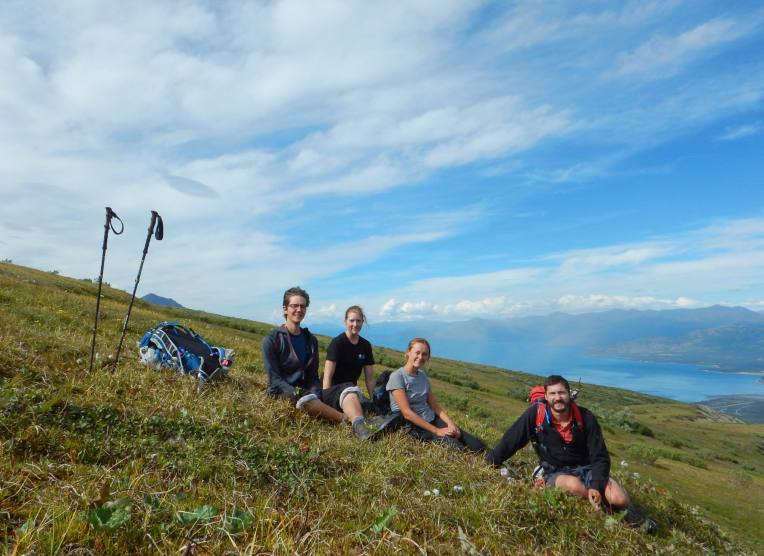
Highlights of our epic hike around Pika Camp include wading across glacial runoff streams, climbing to the summit of East Peak, and seeing a porcupine!!!
We had so much fun we decided to do the whole thing again back on the Kluane Plateau.
Yesterday and today has been windy and cloudy on Qikiqtaqruk. The two days before were glorious, but instead of doing science we headed on a boat ride around the island, to Avadlek spit, Lopez point and to Ptarmigan Bay on the mainland. It was both us the rangers and the AWI crew and Cameron so it was the whole team – a really fun outing.
Impressive cliffs, muskox and a bear. Santo and Jakob also went out to Advalek spit to do some ‘outreach’ filming with the IRIS. They swam in the open Arctic Ocean, drying off in the air afterwards. So all in all we’re doing well, though exhaustion and cabin fever is hitting in and we’re all feeling the strain of fieldwork a bit.
It was great to get various deliveries come in with the rangers. A new drone for starters, plus a load more freshies fromTeam Kluane. We feel very much vitalised and vitamined up with all things colourful and crispy. We also got an awesome care package from Gillian – a drone magazine, fancy chocolate, rubber ducks, a pirate puzzle, little parachute men, snapping rubber things, an air freshener. It is awesome!! We need to do a blog post just about that!
This evening Isla even flew the new drone! Santo had flown it the previous day. So we are all drone pilots now. Isla even took some really awesome drone footage (not) of Pauline Cove on her flights!
Sorry guys, we’re all drone pilots now
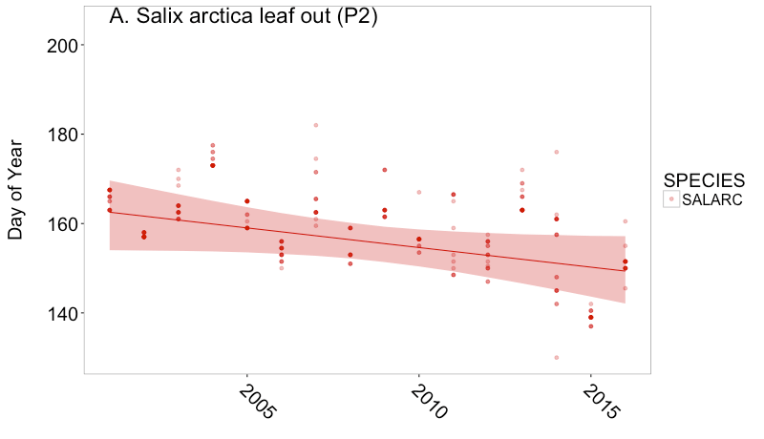
The data present from up here is that Isla entered all of the phenology data and reran the interval censoring model and… 2016 had a somewhat early spring – right on the trend line, but not nearly as early as last year. Senescence also started bit early this year, so a bit shorter of a growing season than last year.
The trend continues
Now the weather has taken a turn for the worse, so we have to figure out when best to try and squeeze in the last field days. In the bad weather, we have started packing. We are trying like mad to eat up all of the food that won’t survive the winter. Too many cans of chick peas and such, but it is better to have too much than too little!
Rain and shine on Qikiqtaruk
Oh and the other bad news is that our flight is scheduled for 10am in the morning on Monday!!! Oh no! That means an 8am wake up to do weather checks. That is going to be horrible. Only 5 more days on the island…we are all both ready for the end of fieldwork and sad to be leaving.
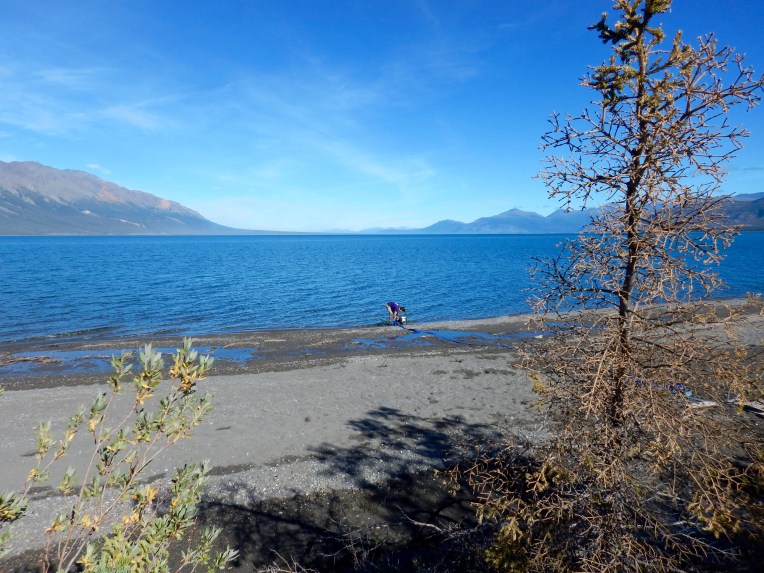
The plume of dust on the horizon told us we were almost back at Kluane Lake.
Climate change can be a real pain sometimes, especially if you’re a glacier. The mighty Kaskawulsh, trundling down slowly from the ice fields, casually gnawing the rocks to dust, is shrinking. No surprises there to anyone who knows anything about the state of the world at present. Unfortunately, a shrinking wall of ice isn’t great news for the Slims River, particularly if that wall of ice is the only thing keeping the water flowing. It turns out that this year was one step too far. With no more ice wall to divert the flow into Slims, there is, well, no more Slims. Kluane Lake, the largest lake in the Yukon, is drying up.
Climate change hurts if you’re a glacier
Of course, there’s a long way to go yet before it gets that bad. At the moment lake levels are just a meter or two lower than normal. It has its advantages: the rugby field, usually under a foot of water by this time of year, is bone dry. Unfortunately it also means that all the dust from the dry riverbed gets blown onto Kluane Base. Imagine exploding a bag of bread flour in your kitchen and then trying to do the dishes. Something like that.
Our dusty view
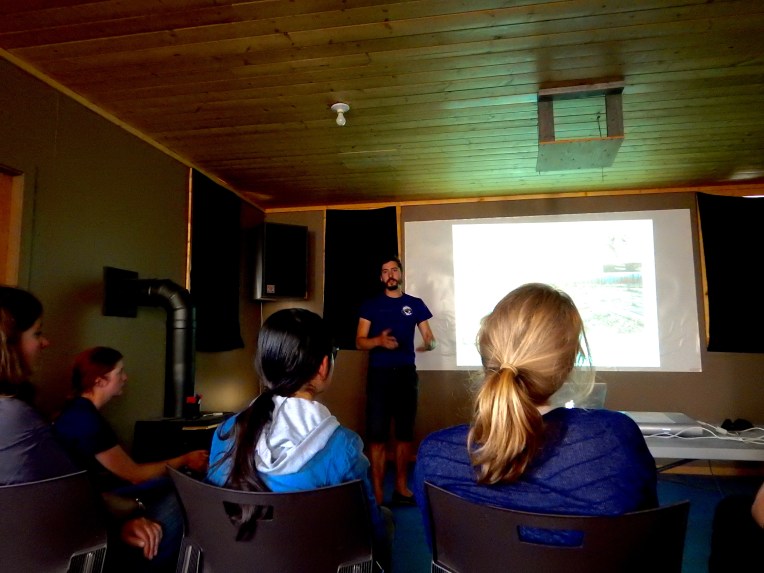
Dust aside, it’s good to be back at Kluane, not least for the food. After three weeks north of the Arctic circle, arriving back to barbecued moose burgers and sparkling wine is a fairly good way to start the week. Not that this happens every night – we had made it just in time for the Open House, an event showing off the work done here to scientists, government and the public. It turns out Sandra and I had to sing for our supper. Nevertheless, it’s not every day that you get to talk about willow stems to the local politician, so we gave it our best shot. The reviews were good, but I do wonder if the free gin and tonics afterwards helped.
Let me tell you about our willows
Other than that, Kluane has been full of little surprises. The willows in the common garden are still growing (even now, still growing!). Some of them look like they’ve been sneaking steroids into the soil while we’ve been away: leaves like playing cards, stems like fishing rods. Our little garden was not designed for over a metre of growth in one year – these are supposed to be Arctic willows!
Giant willows taking over the garden
Herschel willows in their travelling coats
Propagated Kluane willows ready for planting
Our latest trip up the plateau was uneventful, tiring (our legs are out of practice) and coloured in orange. Autumn is setting in now; the leaves are falling and the days are darker. No northern lights yet, and the dust is doing its best to keep things that way.
Jiminy Cricket!
Autumn colours
Vaccinium uliginosum
A dusty sunset
Our new reading material
The greatest success this side of Qikiqtaruk was signalled the other day by cheers from the beach and the sweeping and surge of water. The Tony Grabovski pump is finally up and running! The trials and tribulations, the confusion and crises, pump parts and pulled muscles were worth it as the water barrels filled up…quite slowly. Was something wrong? Did it have anything to do with that new fountain in the bushes over there? It turns out that a pesky ground squirrel has extended its culinary curiosity to our lovely new hose. Oh well, one more chapter in the pump saga that will surely be detailed in full in a blog post yet to come.
John working on the Tony Grabowski pump
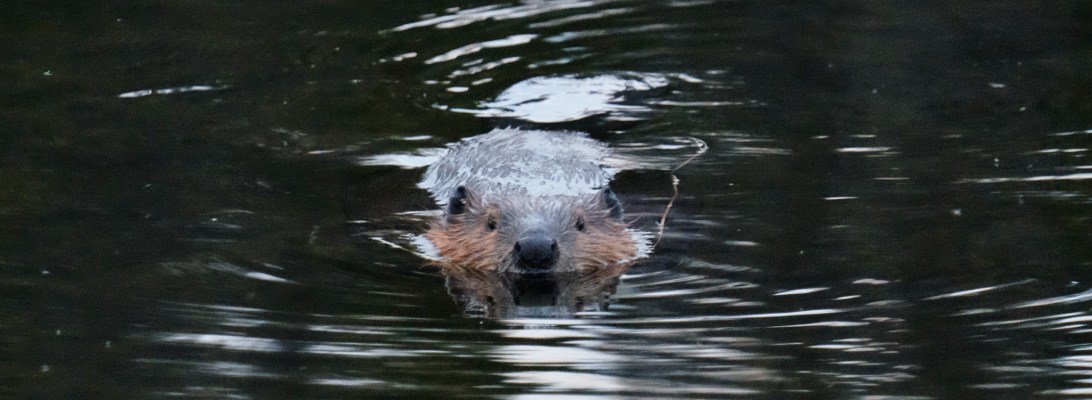
With time to spare one evening we took a trip along the Alaska Highway to see if the beavers were still about. Several wrong turnings later, despite the straight road, we were once more silently fighting our way through head high ‘dwarf’ birch and settling down in breath-held patience at the lakeside. Our shrub impressions mustn’t have been up to scratch because didn’t have to wait long before the beaver spotted us, making for us with something between curiosity and apprehension. Sandra had her zoom lens this time.
And with Sandra I must also end this post as Team Kluane bids her a sad farewell. Thanks for everything this field season, enjoy Edinburgh for us and we’ll see you soon!
by Team Kluane
Final note (2017): For posterity, the diversion of the Slim River was reported by fellow Kluane scientists as the first case of climate-change driven ‘river piracy’. You can read more in their article in Nature.
Peak season has come and passed. The willow leaves are starting to yellow and the tundra is looking less and less green. The wind has a cold edge to it now, and the water temperature has plummeted. Winter is coming… We’ve collected the peak season spectral and structural data with the drones – both the hexacopter and the fixed wings. The ecological monitoring plots have been point-framed – a really fun and pain-staking method to quantify the abundance and cover of tundra vegetation. The shrub biomass has been harvested. The tea bags have been collected, the litter protocol has been conducted. The willow seeds have been counted in the recruitment experiments. Even Joe’s dendro samples have been collected – we didn’t forget Joe!
A Salix arctica catkin at the phenology plots
A wet and cold day of dendro sampling
Point framing – not all are born with the same mosquito tolerance
Trait processing and seed sowing in our lovely cabin
Despite a difficult start to the summer with Arctic Fails, drone difficulties, and epic floods, these past couple of weeks have gone swimmingly well. We have met all of our scientific objectives and made a few discoveries along the way. Of course there are always more data you could have collected, but we are pretty stoked about the really cool canopy models we can now make of the rapidly expanding shrubs on the floodplain, the tundra spectral signatures that we can compare to plant phenology across the growing season, the 3D models of the retrogressive thaw slumps and coast line and the collection of another year of ecological monitoring data to add to the now 16-year time series from the island.
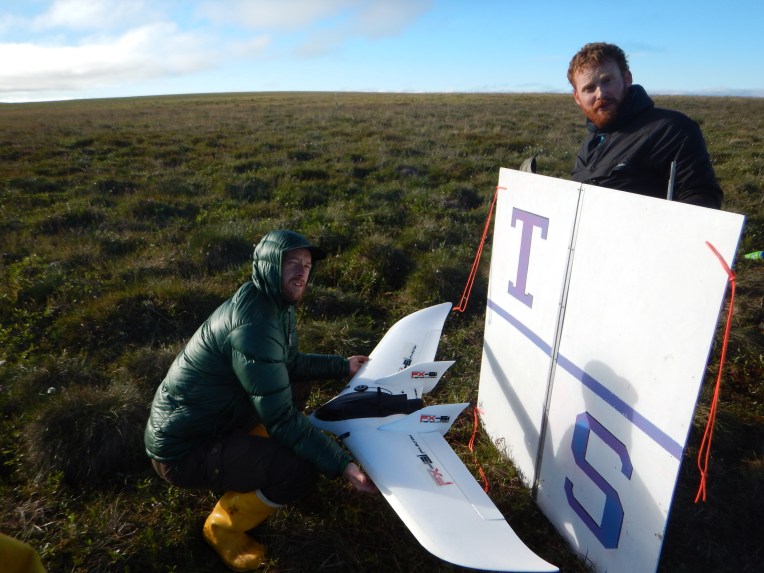
For our final field day as a team, we headed west to explore Slump D, the largest retrogressive thaw slump IN THE WORLD (or at least perhaps the second largest… in North America). Jeff, with the aid of the keen team, flew his fixed-wing drone (christened “the Arctic Turd”, derived from the original suggestion of “Arctic Tern”), mapping the entirety of the slump and its surrounding area for SfM (Structure from Motion), to make a “stupid fresh” 3D model. Part of the very helpful team was employed on a reconnaissance mission to explore the north side of the slump where grazing caribou, a glistening stream and a distant snow patch were detected, and found to be of no threat to the mapping missions. Isla and Andy valiantly stayed put at the ground control station. Isla kept Pilot J-man the K-dawg updated on the Turd’s technical homeostasis, while Andy resorted to his technical drone conversational skills to keep the mood positive, as some imagery was found missing. During a 45min aerial survey, there is a lot of time to be killed and minutes to be filled.
A close caribou encounter
Santeri messing around on a perilous slump overhang
The valliant ground control team
Slump D
Packing away when the wind picked up
Mastodon flowers on the slump
Slump D – truly massive: can you spot John?
Then suddenly, the wind shifted from east to north and the weather conditions were no longer suitable for survey flights. Thusly, it was time to head down to the bottom of the slump and whip out the 3DR Solo quadcopter and get some wicked, radical and totally awesome GoPro HERO4 Black footage of the majestic thawing obsidian-like behemoth that is the Qikiqtaryuk Slump D headwall (btw, 3DR, GoPro, Fjallraven and others, we gladly accept any and all merc for future collaborations, promotions and social media shout-outs). After some Solo-GoPro money shots and sweet camera angles down many-metre deep permafrost holes, it was time for the classic TS jumping shots (although we’ve lost our talent for it – sad selfies are the big thing this season) and thermokarst mud fights (and epic muddy hi-5s). Then, the linearity of time caught up with us and we heard the Ranger Boat heading to our destined pick-up location. The tears of parting were soon dried however as Edward took us for a spin around the abandoned caissons – large concrete structures, remnants of the oil exploration times 40 years ago in Thetis Bay.
Aerial view of Slump D
The Solo quadcopter
Jumping on the slump
A true “exploding high-five”!
Fun in the slump
After returning home, we kicked back: some decided to relax by doing litter sorting for Haydn’s decomposition experiments, while the official Team Shrub group photo was shot outside of the (likely soon-to-be-drowned) Northern Whaling & Trading Co. warehouse. Sandra counted all the baby willows that have germinated in various chunks of tundra vegetation. Isla however refused to relax, and with great determination read books and drank tea (while occasionally taking a break to cook a Delicious Stew for 9 people out of an abundant, yet eclectic and diverse mix of Scottish Feast leftovers).
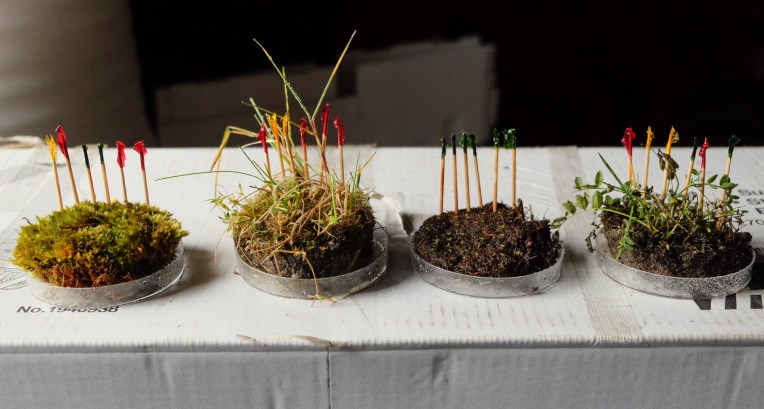
Look at those baby willows!
Tomorrow is the third of August, and if all goes according to plan Team Shrub will be divided yet again for pretty much the rest of the field season. Team Kluane and J-man the K-dawg (Jeff wasn’t in Kluane – though he is now totally on Team Shrub) will be leaving on a prop plane – don’t know when they’ll be back again. Now Team Drone will be left alone on Qikiqtarȓuk for the final two weeks of our Arctic field season. (Though, of course we aren’t really being left alone as the rangers and the German researchers from the Alfred Wegener Institute will still be here and Cameron Eckert from Yukon Parks will be joining us soon.) We will be very sad to see everyone go and are already planning what we are going to do to console ourselves after their departure – maybe a film night? Though, Haydn says that we aren’t really sad to see them go, we are just sad that we are going to have to do more cooking and make our own lunches.
Domestic chores have actually been as enjoyable as they could be, from trying to guess who made your lunch to El making up insults using French words on food labels (“T’es un gros morceau” – “You’re a big chunk!”). And of course, with such a team, forget measuring quantities in grams or cups or spoonfuls:
– “How much Sriracha would you like in your wrap?
– About five seconds, please.”
And before the end of our time together as one united Team Shrub, we also held the annual Scottish Feast – but more on that in a future blog post.
—-
After an exciting Twin Otter flight, several loads of laundry in Inuvik and optimist farewells to Jeff as we’ll surely see him again soon in Scotland, Team Kluane have now returned where they belong. Stay tuned for what they have been up to!
Sad selfie by the Twin Otter
The lucky folks who get to stay on the island a bit longer
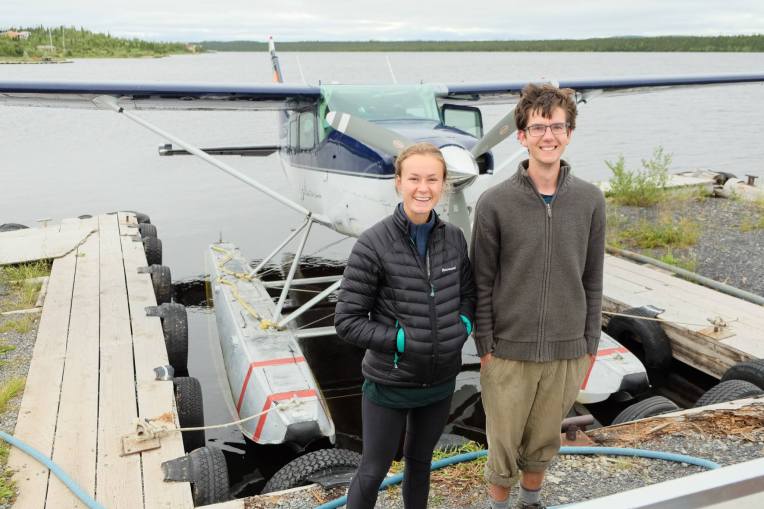
After the flood waters subsided a bit and the winds died down, Team Shrub was reunited at last as our remaining members arrived on a helicopter and two float planes! It was an epic way to converge on our Arctic Fieldsite Qikiqtaruk.
Almost as soon as the rest of the team landed the science planning began. We have a long list of data collection goals, but so far we are ahead of schedule! We are still working as two teams: Team Drone and Team Kluane, but now our mornings and evenings are shared and the enthusiasm from our new arrivals has rubbed off on the rest of us, and their efficient productivity and good luck.
Since the arrival of the rest of TS, our drone luck has very much turned for the better. We have had two successful days of drone data collection – double drone days with a hexacopter and a fixed wing in the air! And we are going for a triple drone day today, trying to fly both of the hexacopters and the fixed wing – here is hoping our luck continues.
We can’t send you the photos through our sat phone connection to the outer world, but imagine multiple GBs of imagery of really awesome green tundra with ice wedges, ponds, patches of bare ground, shrubs and even retrogressive thaw slumps. Once it is all stitched together in 3D models, it is going to look so cool and produce some really awesome scientific findings as well – we hope!
Team Kluane has been busting out trait measurements, collecting samples for the common garden, germinating willow seedlings and collecting tea bags. Their major scientific discovery so far is that lemmings sometimes eat tea bags buried in the tundra, but there are more discoveries to come as their data collection continues.
So it is great to be reunited as one TeamShrub again eating our meals around the big table in trappers. How lucky I am to have all of these amazing young scientists working with me and how cool it is to be past some of our previous fieldwork frustrations of this summer to collecting data again at a great rate!
Exploding high five TeamShrub (both the field crew and our members elsewhere in the world!)
by Isla
P.S. We did our first exploding high five of the summer together on Collinson Head after the first successful flight of the fixed wings and the first day of getting Shrubcopter airborne again. It was an epic sunny exploding high five with all of the 9 of us surrounded by the tundra and Arctic ocean with icebergs floating around in the distance. Next time we will get it filmed with the Solo in 4K!!!
Hi folks, looks like after four days of maybes Team Kluane are eventually going to make it to Qikiqtaruk-Herschel Island.
After the Great Flood and strong winds and rain and snow and all other manner of setbacks, John and El took off this morning for the island. Sandra and I will head off shortly.
After nine days of Inuvik we’d like to say thanks to all the people and organisations that have helped us out. A particular shout out to Rob the pilot for flying us and to the ARI for lending us an HDMI cable!
Hopefully this is the last you’ll hear from us for a couple of weeks,
Every day (or every week day) from far away in Edinburgh we are sent three weather emails from our trusty robotics intern Callum. These weather texts come from NOAA or Environment Canada weather stations along the Alaska and Yukon Coast. It is with these weather texts that we have some forewarning of the weather to come.
After a very warm few days, the winds started to pick up. This is fairly normal for Qikiqtarȓuk. But, what we didn’t know, is that it was also a period of spring tides. We had noticed the tides getting higher and higher and the water level rising. Once the winds started blowing steadily and strongly from the Northwest and the tide level was increasing – the storm surge was underway.
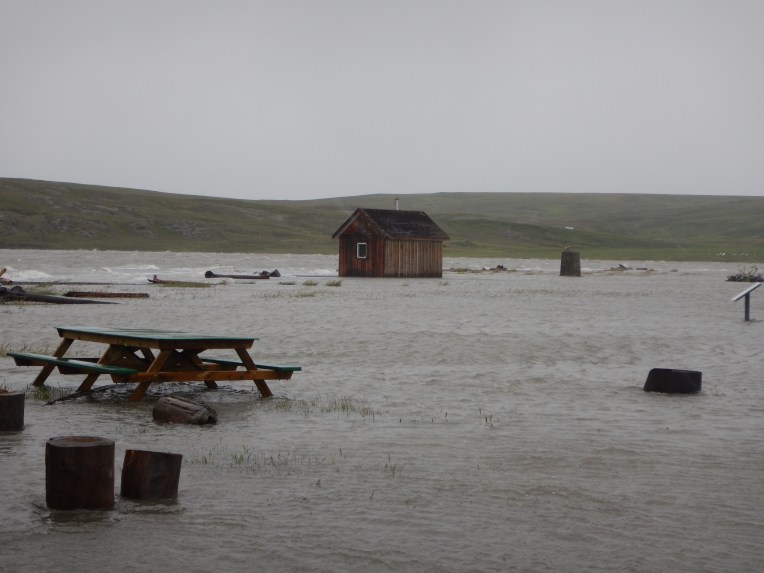
First the water was higher than normal, then puddles followed by ponds started forming between the buildings, then some streams of water started to flow from the ocean onto the lower parts of the spit. As the tides went up and down the amount of flooding increased as the rain and wind was lashing the island.
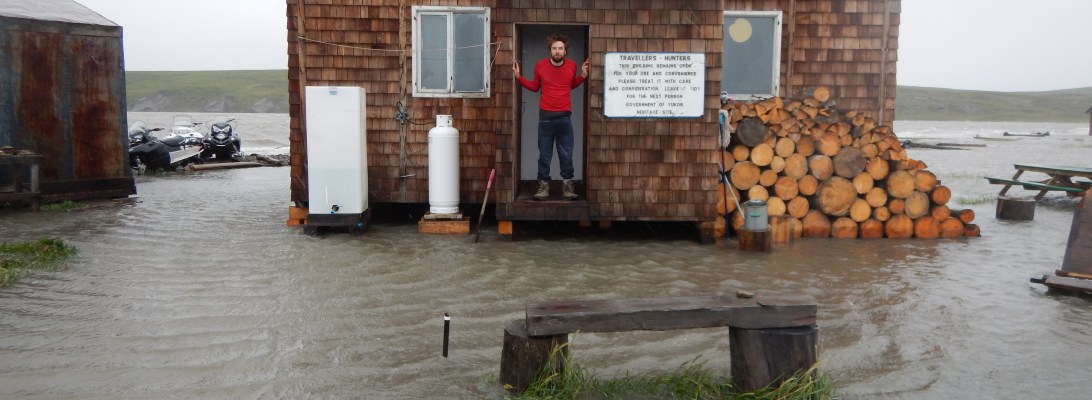
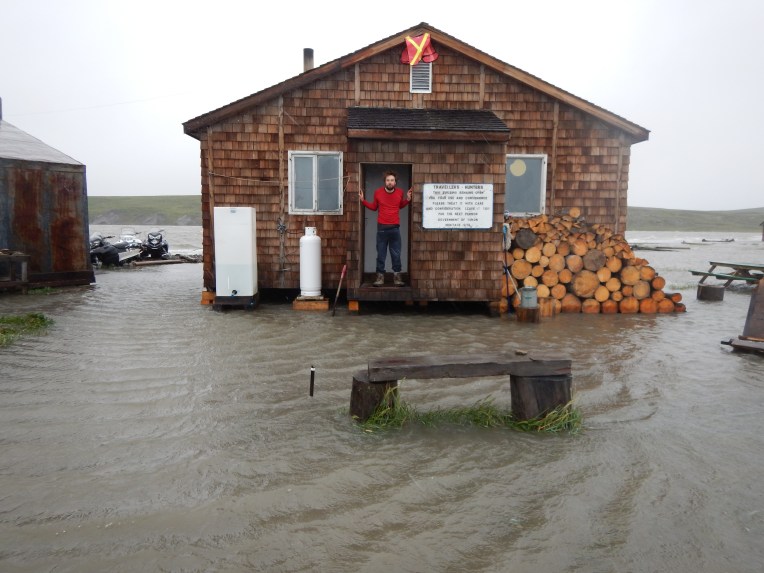
By Monday at around 1pm, things became pretty epically biblical as the water levels reached their peak. Our new home the Trapper’s cabin was both surrounded and underlain with about a foot (30 cm) or more of water. At the peak the water was 10cm from the door level and we were worried that it might flood inside. If you tried to walk between buildings without hip waders on you would over top your boots. There was around 2 feet (60 cm) of water between each building.
The Trappers cabin was surrounded by water but mercifully remained dry on the inside
Jakob and Santo went around camp trying to rescue all the flooded animals – two by two. First, Jakob tried to rescue a bedraggled sandpiper chick and then Santo, in the process of rescuing the muskox sculls in front of the bone house, unearthed some wet and miserable voles including Leo Volstoy the very good friend of Ernest Lemmingway.
Santo had a plan of building a raft out of plywood planks a giant raft to carry all the drowning animals, but there wasn’t enough time so instead they brought over the Zodiak – called Beluga – from the docks into camp to move stuff between buildings. In the end Santo, Jakob and Sammy (the German researcher) ended up putting on the survival suits and floating through water flowing onto the spit from the cove and generally splashing around and having fun – because once you are in an epic 100-year flood – you might as well have fun with it!
Beluga, the Zodiac used to move our stuff away from the flood zone
There were discussions of evacuating all us off of the island, but we said we wanted to wait it out. If had left then we couldn’t have afforded to come back, and that would be the end of our research field season. And thankfully, since then with each passing tide the water level has been dropping. You still need to wear boots around camp though!
All the logs from the sauna sadly floated away
So now we await the rest of our field crew, who have been stranded in Inuvik because of the floods. They were meant to fly here on Tuesday, but now the airstrip is very much flooded and won’t dry out for several days or more. They have booked float planes to get in, but the winds are still too high for the float plane to land on the water. A helicopter carrying the ranger crew change and one of our team members Jeff Kerby has just arrived. And Callum’s e-mails suggest that the high winds should abate today as the winds switch from west to east. So here is hoping that during that window of fairer weather the rest of our crew can fly in and perhaps we can even get back to science and flying drones!
Blue skies make us hope that the rest of the team will make it to the island soon!
Casualties of the storm surge:
Three support posts knocked out from under the Canadian Whaling & Trading Company Warehouse Building by waves and logs – it is now precariously balanced on the one side – this is where we store our food and research equipment.
Flooding of the Bone House building with standing water in each of the wings of the building, it is slowly started to dry off.
The fish smoke house was swept away by the waves completely.
Loss of all of the wood and water containers from around the sauna all floated off to high ground about 100 m or more from camp.
And here is our storm surge rap or poem – depending on how you read it:
Update: Qikiqtaruk-Herschel Island is currently experiencing a major storm and has been badly flooded.
A drowning Qikiqtaruk
Team Drone are all safe and dry (mostly dry), but access to the island is all but impossible. They have been taking the time to work on important aspects of field life, including:
Playing an epic game of Settlers of Catan all night (Santo came from behind to win)
Country blues jamming with Senior Park Ranger Richard Gordon
Let it flood, no bother We have willow blood It is wet, no worries TS connected through the net Let it storm, no problem We’re in Super Shrub Form
Encouraging Team Kluane to make data presents (possibly making some themselves)
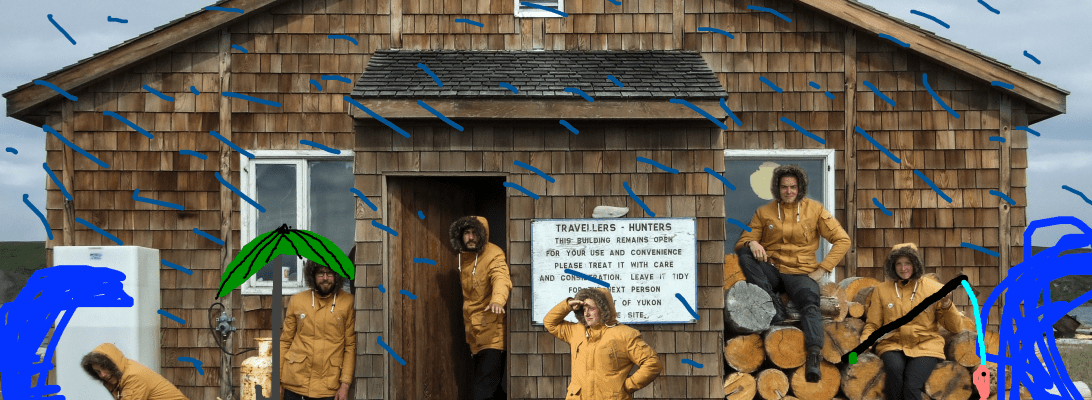
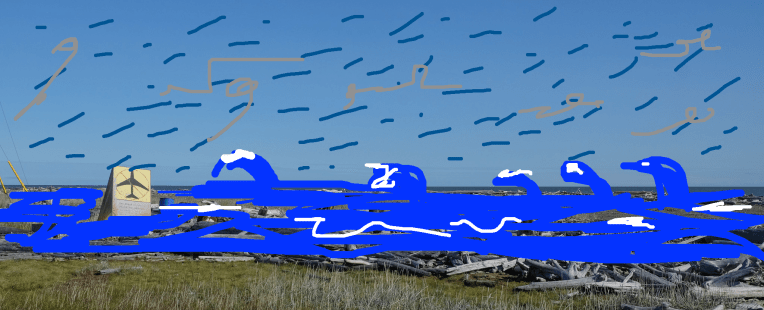
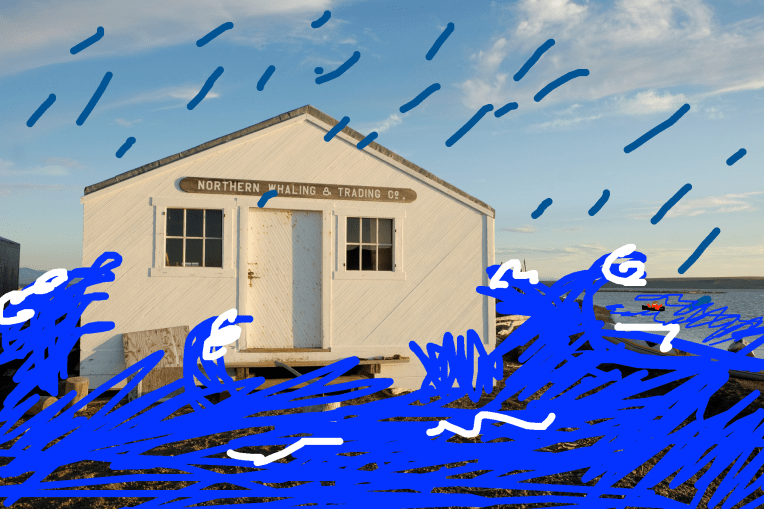
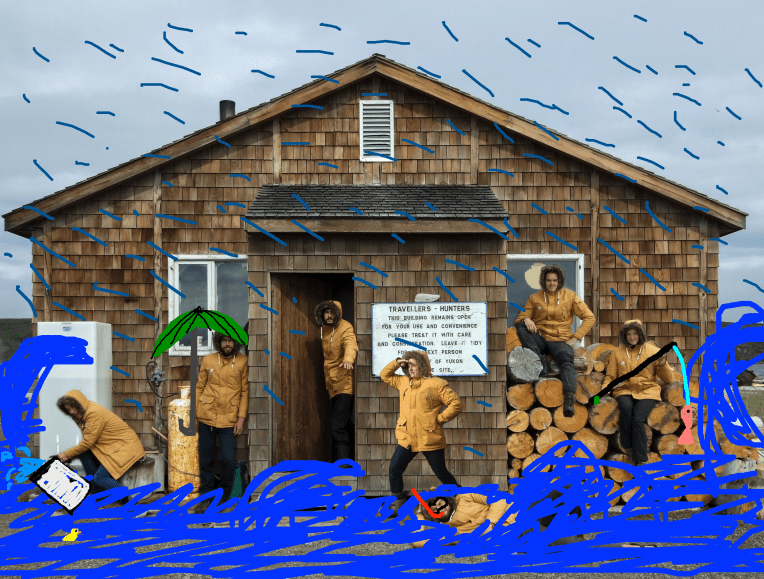
Writing responses to disgruntled team members. Note that due to the isolation of Team Drone at the present time we were unable to receive photos from the island, but an artist’s impression has been provided.
Hello Team Kluane,
We apologise profusely for our ill though out willow wishes. If only we had known the power that the willow seeds infer on mere wishes for more wind.
Wish 1: Isla meant to add in something about the fixed wing, kites and new drone, but she forgot because she was writing that post at 2am in the morning! Apologies again. We can’t wait for your help to get airborne data collection again!
Wish 2: This in retrospect was a great error. The wind had been very still and the mosquitoes very bad, but were we to know that our wish would result in the now driving rain-snow that is lashing our windows, we never would have made that original wish and would have stuck to something far more precise.
Wish 3: Awesome pictures of the muskoxen knocking down the phenocams? Nope, just upright and then black or extremely close up tundra. There is one very distant photo of the muskox in one cam and some of people hiking by, but no super cool wildlife yet.
Wish 4: We did wish for your arrival, so that could theoretically have canceled out wish 2. Perhaps the order of operations matters, because at least right now it seems pretty clear that you won’t be flying today as the water has been higher than ever and the storm is in full force now.
The completely flooded airstrip
Wish 5: We feel confident that some mostly fresh food will make it out to us at some point and you guys too!!! Santo and I are in a pit of despair about the lack of “Sweet Memories of Cebu” in the stores, or lack there of. Our addiction to that product is profound and when it runs out we are going to suffer terrible withdrawal symptoms. Possibly resulting in an attempted swim to the Phiilipines.
Update: “Oh man, huge whitecaps out there” – Jakob
Waves crashing up against the stairs and side of the warehouse
Wish 6: Isla will be removed from cooking responsibilities??? That sounds amazing, but her actual least favourite chore is lunches. She hates making lunches. Cooking is fine and dishes are okay. And by the way, it isn’t really so bad – Isla’s dish piles that is, she does dishes as she goes a little bit. Jakob, do you know what asking to be moved in the dishes schedule sounds like???…
Wish 7: Well $1.71 doesn’t sound so bad for the pound – maybe we will be able to afford that first latte when we get back to the city. Qikiqtaruk has now become a microcosm of the EU with German, Finnish, English, Scottish (and Canadians) all living in one geographic region where they have to share resources and space. Perhaps we can resolve what Europe and the UK could not and show the world how people can live together in one happy economic and political union!
Wish 8: No sign of Otto in the storm, but perhaps this wind will blow more walrus and a few Narwhal towards us???
Update: There are high winds and heavy rain and some sleet/snow stuff. Jakob has investigated the water level under the house and it is completely flooded. Trappers was lifted this year, but if the water reaches a certain level, then he things we should leave this building and head for higher ground in the community building. The Ranger’s cabin is the most flooded, and Signals house is on a small island. You almost top over your boots now walking between buildings. The waves and ocean edge is getting closer and closer to the back side of trappers and the outer warehouse is now being hit by waves on atlas two sides and the water are getting close to the door level.
The strip is well and truly flooded. There are logs floating out there. We have lost the logs from the sauna, which is flooded now. There is water from pretty much the loading area to the orange cones – so three quarters of the strip is under water. We can’t get out there without over topping our boots. One of the next items on our to do get out all of the hip waders so that we won’t get wet feet.
The Trappers cabin surrounded by water on all sides with huge waves crashing just a few metres away
Wish 9: We will now focus our efforts on wishing for the end to the storm and the rapid drying out of the runway. However, since our wish for brisk winds was so powerful we are eagerly anticipating the arrival of our magical powers to sense wildlife and ward of mosquitos.
The only problem with making willow wishes now, is that the willow catkins are all too wet for the seeds to blow away on the 10 metres/second winds…
From a sad TeamDrone who is wishing fervently to be reunited rapidly with TeamKluane,
This is a reply to Team Drone’s latest blog post, Willow Wishes, from a very disgruntled Team Kluane. Be careful what you wish for.
Wish 1: Please can one of our drones start working again. We agree with this wish, but feel you do not provide enough evidence that “a fixed wing, some kites and a new drone are on their way to the island”.
Wish 2: Please can the wind stay brisk. Be careful what you wish for, particularly when using vague, unscientific terms such as ‘brisk’. The wind has indeed picked up, to around 60mph, and as a result Qikiqtaruk is now in the throes of a strong storm surge. While I suspect that there are now very few mosquitoes, my understanding is that you are now completely flooded and no flights can land for several days, leaving us stranded in Inuvik. On balance, this is not a good outcome.
Wish 3: Please can the Muskoxen stop knocking down our phenocams. Please clarify if this means you have awesome pictures of muskoxen knocking down phenocams.
Wish 4: Please can the remainder of our field crew make it out very efficiently to us this week. See Wish 2.
Wish 5: Please can all sorts of delicious fruits and vegetables come out with Team Kluane so that we can feast! In light of recent events we do not feel that this is either likely or appropriate. Also there is no mango.
Wish 6: Jakob wishes he wasn’t after Isla’s cooking in the chores schedule. A rather complicated point. On one hand, information provided earlier by Team Kluane (Haydn Thomas, personal communication 17.07.2016) implies that Isla will be removed from cooking responsibilities due to the additional of team members. However, given Wishes 2 and 5, the probability of this occurring has now significantly decreased. This is further complicated by the fact that the food warehouse is now almost underwater.
Wish 7: When we return to the city, can the pound be worth a normal amount. I do not think it is appropriate to use the term ‘normal’ in this context without explaining underlying assumptions. Given the political landscape of the last month, ‘normal’ has shifted in both essence and meaning. Indeed there has been some recent suggestion that the word itself should be rejected since it bears too close a resemblance to the French ‘normale’, and as such defers linguistic power to an unelected elite in Brussels. Perhaps it would be more appropriate to simply state that £1 currently equals $1.71, ($2.02 on this date in 2015, $1.54 in 2011).
Wish 8: Please can Otto the Walrus come back to visit us again! We agree with this point.
Wish 9: Please can we gain magical powers to both ward of mosquitoes and know where and when all the really cool wildlife are near us. We further suggest that a magical power to ward of storm surges and dry out runways could be considered.

















 Team Shrub