
Our final days on Qikiqtaruk for 2017

Our Arctic field seasons are both long with the passing of 24 hour days and hard work out in the field and incredibly short.  Now that the field season is over and summer has ended in the Arctic, we can reflect on our final days on the island and what we accomplished during the field season of 2017.

DCIM100MEDIADJI_0002.JPG
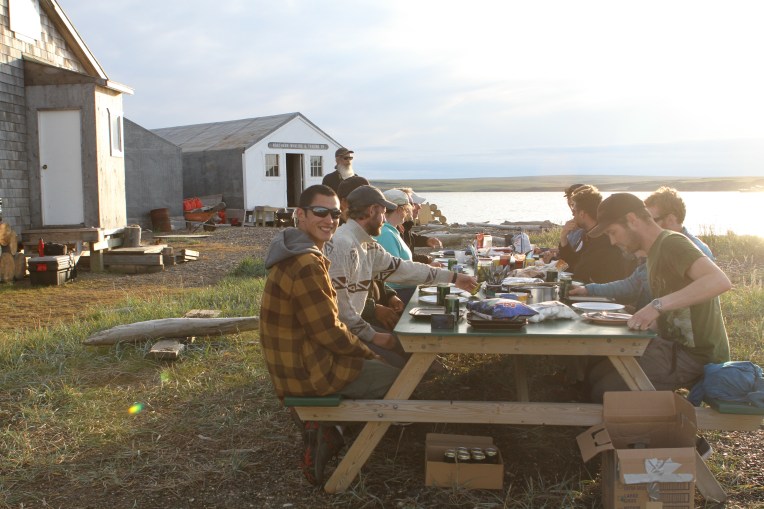
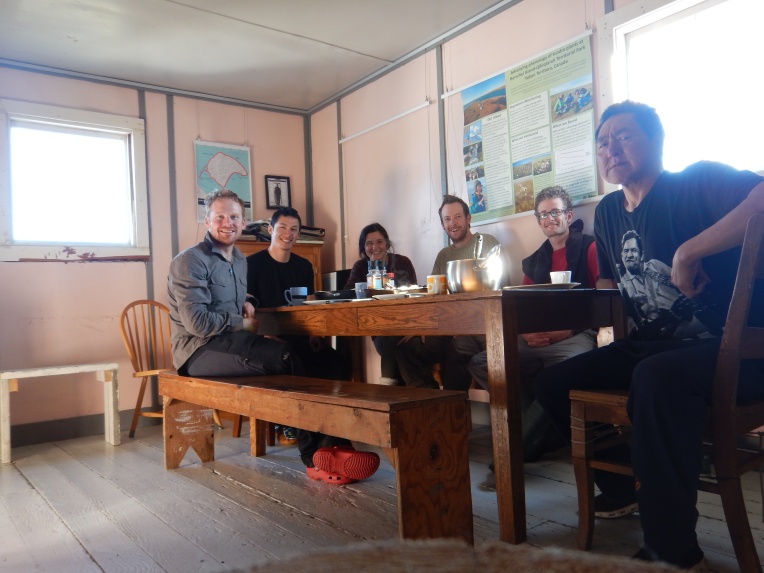
A lovely meal in the sunshine on the last day before the rain and wind came!

When you are in the swing of fieldwork, you are in a routine of “early” mornings and very late nights and long days out on the tundra.  On Herschel time, you get up at the crack of 10 am and then work out on the field sometimes as late as midnight or later with bedtime at around 2 to 4 am.  After each long day in the field, you colour in a few more boxes on the fieldwork plan of tasks accomplished, but there is so much left to do that you wonder if we will get it all done.

On Qikiqtaruk you are always at the mercy of the weather and no time more so than at the end of the season.  As the tundra starts to turn yellow and brown, the temperatures start to decrease and the fog starts to roll in grounding drone flights.

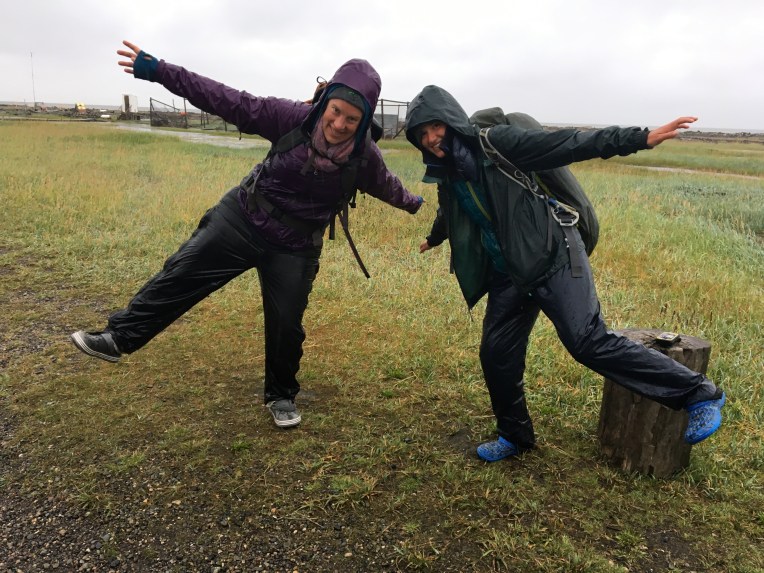
Storms are common in August and this August was no exception with a three-day storm overlapping with the date our charter flight was supposed to pick us up off of the island.  That meant a day of being weathered in, but also a chance to do more last-minute data collection in the driving winds and rain.  This year’s common garden samples might have been collected in pretty horrible weather, but here’s hoping those willows thrive in their new warmer home in the Southern Yukon.
Qikiqtaruk_17-08-13_047_CameronEckert
Wet days out in the field. We were not wearing crocs out there, but Gergana’s wellies were too wet to spend any more time with them on! Photo by C. Eckert

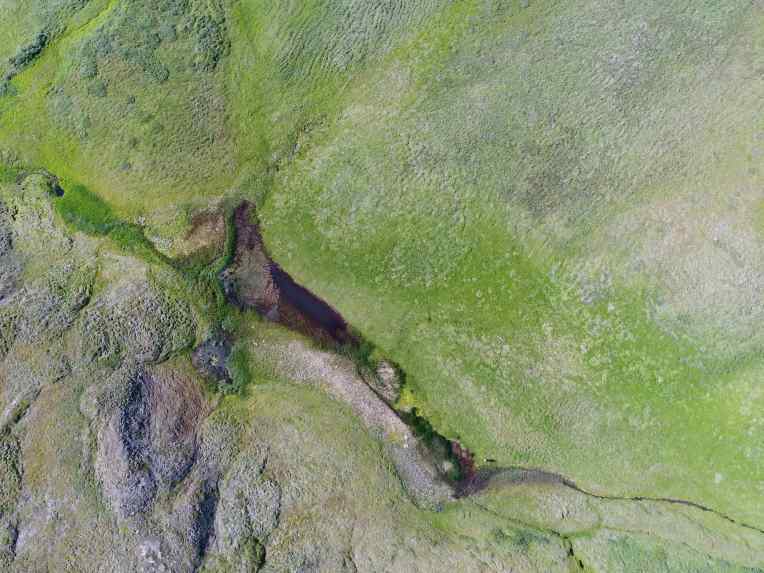
This year there were some end of field season weather surprises for us.  Unlike last year when the fog grounded our drone flights for more than a week.  This year there were a few glorious days allowing us to get back to Slumps D and ABC to quantify permafrost thaw across the 2017 growing season.  We were also able to complete a final round of multispectral flights over all of our tundra plots as the tundra was turning from green to brown and the plant phenology records indicated the yellowing of leaves and release of seeds.  On the final glorious day before the storm, Andy and Will made it out to fly large extent flights of the Ice Creek watershed, allowing us to put our higher resolution data into a larger landscape context.
DCIM101MEDIADJI_0295.JPG
Ice Creek from above with Cameron Eckert (bottom right) and the “Bottomless Pool of Eternity” (top left) visible in the frame.

Just hours before flying off the island, we even managed to achieve one of the most elusive goals of the field season. It still feels slightly unreal, but after many attempts, involving finding different types of batteries, cables, Allen keys, screwdrivers, and building shelters to keep the rain out when taking the computer out into the field, we are finally happy to report success. We have downloaded all the data from our HOBO temperature data loggers, put in new batteries and restarted the data logging for the winter. These might all seem like simple tasks, but really, when you are out in the tundra, so many elements have to come together in order to achieve your goals!

Just when we had one HOBO sorted and ready to tackle the second one, we found out it requires entirely different tools to open it and cables to download the data. Because of the pouring rain, the process had a distinct Russian doll flair to it – a laptop inside a bin bag inside an emergency shelter inside a tarp.

On the morning of our last day, though, everything came together.  Beautiful belugas accompanied us on our beach walk towards the data loggers on Collinson Head.  We had all the tools we required (well almost), we even managed to improvise a radiation shield out of wooden skewers and medical tape to fix the broken one on that pole.  And once we removed all the screws without dropping them in the pond below the logger box and plugged in the cable without getting it wet, the data were on our laptop in minutes! Yukon Parks conservation scientist Cameron Eckert was there to document the big moment – thankfully we are better at handling data loggers than high fives! It is a great feeling to leave your field site knowing that you have accomplished all of your fieldwork goals.

Though two months in the Arctic can seem like a long time when the data collection is going on, it is also a very short time.  The end of the field season is when you begin to realize that your time on the island is coming to a close.  You have your last walks across the tundra, last dinners with the community of people on the island and the last dips in the Arctic Ocean.  This field season marks the end of the three-year ShrubTundra project.  We have lots of data analysis and writing ahead, but no more data collection on this specific project.  Sigh.  Though the science never really ends!

We have learned an incredible amount over the past three years and it will be great to see all of that work come together, but it also brings us to the question of what research questions should we be tackling next.  The work of a scientist is never done, as soon as you learn one thing, you are already thinking about the next question that you want to answer.  Perhaps, through the HiLDEN network or other opportunities we will be able to explore whether some of the things that we have discovered at Qikiqtaruk-Herschel Island apply across other Arctic tundra locations.
markers
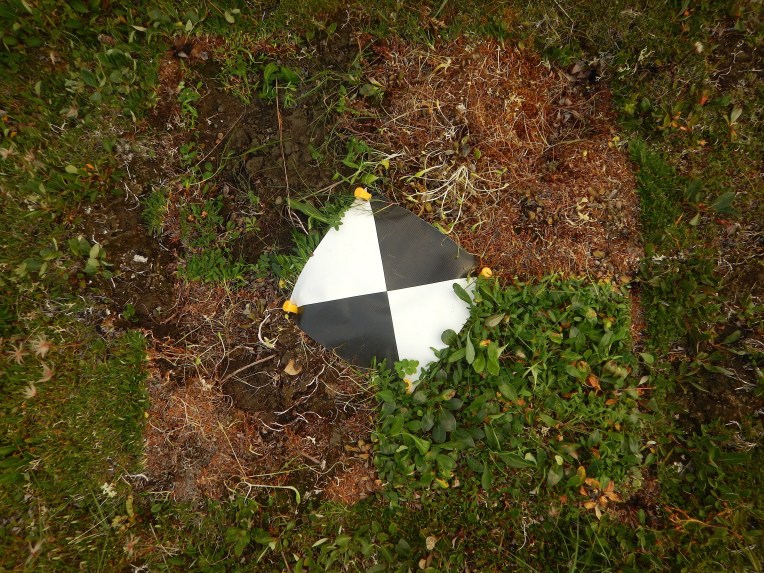
Removing drone markers leaves a literal mark on the tundra of our 3-year research on the island that will quickly grow over.

Here are some of the preliminary research findings of the Shrub Tundra project research on Qikiqtaruk-Herschel Island:

  1. Plant phenology including the leaf out, flowering and to a certain extent leaf senescence is occurring earlier on Qikiqtaruk over the past 18 years as snow melts and sea ice retreats earlier (Qikiqtaruk Ecological Monitoring Team, in prep., Assmann et al. in prep., Lehtonen Ecology Honours Dissertation 2015).
  2. Plant biomass and height is increasing across the patches of monitored tundra and certain plant species are becoming more abundant including Eriophorum vaginatum (cottongrass) and Salix pulchra (diamond leaf willow), while other plants are found in the monitoring plots that weren’t there 18 years ago such as the grass species Alopecurus alpinus (Qikiqtaruk Ecological Monitoring Team, in prep.).
  3. Although plant heights are increasing community-level leaf traits such as the specific area of the leaves is not occurring very rapidly at Qikiqtaruk or other tundra sites (Bjorkman et al. in prep., Lowe Ecology Honours Dissertation 2015).
  4. Tundra traits differ from other of the worlds biomes and it is the traits of plants that link vegetation change to changes in decomposition and carbon cycling (Thomas et al. in prep.).  That is why understanding how rapidly plant traits are change is key to understanding the implications of future tundra vegetation change.
  5. Qikiqtaruk willows can grow in warmer environments 1000 km to the south, but local adaptation to Arctic light conditions means that they are not growing as fast as their southern alpine counterparts in our common garden experiment that are really able to respond to the warmer growing conditions at the lower elevation down in the boreal forest.
  6. Climate is not always the factor explaining the variation in growth of shrub species from year to year on Qikiqtaruk, indicating that other factors such as deepening active layers and thawing permafrost releasing nutrients might be a driver of vegetation change (Qikiqtaruk Ecological Monitoring Team, Boyle Ecology Honours Dissertation 2017, Angers-Blondin et al. in prep.).
  7. Decomposition rates differ among microclimates, and soil moisture is just as important as temperature in explaining decomposition rates, but these differences are small compared to the differences between different types of plant litters (Walker Ecology Honours Dissertation 2017, Thomas et al. in prep.). As vegetation changes, so too might tundra decomposition rates.
  8. Analysis of drone imagery and 3D models indicates that tundra greenness is strongly related to topography and wetness of the landscape, but that this relationship depends on the scale of measurement. As permafrost thaws, this could lead to increased moisture where ice wedges are thawing and increased tundra plant productivity (Kennard Geography Honours Dissertation 2017, Assmann et al. in prep.).
  9. Rates of permafrost thaw and coastal erosion can be rapid and are associated with moisture in the landscape, with sometimes faster thaw rates in areas with water tracks or streams than in adjacent drier tundra (CBC article on high coastal erosion rates, Cunliffe et al. in prep.).

But these are just some of the results so far.  Once we have analysed this year’s data in association with the data that we have collected over the past three years, we will really be able to put the story together of how vegetation is changing on this island in response to climate and environmental change and what that might mean for the future of this tundra environment.

feast
A final feast on the island before we departed.

After we made it off of the island after a one-day weather delay and a second day of ‘will we or won’t we fly’, we managed to make it back to the busy and bustling town of Inuvik where we had a few days of packing and inventorising.  After getting all of our stuff organised and shipped back to Edinburgh or put into storage we had a chance to explore the MacKenzie Delta and town of Inuvik.  Then we travelled down to Whitehorse and out to Kluane to bring this year’s common garden samples to their new boreal forest home.

Our arrival in Kluane meant the first reunion of the entire TeamShrub field crew for the field season of 2017.  Finally, Team Drone could meet up with Team Kluane and share stories of our very different field adventures in the Canadian North.  The reunion was celebrated with a party involving one last feast, music and even a magnificent show of the northern lights from green to pink rippling and dancing across the skies overhead.  And with the final planting of willows in the common garden and a bit more storage and inventorising, our fieldwork was complete.  Time for Team Shrub to have one (or several) last exploding high fives and to depart southwards and back to our other non-fieldwork lives.

Thanks Team Shrub for an amazing and incredibly productive field season!  I can’t wait to see all of the data presents that will be revealed over the coming winter.

By Isla and Gergana
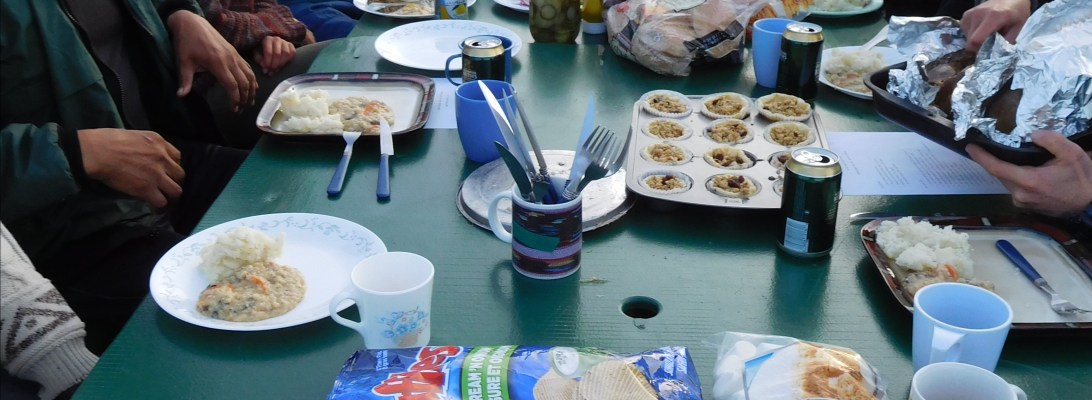
The Scottish Feast – 2017 edition

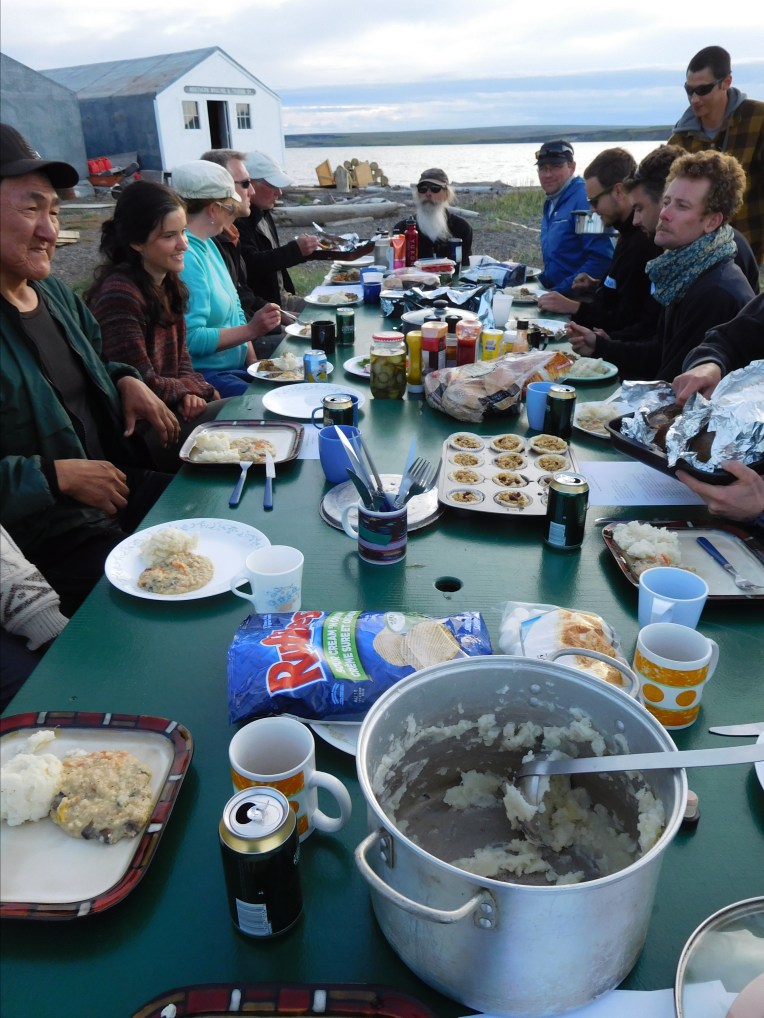
A community of people coming together, a beautiful outdoor setting, delicious food and fun chatter late into the night – all of those and more made for a particularly special Scottish Feast this year! The feast included several island firsts – the first time we had real haggis thanks to the Grabowskis from Whitehorse, the first time the feast was outside thanks to the lovely sunny weather, and some pretty innovative hoola hoop action, when we kicked a ball around whilst hoola hooping!

IMG_6170
Lovely weather allowed us to have the first-ever outdoors Scottish Feast! Not something you’d do in Edinburgh.

Though planned at the last minute and without much time to prepare, the feast definitely did not disappoint, and it’s always impressive how events like this come together – everyone contributes, and then we get to share the festive atmosphere that follows! The feast brought together Team Drone, the AWI crew, Yukon Parks rangers Edward and Ricky, as well as the Yukon Government Heritage Crew – we come from all over Canada and the world, but this summer, we got to share the beauty and weather unpredictability and occasional challenges of Qikiqtaruk together.

DSCN1060
The Qikiqtaruk Scottish Feast 2017 – a table of plenty under the midnight sun.

First came the haggis, and then the speeches! Isla piped in the haggis, which Ricky then cut with the ulu –a traditional Inuvialuit knife. The haggis was a success – for some of us, it was the first time trying haggis, for those of us living in Edinburgh, it was a nice reminder of home. Then came the speeches and recitations by all members of the table. Being allocated a speech to give on the spot was a surprise for those of us that hadn’t been to a Scottish Feast before, but everyone did a great job, and there were many laughs, thanks to jokes, interpretive dancing and poems!

IMG_6175
Isla piping out the haggis to the sound of the tables a capella bagpipes.

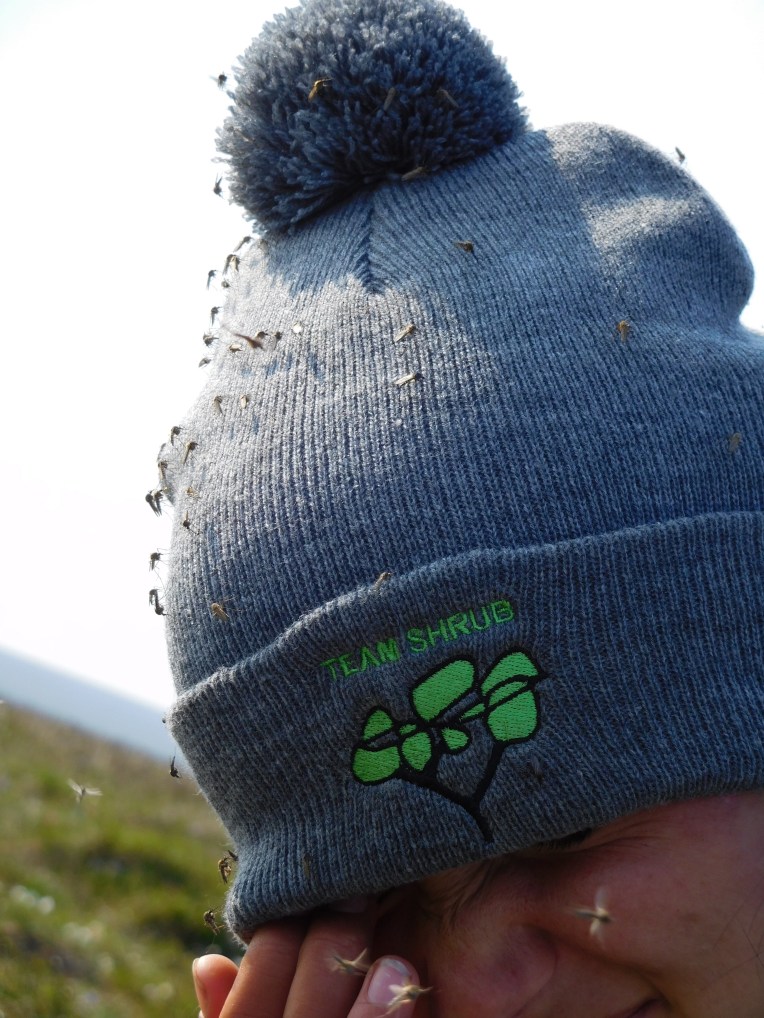
We also gave the rangers this year’s Team Shrub t-shirts, and for the first time ever, the Team Shrub hats or toques – to use the Canadian word for them! This year’s design was mostly generated by code in R – in particular our map illustrating where we all are from, and which field sites we are going to – Qikiqtaruk or Kluane. The front of the t-shirt features “Team Shrub” written in all the languages we speak on the team – English, French, German, Inuvailuktun, Bulgarian, Spanish, Finnish, Danish, etc. Sadly we ran out of time to add Polish, spoken by our most recent addition to the team, Informatics Master’s student Karol! Next t-shirt! The Team Shrub hats are nice and warm, though for next year we might explore hats that have an insect-repellent coating!

DSCN0357
Some say they inspired a nation – the mosquitoes that is not the hats!

We loved hearing about the finds of paleontologist Liz, and we couldn’t resist showing her some of the bones we’ve found – one find was particularly exciting, though we didn’t quite realise it at the time. Isla picked up a bone from what she thoughts was the leg of caribou from Slump D as we were on the run from the epic storm – it was a very big bone fragment, though it didn’t really give off a mammoth vibe, which is what we were hoping to find! Turns out the bone is from a Pleistocene horse, and more interestingly, the bone is, we think, only the second bone found on Qikiqtaruk that was found inland and not on the beach!  It has now been documented and shipped to Whitehorse for radio carbon dating… One day we will find out how old it really is, telling us what animals were living on this island, back at the end of the last ice age perhaps.

DSCN1070
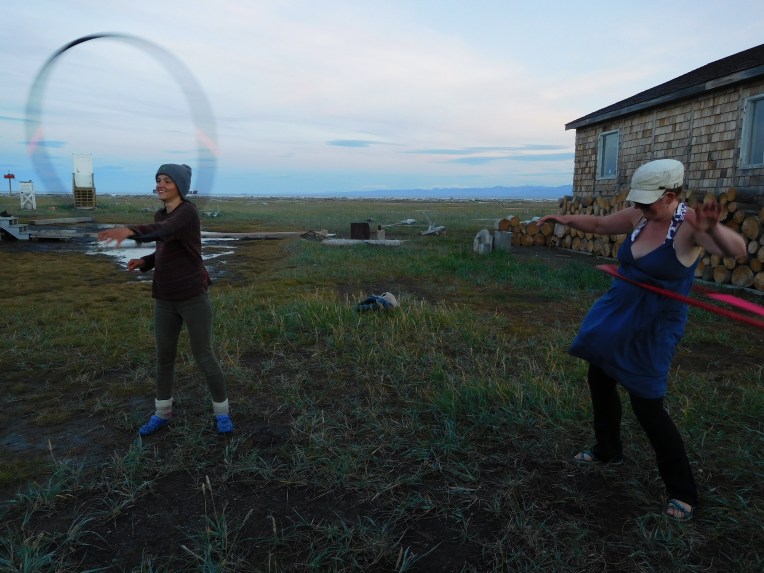
Hoola hooping after the feast

This year’s sporty activity was also inspired by Liz who had made two hoola hoops to bring to the island – most of us had a go at the hoola hoops, and Gergana still has bruises from some enthusiastic knee hoola hooping. We then hung out by the fire, as the sun was first setting and then rising – bathing the island in a beautiful golden light – a lovely evening to spend together in appreciation of our time on Qikiqtaruk!

By Gergana
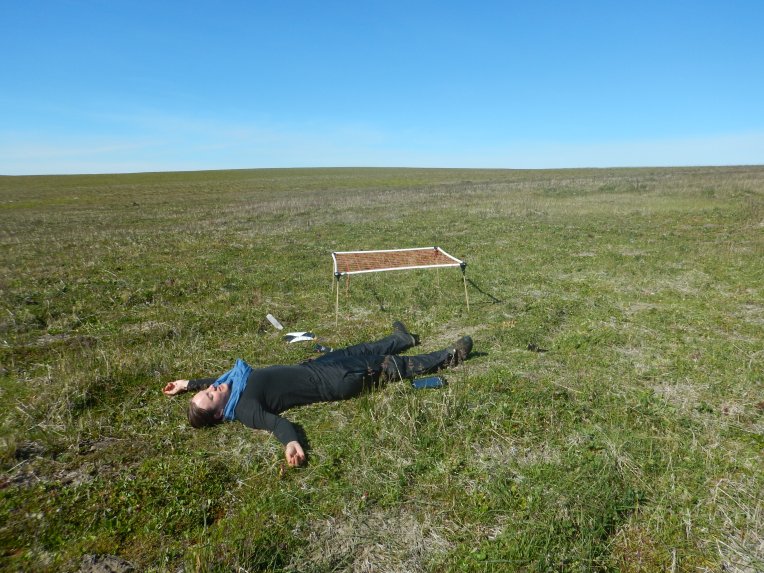
New adventures in birding: Part 2 – Why birding isn’t so bad after all.

I recently wrote – or perhaps you could say vented – about our recent forays into birding. With an additional morning under my belt, I’ve had a bit of time to reflect. Perhaps birds aren’t so bad after all.

  1. Birding is cool.

By cool, I mean cold. Birding is still definitely not trendy cool, but right now I’d happily embrace an icepack wearing socks and sandals. Kluane is melting under a heat wave, and in the full blast of the sun we are getting baked from the lakeside to the alpine. The bird surveys, and the early mornings that come with them, are a welcome relief.

SAB-5246
Birding in the wee hours of the morning means peace and fresh air
  1. Birding is peaceful

Our surveys last 30 minutes at each site. Here in my field assistant role, my responsibility is simply to record any new bird calls we hear. As Matt’s identification skills improve, there is less and less for me to do, and more and more time for me to do what I like best – perfecting the art of the tundra nap. It is incredibly peaceful drifting off to sleep to the rustle of the willows, the distant wash of waves on the lake shore, the buzz of pollinators, the soft tweet of an unknown bird call….oh wait! Damn, where is that recorder!!

  1. Birding is exciting

There is a certain thrill to coming across a new species, or getting that perfect photo you’ve been waiting all morning for. Sometimes the surprises are small – a colourful bird settling in the shrub above your head. But as Cameron found with the hummingbird on Qikiqtaruk, you never know what you may see!

  1. Birding is interesting

For all their skittishness, and the whole moving around thing, things that aren’t plants can sometimes be interesting. Even though I’ve walked up and down the Plateau many times now, seeing the drop off in bird diversity with temperature – in the data and with my own eyes and ears – is neat, and a nice little test of theory.

  1. Birding is beautiful

Once again, no explanation needed.

SAB-0695

By Haydn

Qikiqtaruk Book Club part II: Selection in the Arctic

July, 2017

A variety of different evolutionary strategies promotes species coexistence in the Arctic – there is not one way to handle the short growing seasons and cold. This year we ran a new protocol, part of the ITEX network, which involves surveying the species pool around our community composition plots. We thought the protocol would take us a couple of hours, but little did we know that six hours in we would still be walking in concentric circles around our plots, identifying species after species. We were surprised by how many vascular plant species we found (55 near the plots in the Herschel vegetation type and 66 near the plots in the Komakuk vegetation type) in our two focal ecological communities, and we have been pondering what processes are shaping and maintaining diversity here on Qikiqtaruk ever since.

In “The Theory of Ecological Communities”, Mark Vellend singles out four high-level processes, which shape ecological communities – selection, dispersal, drift, and speciation. The relative importance of each of the four processes varies among biomes – for example, drift might strongly influence communities in tropical areas, whereas environmental filtering, a type of selection, might have a bigger role in cold or arid places where conditions are harsher and resources are limited. Dispersal does have a role on Qikiqtaruk, as for example the grass species Alopecurus alpinus is a recent arrival to our Komakuk monitoring plots between 2004 and 2009, and has been increasing in abundance ever since. Many tundra plants have small seeds and are adapted for long-distance wind or animal dispersal such as the feathery seeds Dryas integrifolia (mountain avens), the fluffy seeds of Eriophorum vaginatum (cottongrass), or the tiny seeds and fluff of willows. Nevertheless, out of the four high-level processes shaping ecological communities, selection seems to be the dominant force here in the Canadian Arctic.

One of the factors discussed by Vellend (2016) influencing community composition is negative frequency-dependent selection.  That is a relative advantage for a species when rare relative to other species, because of inter-specific competition, disease, predation or other biological interactions. On Qikiqtaruk, trait-based negative frequency-dependent selection might be stronger than species-based negative frequency-dependent selection, because of the harsh environmental conditions might favour certain trait combinations. For example, evergreen species with small hardy leaves and large seeds or berries dispersed by animals versus deciduous species with large fleshy leaves and small wind dispersed seeds. We have observed high variance in traits both within and between species. Different evolutionary mechanisms and modes of selection could promote overdispersed tundra plant communities – with trait combinations spread across the phylogenetic tree.

Environmental variability within the growing season further maintains different reproductive strategies. For example, Salix richardsonii (Richardson’s willow) and Salix pulchra (diamond-leaf willow) flower early in the season before they leaf out in spring, whereas Salix arctica (Arctic willow) and Salix glauca (grayleaf willow) flower later, after green up and during the peak of the growing season. Here in the Arctic, selection fluctuates on both short timescales within the growing season and long timescales among seasons and over years. Most of the species are hardy perennials, so if conditions are really unfavourable in one year, they can hold off reproducing until the next, an example of “buffered population dynamics”, as outlined in Mark’s book. Even within the tundra landscape different environmental conditions exist with exposed ridges and snow patches where plant phenology, community composition and plant traits differ. Environmental variability over space and time likely dominate selection processes in the tundra biome.

IMG_5737
Snow patch near Pauline Cove

In our first book club blog post , we told you about the two distinct vegetation communities we study – the Herschel type (dominated by Eriophorum vaginatum tussocks) and the Komakuk type (dominated by grassy species and bare ground patches). With the exception of perhaps little patches of tundra around and about, we haven’t observed an intermediate community state, suggesting that there are positive feedbacks in place, which push communities to either the Herschel or Komakuk vegetation type. But, what are the mechanisms which underpin the maintenance of these two different plant communities, and what selective forces are at play?

HEKO
Herschel (left) and Komakuk (right) plant communities

A highlight of Mark’s book for us have been the summary tables in each chapter on the four high-level processes. We love hypotheses, and the tables summarising the hypotheses linked to selection spurred much discussion in our island book club. We couldn’t help but pick out the ones which we consider to apply most to the Arctic tundra, as well as the ones we have been testing in our work – and make a table of our own.

Table 1. Hypotheses and predictions for selection in plant communities and the links to our work on Qikiqtaruk-Herschel Island.

Hypothesis Prediction Links to the tundra biome and our work References and ongoing work
Constant and spatially variable selection Composition-environment relationship across space


We have been investigating how composition-environment and trait environment relationships shape the tundra biome, the extreme edge of life on planet earth. Elmendorf et al. 2015, Bjorkman et al. in prep., Thomas et al. in prep.
Large variance in traits locally Tundra traits do vary locally both within and between species and as intraspecific trait variation (ITV) is very important for studies at local scales (sites less than 100 km apart). Bjorkman et al. in prep., Thomas et al. in prep.
Change in environment leads to change in species composition A big disturbance event such as active layer detachments might have facilitated the establishment of Komakuk communities, which are then maintained by smaller-scale cryoturbation. Overtime climate change and reduced rates of cryoturbation might be leading to an increase in plant biomass and a change in community composition. Qikiqtaruk Ecological Monitoring Team et al. in prep., Bjorkman et al. in prep., Elmendorf et al. 2015
Positive relationship between species diversity and spatial environmental heterogeneity We are using drones to map microclimate, a metric of environmental heterogeneity, to test this prediction! And this is something that could be explored across tundra sites using future data from the HiLDEN network. See future manuscripts…
Negative frequency-dependent selection Species increase when rare or decrease when dominant at equilibrium We haven’t found support for this per se, as from our observations, in the tundra rare species tend to stay rare, and dominant species tend to maintain their dominance – though some of the dominant species do seem to be becoming a bit more dominant, though this could be under non-equilibrium conditions with increasing growing seasons, changing active layer depth, etc. Qikiqtaruk Ecological Monitoring Team et al. in prep.
Trait overdispersion locally We have observed trait overdispersion in the tundra, as there are many different strategies to survive the cold conditions and very short growing seasons. Thus, trait combinations are represented across tundra plant phylogenies, covering almost the entire extent of global trait variation except along the height/seed size axis. Thomas et al. in prep. and see future outputs of the ArcFunc Working Group
Temporally variable selection Composition-environment relationship across time The long-term environmental monitoring on Qikiqtaruk and elsewhere in the tundra biome are allowing us to study how composition-environment relationships in the tundra change through time. Qikiqtaruk Ecological Monitoring Team et al. in prep., Bjorkman et al. in prep., Elmendorf et al. 2015
Community-level trait environmental relationship across time Out of the species traits we study, height is the only one demonstrating a strong trait-environment relationship over time. Bjorkman et al. in prep.
Positive relationship between species diversity and temporal environmental heterogeneity We suspect this prediction is not valid in our island context, as the floodplain here is the most temporally heterogeneous habitat, yet it is not very diverse. Instead, topographic diversity might be the driver of higher species diversity. No manuscripts planned at the moment, but maybe we should write something about this!
Positive frequency-dependent selection Community dynamics sensitive to initial composition Once the Herschel and Komakuk communities have established, they appear to be maintained across the landscape, thus the initial composition is influencing which, if any, new species colonise. Again, no manuscripts planned, but it could be fun one day to experiment with artificial communities and initial conditions – though tundra plants are quite slow growing and long lived, making these experiments a challenge.
Positive intraspecific feedback via environmental modification In the Herschel communities, the Eriophorum vaginatum tussocks create a specific microclimate, which is favourable for other species. For example, Stellaria longipes is present in both Herschel and Komakuk communities, but appears to do much better in the Herschel vegetation type. Similarly, nitrogen fixers, like Lupinus arcticus, alter the habitat and facilitate the persistence of other nitrogen-loving species. Maybe it is time for a Qikiqtaruk plant biodiversity patterns manuscript?
Multimodal community composition That is definitely the case on Qikiqtaruk, where there are two very different communities – Herschel and Komakuk. See Table 2 for environmental differences between the two communities as proxies for differences in selective pressures. Qikiqtaruk Ecological Monitoring Team et al. in prep.

Table 2. Different environmental factors potentially influencing selection in the two dominant vegetation communities on Qikiqtaruk-Herschel Island.

Komakuk Vegetation Type Herschel Vegetation Type
Deeper active layer Shallower active layers
More cryoturbation Wetter soils
More N fixing lupines More acidic soils
More disturbance-loving grasses (Alopecurus alpinus, Arstagrostis latifolia) More microtopography

So, how do selective forces shape plant composition in the tundra biome and on Qikiqtaruk? Evolutionary adaptation and plastic responses to changing environmental conditions are as strong or stronger here as anywhere else on planet Earth.  It is here in the tundra biome – one of the coldest places on the planet – that the environment and species interactions dominate to determine the species composition that we observe across the landscape.  Probably Hubbell would not have come up with his ‘Neutral Theory’ if he were studying tundra plant communities instead of Barrow Colorado Island in the tropical forest of Panama, but that doesn’t mean that selection is the only force at play shaping tundra plant communities.  To find out more, stay tuned for our next blog post on speciation, dispersal and drift in the tundra.

By Gergana and Isla
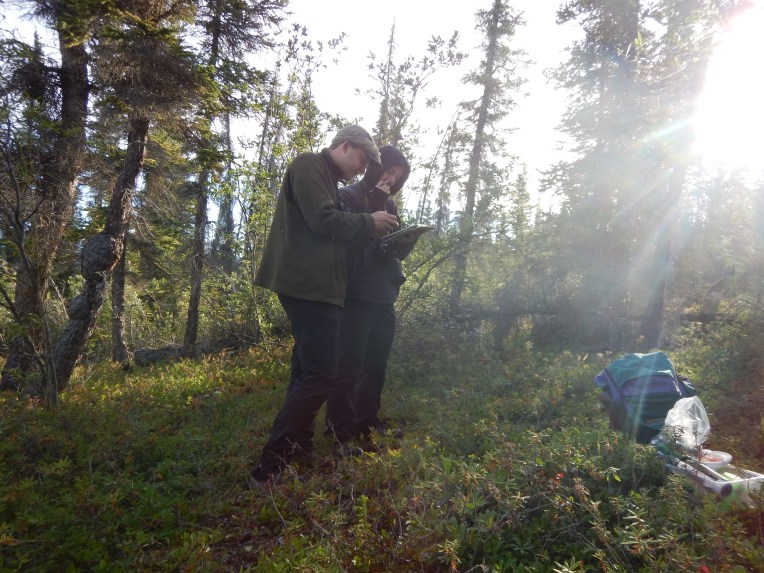
_____________________________________

This blog post was written on Qikiqtaruk-Herschel Island in the Western Canadian Arctic as part of Team Shrub’s island book club, aiming to read and discuss Mark Vellend’s 2016 book “The Theory of Ecological Communities” while we are out in the field, right next to the communities we study.  Team Shrub are a group of plant ecologists who often work in high-latitude tundra ecosystems on topics in community ecology.

The team’s book club discussions are summarised in four blog posts:

The pig, the caribou and the ground squirrel

It’s been a fairly uneventful first week at Kluane Lake, our research site in the south of the Yukon. Despite a major plane delay (but who doesn’t love sitting on the runway in Gatwick for five hours right?) we all made it out exactly to time, Tony Grabowski’s poor Corolla laden down to the ground along the hot and very dusty Alaska Highway.

Photo_1
Loading up the faithful Corolla

This year we are at a new camp – Outpost Camp – a charming cluster of old log cabins that seems to have been built by the Yukon itself. Varnished decking sits beside old ramshackle cabins, roofs still mostly secure, insides mostly abandoned. Rusting signs for root beer hang alongside shining solar panels; tins of paint are stacked beside sleds and moose antlers.

Photo_2.jpg
The charming Outpost Camp

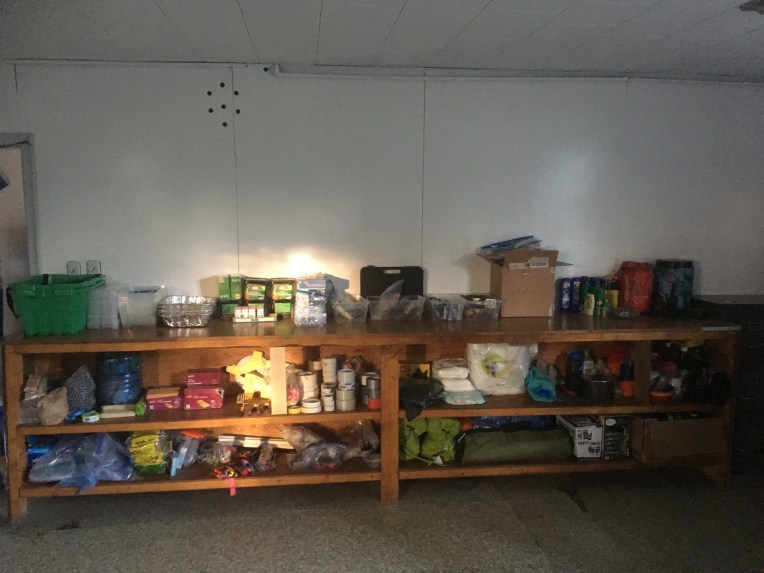
Ground squirrels scampered across the dust and the aspen whispered in the still air as we walked over to unpack into our new lab space. A huge old cabin, rooms spilling over into yet more musty rooms, we had plenty of space to ourselves and before long the shelves were neatly ordered with zip-lock bags and gardening tools, sampling equipment and coin envelopes, bug spray and bear barrels. It looked brilliant. Alas, overnight we were raided. I returned to find the contents scattered across the room, through the whole cabin-complex, and out into the trees. It turns out that ground squirrels have a real taste for teabags, and, it seems, boxes of matches!

Photo_3.jpg
Organisation skills 101

Since then we have been trying to get on top of the science here. Haydn and Izzy are continuing to maintain the common garden experiment down by the lakeside, and are also setting up phenocams and collecting samples up on the Kluane Plateau. Matt is conducting bird surveys up the mountainside, and Cameron is looking at the transition from trees to tundra. The team have also looked at herbivory up the mountain, collected Cassiope samples for genetics work, and tracked a trailside coloniser. The highlight has been hanging out with our resident caribou at the top of the Kluane Plateau, who certainly seems very interested in our science!

At the bottom of the hill things are jolly as ever and we are enjoying spending time with Sian, Lance, and the rest of the comers and goers in this part of the world. We enjoyed a festival of rugby at the weekend, receiving more cuts and bruises from a mighty three-way tournament on the lakeside than anything the mountain has given us so far, followed by a feast of a whole pig spit-roasted over an open fire. It felt a little primal butchering it up on a big plywood table and then attacking with hands, forks, knives, teeth, anything that could get a hold.

As for now, the sun is up and the heat of the day is setting in. The dust from the Slims River is rising, and the whirr of the propellers is starting up across at the runway. The ground squirrels are still scampering and the aspens still whispering, and my radio is buzzing to tell me to get back to work. Better not keep those willows waiting.

Beautiful morning

Haydn & Team Kluane

Tangled up in plots

“Help!  I am tangled up in the plot!”  Said Isla as we were hiking our way out to Collinson Head to start the most exciting part of our field work data collection all summer – the point framing of the long-term monitoring plots. That entanglement – from which Isla was soon rescued – was the inspiration behind the title of this blog post.

DSCN5061
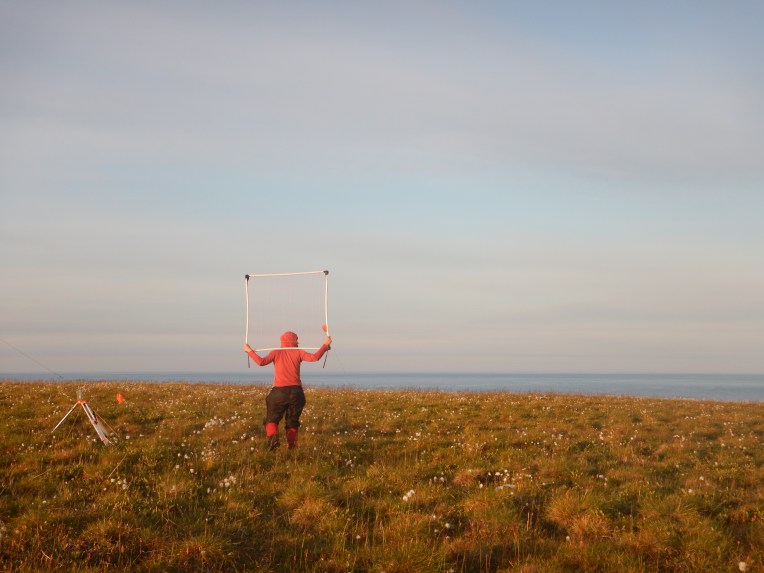
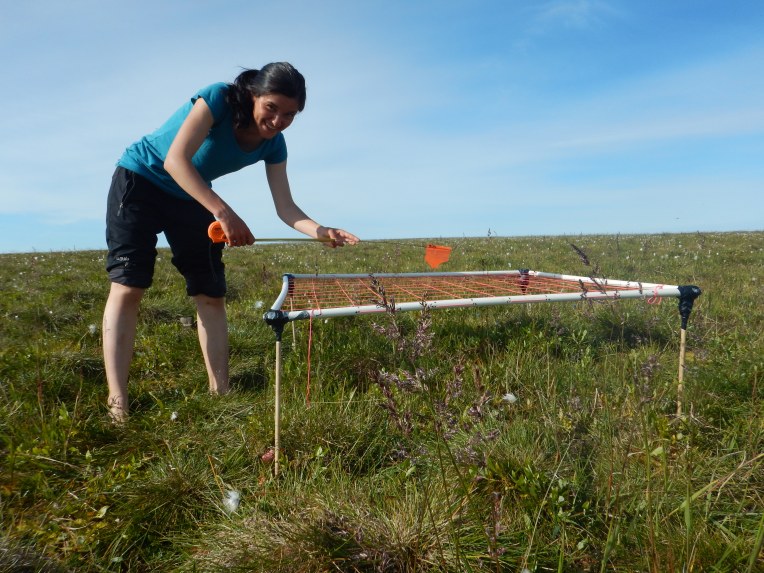
The long-term point framing protocol on Qikiqtaruk allows us to track changes in community composition over time

It was a long stretch of hot days, almost as hot as the hottest day of the year, when, amidst the buzzing of mosquitos and boat noises, dramatic words echoed through the tundra – hour after hour, one could overhear: “Three live, two standing dead”, “Salpul, seven point four”, “Wait, how many were dead?”, “Four dead.” The soundscape of point framing!

We have been going back to the same 1 x 1m plots on Qikiqtaruk for six years now – half of the plots are in the Herschel vegetation type, and the other half in the Komakuk vegetation type. The communities there are very different, as we previously pondered in our first book club blog post after we started reading Mark Vellend’s “The Theory of Ecological Communities”. We have kept up reading the book in between fieldwork this summer, and point framing in particular has been a thought-provoking companion to our reading. We will be posting our second book club post soon, but until then, grab an imaginary pin flag, and picture yourself in the tundra landscape as we share with you our impressions from the 2017 point framing season.

  • Interestingly, we recorded 32 species in both the Herschel and Komakuk plots. Even though observed species richness is the same, the identity of the species and their frequency in the two vegetation types are very different.
  • The Herschel vegetation type, where one can often find patches of moss in between the cottongrass tussocks, is much more pleasant for barefoot walking than the Komakuk vegetation type, where there is an abundance of spikey dead flower stalks of grass species! The mosquitos had scared us off from kicking our shoes off at first, but the heat finally convinced us to throw our cares and socks to the wind.

    DSCN5045
    Gergana enjoying the refreshing feel of mosses on her feet.
  • We are very thankful for iPads and the Numbers app! We collected over 4200 rows of data, entered straight into the iPad, which means we don’t have to spend weeks digitising it from fieldbooks! We can now load our data right into R and analyse it when we get back from a day in the field. For anyone reading this post who hasn’t yet switched over to digital data collection – make the switch now, it will change your life!
  • We looked over the data from previous years and checked out what interesting things were “hit” with the pin flag – a spider, some caribou poo, little pools of standing water and more. No wildlife touched our pin flag this year, but there were still plenty moments of excitement. For example, amidst walking between the plots, I spotted the biggest Salix arctica leaf I’ve ever seen, measuring at 11.4 cm! There were beautiful patterns of moss and Peltigera lichen patches, which inspired us further – point framing is very repetitive, so anything to break the sequence of dead and live Eriophorum leaves is exciting!
  • We also conducted a new protocol – the International Tundra Experiment species pool protocol, which I was most excited about. Point framing is great, and it’s even better when you combine it with a survey of what plant species are present in the area around the plot! We walked in bigger and bigger concentric circles, starting from the center point of our plots, till we reached a radius of 100m, which is pretty far when you are walking in circles to get there! Then we recorded each new species, the distance at which it was found, as well as its vegetative and reproductive height. This is the best kind of treasure hunt – biodiversity monitoring! We have been dreaming of species-accumulation curves ever since, and once our data and graphs make it off the island, we shall be sharing those with all of you!

    DSCN5026
    Isla taking a tundra nap in between two sets of point framing.
  • We were surprised to find so many different plant species – within a 100m radius of the plots, we identified 66 species for Komakuk, and 55 species for the Herschel vegetation type – currently only 32 of them are present in the plots, and we can’t wait to see if and how selection, dispersal and drift change the plant composition in the future.  New species could disperse into the plots or species might disappear by random chance or because they are out competed by other faster growing plants! Community ecology is so exciting!!!

In summary, for four days, our lives were indeed tangled up in plots, but what a great tangle to be in! We will be sharing graphs and more thoughts on community ecology in the Arctic in our next book club blog posts, so stay tuned.

By Gergana
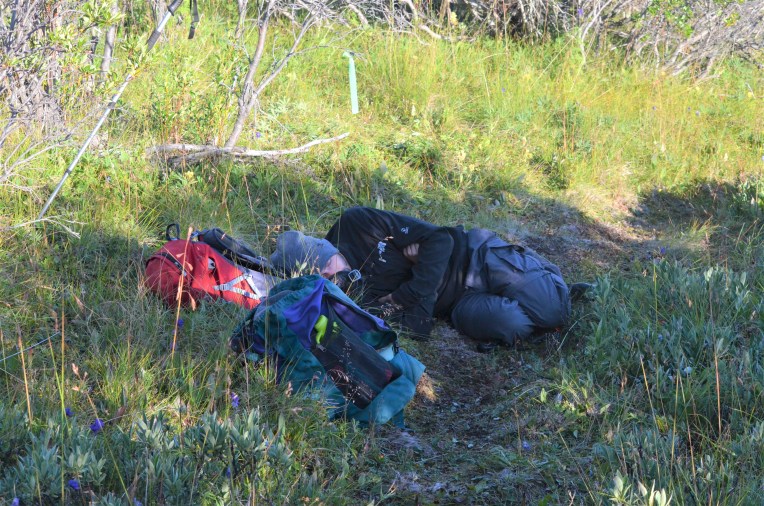
New adventures in birding: Part 1 – Why shrubs are better than birds.

This year we have been conducting bird surveys on the Kluane Plateau, the flat patch of tundra jutting above our field base on Kluane Lake. It’s the first time I have been involved in bird-based fieldwork. Trudging up the mountain earlier even than the sun does, I’ve had time to realise why I joined Team Shrub, and not Team Sparrow.

  1. Shrubs are stationary

Shrubs are always there. They’re reliable little fellows, sitting quite peacefully on their little patch of soil. You can go up to a shrub, pat it on the head, give it a little hug… whatever floats your boat. Shrubs don’t care. You can come back the next day, the next day, the day after that, hey we come back year on year! Our favourite shrubs are still sticking around, stoically soaking up the sun and the storms and the deep snows of winter. Choose a shrub – they’re always there for you.

Birds are flighty little things. You never know where you are with birds: swooping up the mountainside without a care in the world, no regard at all for scientific process. One day you’ll be beset by bird calls – your recorder runs out of memory and your camera runs out of batteries. The next day you just sit in silence for half an hour. Unreliable, inconsistent, fickle: the life of a birder.

Birding
Up the mountain bright and early to chase the birds
  1. Shrubs are obvious

Shrubs stand out. They hold up their branches to the skies as if to hail their own existence. They rambunctiously rustle their leaves and provocatively shimmy in the breeze. They’re grandiose, with the gravitas of a tree but with grace of a gazelle, pointedly yet politely waiting for your arrival on the tundra with all the proper respect that a plant, and only a plant can show.

Birds are downright antisocial. They’re the conversation that stops when you walk into a room. They’re the cool kids that drift off when you join the party. Birds wait to catch you unawares before bursting forth in a cacophony of absurd twittering, knowingly timing their chorus for the moment your recorder times out. Giggling childishly, they watch on as your sleepy fingers fumble with record button and camera lens. As soon as you’re ready, planned and instantaneous, the din shall stop and off the birds shall fly in gleeful silence, disappearing to their hiding places under the obvious shrubs.

  1. Shrubs are straightforward

Shrubs are the solid, down-to-earth types you want fixing your car. Shrubs call a spade a spade, even if they’re not always the spade’s biggest fan. You don’t even have to ask a shrub its name – they stand around wearing nametags, offering up their identity as a simple introduction. Although there are some characters out there who like a little mystery, some pretence (and even some cross-dressing), they are more than happy for you to take their business card away with you, with a few extra leaves thrown in, just to check up on them in the morning. Pleasant and simple, shrubs do what they say on the tin.

Birds are dirty tricksters. They dress up in different colours, and put on different clothes. The teenagers, as teenagers do, wear strange and often drab outfits, and the children sometimes don’t go out at all. Half the time half the birds seem too busy trying to impress the other half, and the other half the time they’re still not interested in your science experiment. As for singing, birds would do well to learn their tunes and stick to them. I simply can’t stand improvisation. It seems that birds just cannot appreciate that the more they fool around the longer we will be pouring over identification books and churning through endless lists of their pointless calls. Birds should pull themselves together.

Matt working
Entering bird survey data
  1. Shrubs are restful

Shrubs know the meaning of a full night’s sleep. They’ve read the health books. They’ve ditched the coffee. They know the agony of the new parent, the red-eyed commuter, the burnt-out scientist after a long day of fieldwork. Shrubs need no watches, and have no alarm clock. Shrubs work on your schedule, meet your deadlines, put up with your missed appointments. Shrubs wait for you.

Sleeping willow
Shrubs will watch over your sleep and wait for you to gently wake up. Birds? Not so much.

They say the early bird catches the worm. Well, birds must bloody love worms. Up, often before the sun, and letting the world know about it. If you’re not up for their 6am meeting, sweaty and blurred, dusty and aching, bruised and bleeding, then too bad for you. Birds are ravers, Glastonbury stop-outs worshipping the dawn before crashing into a stubborn stupor for the rest of the day. Birds are the boss from hell and the teenage dirtbag, all rolled into one.

  1. Shrubs are beautiful.

I need no explanation here. Just look at this beautiful willow in the sun. Birds got nothing on that.

SAB-0710
Strong, steady, and really quite lovely: so many reasons we love shrubs!

And you know what they say. You can’t polish a Turdus.

By Haydn

Changes on Qikiqtaruk: Perspectives from Ranger Ricky Joe

Ricky Joe is a park ranger on Qikiqtaruk – Herschel Island from Aklavik, NWT.  Here he shares his perspectives on life in the Arctic, working on the land, and the changes he has observed on Qikiqtaruk.

The first time I came to Qikiqtaruk I was 17 or 18. I was travelling and hunting. Back then, there was no park established yet (1978) – there was a lot a char and herring, and people came here for sealing as well. The Mackenzie family were living on Qikiqtaruk. Their children were born and raised here. Most often I came here alone, but I wasn’t scared. You really have to watch it when travelling alone, but when I was younger, I made sure to be there to learn from my dad and uncles, to always follow them and help. I got the basics from them, and then I took it another step further and tried to improve.

DSCN4928
Schooners from Banks Island and MacKenzie Delta at Pauline Cove, 1930 (Finnie Coll. YA)

There is no sense of time when you are travelling around here – you need a lot of patience. You need to know where and when to stop, when it’s safe to move on. Now everybody is always in a hurry, people travel to places quickly, but don’t get to fully experience them. There are journeys that used to take us days when I was little, and today we can travel to those places in hours. But you still have to remember to really experience the place, to stop and take it all in. My family and I, we just love travelling. It’s hard to say what we love about it – everything. The openness. We have all been travelling since we were very little. I was always with my grandmother and her dog team, helping her, hauling ice for fresh water and hunting.

DSCN4946 2.jpg
Hunter and dog team going over ice to ships (The Mariner’s Museum, Newport News, Virginia)

It’s important to have a connection between the generations. To show children the land, teach them how to travel, how to deal with the weather, teach them the language. My grandparents originally came from Alaska. I used to speak Uummarmiut with my grandmother, but we are losing our language and I kick myself for forgetting words. Now teachers are supporting children going out to the land, there are language classes and drum dance groups. My grandchildren are probably better than me in my language. Culture, dances and stories are coming back to schools, to people’s lives as well.

DSCN4930.jpg
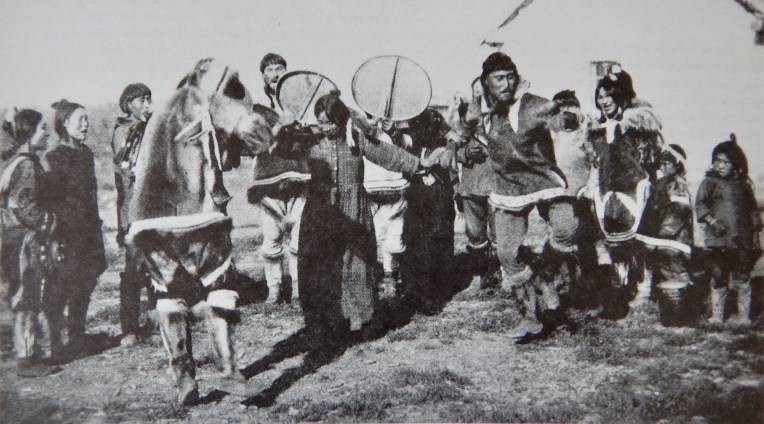
Inuvaluit drum dance at Fort McPherson, 1892 (NAC, E. Taylor C-7519)

When we’re not travelling, a lot of times we’ll get together, have supper and just tell stories. Everybody would chip in and we’ll all share stories – that’s how we learned about our culture and land. We try to make everything from the land. We share stories about where you see certain animals, how to survive here and be safe. Some people like to keep information to themselves, but I like to share. I know how to travel in the delta and mountains in all seasons, and when I am available, people call me when they need help to find lost people. Everybody knows each other in our community, and we always try to help one another.

DSCN4955.jpg
Crossing the tundra on Qikiqtaruk – Herschel Island

I’ve always chosen jobs that are out on the land – animal surveys for beluga whales and grizzly bears, wildlife and environment monitoring, being a guide. I’ve also travelled to teach – I loved travelling to different communities, learning about their livelihoods, and teaching them the basics for how to work with tourists – we were learning off each other and sharing. When I first heard about the park ranger job, I knew I wanted it. I started working as a ranger in 1999, and I really enjoy working out here on Qikiqtaruk Herschel Island Territorial Park. All my previous skills – how to read weather, travel safely, monitor animals, interact with tourists – are useful for the job. I just love being here, and meeting different people – tourists and researchers, that’s my favourite part. Learning different things and increasing my knowledge, too. It’s so peaceful here, but it can also be hard – leaving your family for two weeks or more at a time.

DSCN0765.jpg
“It’s so peaceful here”

I enjoy meeting people, talking to people. The people that come here are most interested in our lives, what we do, where we are from, the animals they can see here and our stories. We tell them about our work here – for example, the Qikiqtaruk Ecological Monitoring Programme. We do bird surveys, we monitor permafrost depth and changes in plant phenology – the timing of when plants leaf out, flower and disperse their seeds. The raptor survey takes us on a good long trip around the island – all the parts of the island are different in their own, especially the exposed north-west side, which takes a beating from the weather. From the surveys we’ve learned that the raptors are building their nests along the coast, but the nests are collapsing into the ocean. It must affect their populations down the road, and it also throws away the balance between species. There are cycles in the populations of voles and lemmings, some years we see more, others less. We haven’t seen a snowy owl on the island yet this year.

IMG_5416 (1).jpg
Monitoring birds of prey

People are concerned that Qikiqtaruk is changing. It’s very different to what I saw when I first came here when I was 18. When we go home, we tell people about the changes we’ve seen on Qikiqtaruk over the years, about climate change. There is pollution from rubbish washing on the shore. There are different animals and wildlife coming – things we never saw before, like the hummingbird Cameron saw. There are different seabirds, eagles. I’ve seen otter tracks around the island, a moose and a beaver – those were never here before. Everything is changing – more extreme weather, higher waters, bigger winds. Some years, people at Shingle Point can’t hunt and support their livelihoods because it’s too windy. The changes are impacting people’s lives. Our collaboration with researchers helps us learn more about those changes – people in our communities appreciate seeing the products of the research, the reports, but also getting the chance to meet the researchers in person and ask questions. We learn from one another, and sharing our knowledge is important. But how to fix climate change is another thing, it takes the whole world to fix those problems, not just the researchers and communities of the Yukon North Slope.

DSCN4394
Rangers Ed McLeod (second left) and Ricky Joe (right) with Team Shrub, Canada Day 2017

By Ricky Joe, Qikiqtaruk – Herschel Island Territorial Park Ranger

_______________________

You can read another guest blog post by Yukon Parks Ranger Edward McLeod here – Qikiqtaruk perspectives by ranger Edward McLeod.

The Power of Stories

“I feel like we could be sharing stories for hours” said Qikiqtaruk – Herschel Island Park ranger Ricky to me one evening after we had chatted about our homes and cultures out on the rangers’ porch. I walked back to Signal’s House with a smile on my face, hoping that we would continue the conversation. Time has passed since that evening, we have shared more stories, and on a rainy day like today, it feels like just the time to tell you one more – a story about stories.

I grew up in a place where every patch of land, every object and every dent in the house walls has a story behind it. Some of them I was fortunate to hear from my grandparents, others I could only imagine. Back home, everybody talks about villages like mine, Tyurkmen, in past tense – stories full of nostalgia about everything villages used to be and everything they are not anymore. Such stories could easily wrap you up in the past, cast a shadow over your attitude towards the present – many villages are now abandoned, traditions are lost, stories are forgotten. Some say villages will never again be the rich cultural centre they once were.  Even if we hear about old traditions, we don’t always engage with them.

There are still, however, days when people take out their old traditional clothes, full of colours and intricate embroidery, and gather to dance together to the rhythms of bagpipes, accordions, drums and flutes. My favourite part comes later in the celebrations when we share stories late into the night – some we hear every time, others are new. I love them all. Listening to them, sharing them, writing them down. I think that the best kind of stories need little embellishment from the truth, for there are so many incredible places, people and events all of them worthy of being remembered. Of course, I love to read great works of fiction, but for me those cannot quite compare to the power and privilege of hearing a story first hand from people who hold those stories dear to their heart.

Here on Qikiqtaruk, stories are a constant part of our daily routine: stories of past adventures of the field team: “Did I ever tell you about the time that the bowhead whale came into Pauline Cove… or when the radio got lost out on the tundra and we tried to use the drone to find it…”. Stories about the past and present life on the island from the rangers. Stories about the findings of our research. Fieldwork and stories tend to go hand in hand – funny stories liven up those moments when no field plan seems to work, and evenings after a day’s work can quickly go from quiet to lively chatter. Stories are how we communicate both our daily lives and our science.

Scottish_feast
Sharing stories and a meal on Qikiqtaruk

From one end of the world to the other, stories about how the world around us is changing and about the connection between people and land make me feel at home. Some of those stories have been scientific stories: a clear structure, many numbers and frequent reminders of why those numbers are important. Scientific stories take many shapes – journal articles, reports, presentations, computer code, blog posts and more. Just like a good story, a good scientific paper takes you on a journey through what we know, what we don’t know, and what it all might mean. Sure, there might be more graphs and less pictures than your usual story, but as a whole, scientists are professional tellers of very precise and accurate stories about how the world around us is changing and what that might mean for people and places.

IMG_5297

Villages like mine, Tyurkmen, are changing, and so are communities all around the world. Ecosystems are changing, too. A story that is happening right now out from the Arctic tundra of Canada to the abandoned agricultural lands of Eastern Europe. Perhaps it is in sharing our stories of the past and present, be it through numbers, pictures or words, that we can better understand processes of change around the world and what they will mean for all of us now and in the future. As the day is coming to a close here on Qikiqtaruk, I feel happy and privileged to hear stories about the island’s heritage and to be able to collect information on how Qikiqtaruk’s environment is changing – a new story in the making.

By Gergana Daskalova