Holiday Reading List

If your holiday is like mine, it is a chance to catch up on all the things that passed you by in the rest of 2017. Then, perhaps you will enjoy a few of the articles that I have been reading or re-visiting over the past couple of days. While explaining to my visiting family why I do the research I do, I have been drawing connections between past and current collaborators, the activities of Team Shrub over the last year and thinking ahead to future research possibilities.

The holidays for me is a time to sit in front of the Christmas tree and catch up on some reading, be it journal articles, all of the manuscripts I have been remiss on commenting on over the past few weeks or blog posts and magazine articles on topics close to my heart.

At the December ArcticNet meeting a couple weeks back, I had the chance to catch up with folks from the Canadian Museum of Nature and to ask after the world’s premier willow taxonomist George Argus. This reminded me of my visit with George during my PhD, when I spent a wintery day with him in at his farmhouse near Ottawa going through willow samples from my PhD field sites confirming my willow ID skills and hearing stories about Alaska back in the day.  Thinking about George got me thinking about my former officemate during my MSc at the University of Alaska Fairbanks Les Viereck and my former neighbour Ginny Wood.

Ginny told me in person of the incredible tale of the first assent of Denali’s South Buttress, then known as Mt. McKinley, the tallest mountain in North America. George Argus, Les Viereck, Morton Wood, Elton Thayer made the climb with Ginny flying the food resupplies in the spring of 1954. On the expedition, the very same George Argus that I met during my PhD, was left in a tent for over a week with injuries after tragedy struck high the team up on the mountain. The following article from back in 2002, gives a riveting account of the tale which is well worth checking out if you have never heard the story before. These science and conservation heroes of mine, make my own adventuring seem very tame. But I feel privileged to have got to know Ginny, Les and George during my MSc and PhD, and they remain a source of inspiration to this day.

Remembering Denali’s Greatest Rescue

H1DO_Thayer___Argus_in_tent
George Argus sticking his head out of his tent when stuck on Denali back in 1954.

Ginny would be appalled by the current political situation in the US.  She used to discuss with me the hubris of previous administrations – a word I will always associate with her. I can’t think what she would say now.  Ginny was a great proponent of wilderness preservation in Alaska and was the co-founder of the Alaska Conservation Society.  She was a key supporter of the establishment of the Arctic National Wildlife Refuge (ANWR) in 1960 when she lobbied U.S. President Dwight D. Eisenhower to establish the reserve.

This beautiful article by Christopher Solomon from November in the New York Times makes the recent passing of the tax bill and the opening of ANWR to development this month all the more poignant. This vast tundra region adjacent to the Yukon North Slope where Team Shrub has been working for several years is a fragile wilderness that is currently exposed to potentially dramatic impacts from climate change. ANWR truly merits protection from development and it makes saddens me deeply to see that protection lost.

la-mn-na-0823-ladies-jpg-20130312
Ginny Wood and Celia Hunter being recognized for their contributions to Alaskan conservation in 2001.

Reflecting on the North Slope of Alaska, makes me remember that it is also a place where my car was once broken into while I was on a five-day hike in the foothills of the Brooks Range. Some of my stuff was stolen including my back pack with a few telephone numbers in it, including Ginny’s number and that of one of my MSc supervisor. When a fisherman found the backpack floating down the Sagavanirktok River, he assumed the worst, but luckily I had just arrived back to Fairbanks and could let everyone know I was okay. It was also a bit of a challenge to make an insurance claim, as the car was broken into in the jurisdiction of Barrow Alaska even though Barrow was over 500 kms away with no connecting roads. There was a lot of confusion on the other end of the line when I tried to call in the break in. That car, Dr. J, met it’s end in a scrap heap this very year in 2017, after serving me loyally for over a decade and it is a vehicle I will greatly miss. Oh, the adventures that two-door Hyundai Accent without power steering and I had!

My travels to the North Slope of Alaska with my trusty car Dr. J back in the early 2000s when I was an MSc student at the University of Alaska Fairbanks.

Thinking about future development on the North Slope of Alaska, makes one consider the current rapid development in other regions of the Arctic.  This evocative article that appeared in the October issue of National Geographic follows the Nenets reindeer herders on their annual 800 km migration across the Yamal peninsula through the development of the Russian oil fields. I guess I knew about the article when it first came out, but I didn’t get a chance to read it properly until this holiday. The article features a colleague of Team Shrub, Bruce Forbes, who has been studying and working with the Nenets people for decades to understand their resilience in the face of change.

They Migrate 800 Miles a Year. Now It’s Getting Tougher.

One of the team, Jeff Kerby had a chance to visit Yamal this past summer funded by a National Geographic Explorer grant.  In this blog post, he recounts his time in Yamal during an unexpected heat wave working to set up exclosures to understand the impacts of herbivory and collecting drone imagery as a part of the 2017 data collection for the High Latitude Drone Ecology Network that Jeff and I have been coordinating. Fieldwork in Yamal seems much more challenging that our work in Northern Canada with soaring temperatures and thick clouds of mosquitoes, but the imagery that Jeff has put together is striking. Aerial shots of reindeer herds crossing the tundra looking like ants from above and fog flowing like a river past shrubby tundra. I wonder what secrets hi-tech drones will indeed reveal.

Indigenous Cultures and Hi-Tech Drones Reveal Secrets of Siberia

And if you haven’t seen it already, you should totally check out Jeff’s other Nat Geo contribution this year when his photography and story were featured in the April issue of the magazine. This time it is the Gelada monkeys of the Ethiopian highlands that Jeff highlights with stunning photographs and a compelling scientific story.

Where the World’s Only Grass-Eating Monkeys Thrive

On the Nat Geo theme, I wanted to give a shout out to this story about the “Trees of the Tundra” featuring Steve Mamet about treeline research in Churchill, Manitoba on the coast of Hudson’s Bay. In his quote, Steve highlights the importance of data collection in tundra ecosystems to fill in the gaps where sophisticated computers models make assumptions. Filling in the gaps is one of the main motivators of Team Shrub’s research as well.

Trees in the Tundra

Beavers, Canada’s iconic national animal, have also recently featured in the New York Times. In this December article, the Beaver is highlighted as an agent of change in the tundra in an article covering the research of Team Shrub collaborator Ken Tape. I first remember seeing tundra Beavers in Denali National Park during my time in Alaska. The Beaver is relatively at home in a treeless tundra as long as there are tall shrubs to chew on, so to is the Moose and other creatures more normally associated with habitats south of treeline. As they move into tundra ecosystems they may alter those landscapes in relatively permanent ways such as enhancing permafrost thaw as the New York Times article highlights.

And while we are on the theme of treelines, tundra and climate change, Steve, Jeff, Ken, myself and Team Shrub’s other collaborators Trevor Lantz, Rob Fraser and Carissa Brown are all featured in this online piece by Kate Allen in the Toronto Star on the impact of climate change on species distributions in the Arctic and beyond. Whether it is shrubs, trees or butterflies, climate change could be redrawing the map of where species live and thrive.

The Great Global Species Shakeup

Orca_floodplain_02_desktop
“Matched up photos of Qikiqtaruk-Herschel Island Territorial Park in the Yukon to visualize changes to vegetation, permafrost and coastal erosion” – from the Toronto Star

If you want to read a bit more about Team Shrub’s media coverage this year check out Jakob’s excellent interview with Camellia Williams in September about our drone research:

Capturing change in the Arctic

Or have a read of Haydn’s interview with Lesley Evans Ogden about the Tea Bag Index – using the humble tea bag to quantify controls on litter decomposition across the tundra biome.

Brewing Big Data: The Tea-Bag Index

tea bags

And, if you want to see some of the changes we saw first-hand in the Arctic this summer, check out the CBC coverage:

Researchers stunned by rapid rate of erosion on Herschel Island

DSCN5018
Coastal erosion near Pauline Cove this summer. Check out http://www.cbc.ca/news/canada/north/yukon-herschel-island-erosion-1.4253948 for the CBC article about it!

Finally, if you want to ponder how art and science can be brought together and how tundra shrubs can act as time machines to help us understand past vegetation change, check out our blog post about Team Shrub’s contributions to the Edinburgh Science Festival:

Team Shrub at the Edinburgh Science Festival

So, that is a wrap up of some of Team Shrub’s media coverage in 2017 and a taster of what I have been reading and thinking about this holiday break. Thinking back on colleagues of the past and current collaborations makes me wonder what 2018 has in store. The Arctic is likely to continue to experience rapid change, and hopefully Team Shrub will be there collecting and analysing to help fill in some of the key gaps in our understanding of tundra vegetation change. And maybe this time next year, we can update you further on some stories of Arctic change.

By Isla
One day, 12 795 words: The Team Shrub Writing Retreat

12 795 words in one day! That is a dissertation right there pretty much. And members of Team Shrub wrote those words over a mere four hours of structured writing time. How did we do it? To find out more read on…

We have long loved the idea of a writing retreat – setting aside time to just write. No distractions, no emails, even no coding, just pure writing. It always feels hard to focus just on writing – little urgent tasks creep in and next thing you know, the day is over and that Word document is still blank. Writing retreats are a fun combination of peer pressure and peer support. Nothing like the sound of many people writing to make you realise that you really should be writing, too! We all have things we could be writing right now – a manuscript, an assignment, a thesis chapter, a blog post (a great distraction from what I really should be writing right now, but hey, this is still writing…). It’s great when we have a special occasion when all those things do get written – the Team Shrub writing retreat!

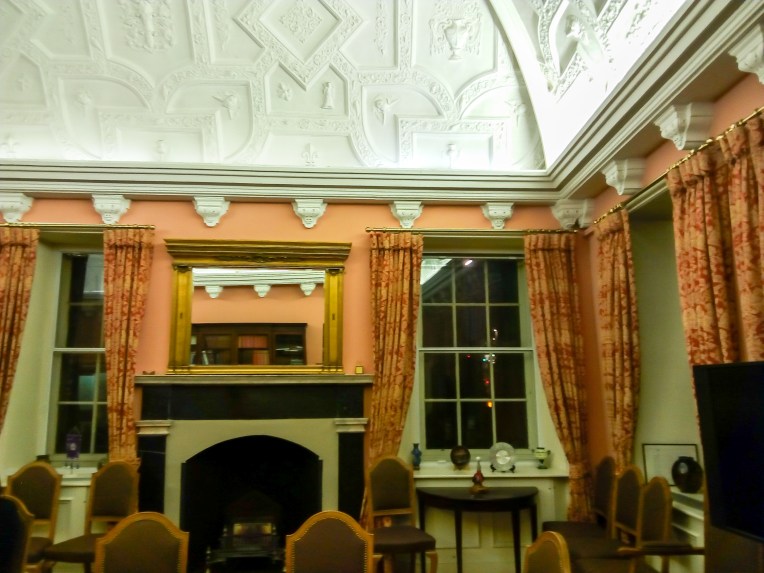
In November, Isla organised a writing retreat, right here in Edinburgh, so a convenient location for all of us. It was quite the fancy setting, with a particularly inspirational ceiling in our writing room!

IMG_20171117_171623
The fancy setting of our writing retreat!

We started off the morning by laying out what we would like to achieve during the day and in the specific one hour writing sessions ahead of us. We shared our writing goals, Isla told us a bit about how writing retreats work, and with an alarm set off to ring in an hour’s time, we began writing! The break between the writing sessions gave us the chance to refuel with tea and coffee and chat about how our writing is going. And then another one hour of solid writing followed.

Next, we moved onto a delicious lunch in a nearby cafe, followed by a casual work session with even more delicious lattes, flat whites, mochas and such! Our cafe visit gave us the chance to chat about our writing projects, how they are progressing, and ponder over any questions we might have. We liked the combination of the more strict writing sessions in the writing room with the casual cafe session – the best of both worlds!

We also pondered what kind of writers we are and what our strategies for success at the writing retreat were. Do you edit as you write? Do you write everything that comes to mind and edit later? These questions, and many more, are covered in Stephen Heard’s great book “The Scientists’s Guide to Writing”. I particularly like the chapter on writing behaviour. I over-analyse to a fault, so if I give in to the temptation to really discuss or write about writing behaviour and writing strategies, I’d never write anything else! I may or may not be wondering whether there is a test online about writing personalities, but alas, I shall be strong and focus on this.

We wrapped our writing retreat feeling very accomplished. So how did we do it? Here are a few of the elements that came together to bring our writing successes, though of course, everyone is different and everyone writes in a different way.

  1. Make the time. Most of us could have been doing different things that Friday, some of which important, but with writing, often one really has to make the time to make it happen, which sometimes involves some tough decisions and prioritising writing over all the other tasks on our to do lists.
  2. Set specific goals. It’s hard to asses progress if you are not quite sure what you are aiming for, so being specific always helps. How many words would you like to write, or are there particular sections of your writing project that you would like to finish before the day wraps up?
  3. Share your goals. Here comes the peer pressure and support again. Sharing your goals makes them more real, which can motivate you to really achieve them, and knowing that someone else is watching and knows what you are meant to achieve, can provide a dose of healthy pressure to write.
  4. Track progress and adjust your goals as you go. At our writing retreat, we had one hour writing sessions, followed by a break where we could reflect on how we are progressing with our goals. Things don’t always go to plan, some things are easier, others harder than anticipated, and that doesn’t mean you’ve failed. On the contrary, being able to accurately asses your progress and adjust your goals is a great skill to hone.
  5. Just write. We had a few rules for our writing retreat, which I think helped us all focus more on just writing. We had to do our reading and note taking in advance, so that during the writing retreat, we focused on just writing.
  6. No internet, no phones. Sometimes writing retreats are purposefully in places with no internet, so that you don’t get stuck answering emails and constantly having to restart your writing process. In our case, we were right in Edinburgh, so the internet was there, so it was up to us to decide whether or not we turn it off. But the peer pressure was there to not check one’s phones during the writing blocks.
  7. Save, back up. Make sure you save often and that your work is backed up – it would be a shame for all that writing to go to waste! Isla had a complete computer melt down in one writing session with her reference software, but she managed to get things back on track and rewrite that paragraph that got deleted!
  8. Reward yourself. Writing retreats are intense and it’s always nice to have a little reward at the end. The satisfaction of having done something you’ve been postponing for ages, a nice hot drink, a delicious meal with the jolly company of your lab mates.
  9. Follow up on your writing projects. Especially if you are the kind of writer that leaves a lot highlighted text saying things like “insert reference, add link, double-check this is true”. Setting aside a full day or more to pure writing is great and it can be really efficient, but it’s also important to remember your writing projects and to try making the time to work on them in between all our other daily tasks.

We all thought the writing retreat was great, we wrote a lot, and we’ve said we should have writing retreats more often, so here’s to a happy and productive 2018 and more writing!

By Gergana

Secrets, rumours and facts from two parallel conferences

From secrets through rumours to facts – science in a nutshell!

conference_map
Team Shrub heading to two big conferences!

Our team recently attended two big conferences – Ecology Across Borders (check out our highlights so far) and ArcticNet (you can read our round-ups of day 1day 2, day 3 and days 4 and 5). Thousands of scientists coming together to share their findings and ponder new directions. Despite the ocean between us, it still feels like we are going through the conferences together – the magic of emails, blog posts and twitter! Sometimes it helps with my fear of missing out, sometimes it makes it worse.

Weather-wise, it’s not that much different thanks to the snow storm in Belgium, though it is colder in Quebec, and I imagine Canada knows how to deal with snow! Conference-wise, it feels like there are many ubiquitous aspects – the big rooms, full up to the brim with scientists, the slight madness of poster sessions, the snacks that get eaten by the time you find out they’ve appeared.

wordle 3
A word cloud from the abstracts of some of the talks at Ecology Across Borders.
wordle 4
A word cloud from the talk titles of some of the talks at Arctic Net.

At the Science Comedy Slam, part of the Ecology Across Borders conference in Belgium, Yvonne Buckley told us about her love of seeds, of which she has weighted many (thousands!), and what the process felt like. I loved her description of the scientific process – we go from secrets, the exciting unknown, to the rumours, our findings that we tentative believe in, but things are not quite clear yet, to the facts, the statements we’ve backed up with strong evidence.

Now that both Team EAB and Team ArcticNet have wrapped up their respective conference experience, we’d like to share some of our favourite secrets, rumours and facts.

IMG_8734
Team ArcticNet excited for all the secrets, rumours and facts ahead!

Secrets. The major unknowns.

Ecology Across Borders

  • What is the most appropriate model to answer your question? In a time of many R packages and many different ways to design your models, which one is the best for your particular question? Laura Williamson compared generalized additive models (GAM) and hierarchical Bayesian spatial models (HBM) with Integrated Nested Laplace Approximation (INLA) to interpret aerial video survey data. The INLA models revealed finer patters in the distribution of harbour porpoises.
  • How does sub-individual variation compare with between-individual and between-species variation? And what does that mean for the scale at which we collect data and answer our research questions? We pondered that after Carlos Herrera‘s plenary talk about trait variance at the sub-individual level.
  • How have global change drivers re-shaped ecosystems around the world and what will their effects be in the future? How do global change drivers such as land use change and climate change interact? Do different taxa respond differently? Do the same taxa respond differently in different locations? What are the predictors of those responses? So many questions!

ArcticNet

  • What happens below ground? When we’re dealing with the tundra, about 90% of biomass can be below ground. The unseen iceberg indeed! We heard many fascinating talks about vegetation change over the course of the conference, and yet for so many of us, the huge subsurface part of the tundra remains a mystery. Paul Grogan‘s talk on the mechanisms behind birch shrub expansion, with that fancy animation that his students made him add, really emphasized the point that it is time for all of us tundra ecologists to get out our shovels and do some below-ground ecology!
  • How do processes scale from individual plants flowering in different parts of tundra landscape up to the seasonal signal of greenness observable by satellites across the northern hemisphere? These were questions pondered across a variety of talks from Zoe Panchen and Cassandra Elphinstone‘s talks on plant phenology to Jakob’s talk about his drone phenology research and Jeff Kerby‘s talk on the High Latitude Drone Ecology Network. Team Shrub has been wondering how drone data can provide that key link to understand how patterns and processes such as plant pheonogy scale across tundra ecosystems. Perhaps we are entering a new age of spatial ecology where we finally have the data collection and analytical tools to ask the scaling questions that have been plaguing ecologists for decades!
  • What would happen if there was no coffee? This is something I wonder at many a conference.

Rumours. The hypotheses, the first results coming in.

Ecology Across Borders

  • Model structure and type of inference mattersLaura Williamson showed us how INLA models (spatial models based on Bayesian inference) can pinpoint where harbour porpoises occur in different months of the year, where they feed, and where they just hand out.
  • Areas of high conservation value and areas of high recreation value do not overlap –  Francesca Mancini investigates what are the implications for human and nature? Perhaps positive in terms of conservation areas not suffering degradation costs due to high visitation, but also negative for ecosystem services, as humans become more disengaged and disconnected with nature.
  • Just Google it… and then determine distribution of different species morphs, pick up on discrete variation in species traits and delimit species rangesGabriella Leighton uses Google images to do all of that! Comparisons with traditional field studies show good agreement between the two methods, opening the scope for wider uses of Google images in research.

ArcticNet

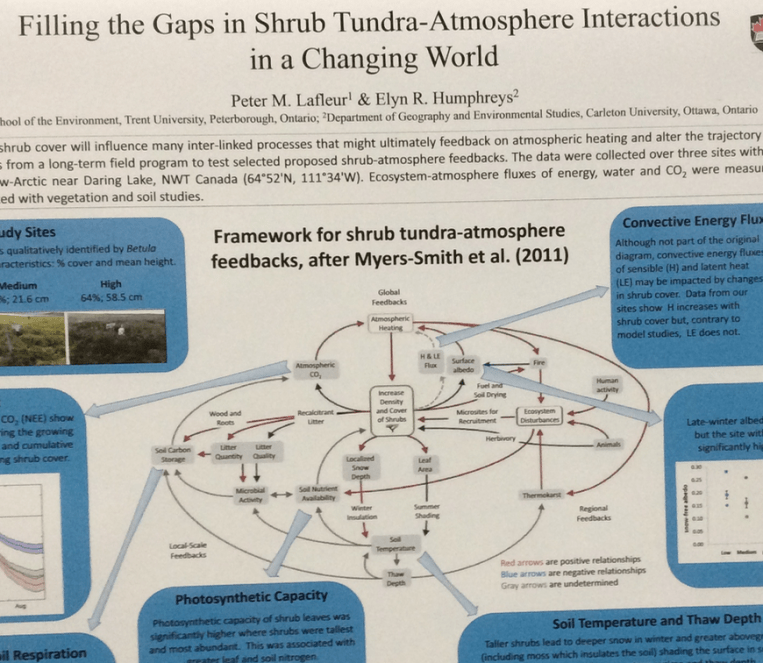
  • What’s going on with the carbon cycle in the tundra? This could have been a secret, but we know more than enough to be making a few hypotheses here. Over the course of Arctic Change we heard a lot about sinks and sources of carbon in the tundra. It does contain more than twice as much of the stuff as is held in the atmosphere after all. But the fascinating thing for me is that there is still huge uncertainty over exactly what climate change might mean. Thawing permafrost and release of soil carbon, almost certainly. Faster decomposition, probably. What about greater productivity, storage in biomass? What about litter decomposition, will that be faster or slower as communities change? Over the various talks and posters we saw evidence for both sides, and quite a few wonderful, but certainly rumoured feedback loops including some of those feedbacks actually tested with real-world tundra data in Peter Lafleur and Elyn Humphreys’ poster entitled ‘Filling the Gaps in Shrub Tundra-Atmosphere Interactions in a Changing World’.
  • Can we predict precipitation? One thing that stuck with me after this conference was that moisture really matters! Whether it was Jackie Hung’s talk on nitrogen cycling in wetlands, Jennifer Baltzer’s research into what makes a spruce forest spruce, or Carl Barrette’s stark findings on loss of snow in Nunavik, water cropped up again and again. And yet we also heard how difficult it is to predict. So perhaps this is one of the most important rumours to confirm – not what has happened, but what will happen.
  • Did someone say that John England, winner of the 2017 Weston Family Prize for Lifetime Achievement in Northern Research, was drinking beer from a boot?? I never confirmed this rumour, but I have a feeling some of our team saw the evidence for themselves.

Facts. The evidence.

Ecology Across Borders

  • The drivers of the distribution of threatened species vary around the world – energy availability is most important but there is variation across space and taxa. Christine Howard
  • Sub-individual variation influences fitness through effects on fecundity and resource use. Carlos Herrera 
  • A synthesis of the effects of climate change on breeding phenology of seabirds reveals that populations respond differently through time, and location  influences how populations respond. On average, seabird populations worldwide have not adjusted their breeding phenology between 1952 and 2015. Katharine Keogan

ArcticNet

  • The Arctic is rapidly changing with decreasing sea ice cover being documented in all different ways.  There were lots of different approaches to understanding the changing sea ice including using new Sentinel-1 SAR imagery to document the cover of different aged sea ice in Stefan Muckenhuber‘s talk, to understanding the melting first-year sea ice as a part of a UK-Canada collaboration lead by Jack Landy, to data collected by local people with their GPS or phones from the plenary by Joel Heath and Lucassie Arragutainaq, winner of the 2017 Inuit Recognition Award, on the Arctic Eider Society‘s Inuit knowledge wiki & social mapping platform called SIKU.
  • Put the people in the picture. Although we attended Arctic Change with our ecologist hats on (no really, very lovely grey Team Shrub hats!), the one thing we cannot ignore is the importance of people, and particularly those that live in Arctic regions. ArcticNet did a fantastic job of getting the voices and concerns of northerners heard, of putting northern interests at the centre of the research agenda, and for calling people out when needed. Good job.
  • Pictures of bears make people pay attention. Nice work Cameron Eckert and Jay Frandsen for your compelling presentations on using camera traps to understand wildlife abundance, travel routes and resource use.
ArcticNetposter
Isla was super stoked to see an awesome poster by her one time undergrad dissertation PhD student supervisor Elyn Humphreys filling in the feedbacks from her 2011 review paper.

But really, the line between rumours and facts in science is often blurry – and facts might not always stay facts, as new evidence continues to come in. That might even bring us back to the secrets, but what ecologist doesn’t love a good secret or rumour.


By Gergana, Haydn and Isla

Arctic Change 2017 – Thursday – Friday round-up

So, it is the end of the week Friday morning and the final plenary session of the Arctic Change 2017 conference. Team Shrub is not feeling quite as perky as we were at the beginning of this conference, in fact some of us are feeling rather beat! It has been a week of full on science – conferencing by day and preparing talks by night. Last night was banquet night, a big night for Team Shrub – thus the delay with the Thursday round up. So, to find out about our final days at Arctic Change 2017 here is the Thursday – Friday round up.

It was a very proud moment yesterday for everyone on Team Shrub, and for me in particular as their supervisor, when PhD students Haydn and Jakob swept the leader board in positions 1 and 2 for the 1-minute presentation pitch competition. From the very back of the banquet hall to the front of the stage, with shouts and whoops from the Team Shrub table, Jakob and Haydn accepted their awards (with or without shoes on)!

Check out their awesome pitch YouTube videos here on the Tundra Tea Bag Experiment and using drones to quantify Arctic Tundra greening:

Both Haydn and Jakob gave presentations on Thursday at the very same time. Forcing me and the rest of the team to have to choose!!! Haydn presented Team Shrub’s tundra plant trait research to link vegetation change via traits to changes in ecosystem functions. Jakob presented results from his PhD and the Shrub Tundra NERC project quantifying tundra greening across the growing season using drones and satellite data. Both Jakob and Haydn totally rocked their presentations to packed rooms with great feedback and engagement from the audiences.

Next, Andy presented about his work as a part of the Shrub Tundra project to quantify tundra change using drones. From coastal erosion, thaw of retrogressive thaw slumps to quantifying shrub growth – Andy covered a lot of ground very clearly explaining the rapidly advancing technology and awesome Arctic applications. It was super exciting for me to see our hard work over the past three years on the NERC funded ShrubTundra project presented by the team.

I gave a talk in the UK-Canada Arctic Collaboration session sharing the preliminary results of Team Shrub’s 2017 collaboration funded by the UK-Canada bursary programme. We are collaborating with the Arctic Ecology Lab and Trevor Lantz at the University of Victoria, Robert Fraser at Natural Resources Canada, Jurjen van der Sluijs at the NWT government and Eric Cheyne and Aurora College to quantify tundra shrub biovolume to understand the drivers of tundra shrubification in the Western Canadian Arctic. My talk hopefully convinced the audience of the power of collaboration, and how by teaming up with other groups through this collaboration and also the newly founded High-latitude Drone Ecology Network you can collect data and answer scientific questions beyond the reach of any one group. You can check out our recent coverage in the Toronto Star to find out more about how both Trevor’s group and Team Shrub are studying shrub change and permafrost thaw in the Canadian Arctic.

Over coffee breaks and post presentation chats we have made some great connections this week with collaborators old and new. Thanks to everyone who stopped by the Team Shrub posters or came to chat to us after our talks.

After banquet festivities including a performance from Iqaluit’s The Jerry Cans and some late night revelries at Le Sacrilège, it is now the final day of the conference and time to wrap up our ArcticNet meeting experience for the year.

In the final plenary, Louis Fortier spoke to us about the future of ArcticNet and we heard about Yukon College becoming Yukon University. The end of the week makes me think about what is in store for Arctic research in Canada and how UK researchers like Team Shrub can play a role. I hope over the coming years, we will be able to help to answer the key questions facing the Arctic research community such as quantitatively attributing tundra vegetation change to climate warming and testing the correspondence among different records of vegetation change from on-the-ground, drone and satellite records.

The Arctic Change 2017 conference was an excellent week for Team Shrub. A chance for us to present our latest research, meet and hang out with tundra scientists from across Canada and around the world, report back on current collaborations and establish new ones and all and all have a wonderful time in beautiful Québec City. Thank you to the NERC Arctic Office, the British High Commission in Ottawa and the British Ecological Society for supporting our travel. And it turns out that all of our tweeting activity during the conference has payed off, as with our with 73K tweet impressions, we were highlighted as the top tweeters at the conference!

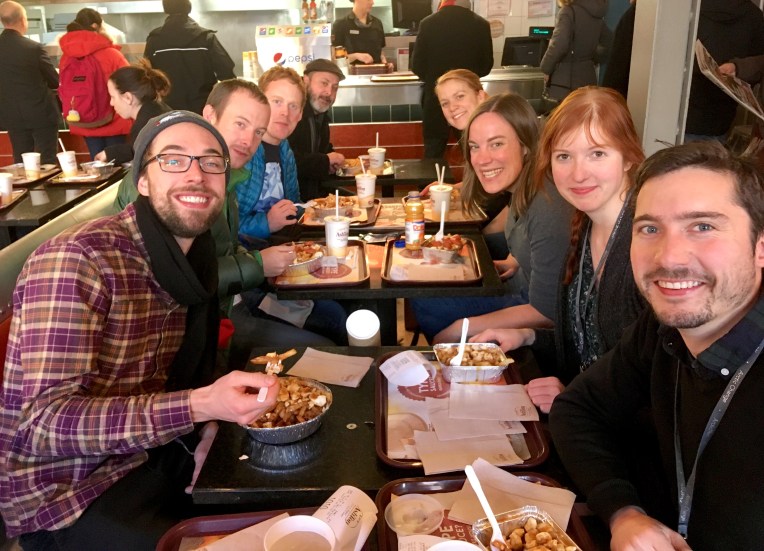
Now that the conference has wrapped there is time for one last meal of poutine. Until next time!

image1-1

By Isla

Arctic Change 2017 – Wednesday round-up

IMG_8708.jpg

Another day of snow in Quebec City, another day of Arctic conferencing at Arctic Change 2017. Another packed plenary, hearing from Larry Hinzman on how we can and must adapt as not only the climate changes, but many other factors as well. We heard the fascinating, and certainly complex debate around the ownership and use of the northwest passage. Finally, we stood together to celebrate the work of Dr. Michel Allard, winner of this year’s Weston Family Prize for Lifetime Achievement in Northern Research.

Team Shrub was well represented in the first session of Monitoring, Modeling and Predicting Arctic Biodiversity. Isla made a convincing case for detection of various components of vegetation change and their attribution to warming. Jeff then demonstrated the scaling issues we have when going from ground-based to satellite observations – impressing the audience with drone footage at the same time.

In this session we also heard from Paul Grogan of Queens University with a fascinating talk on birch expansion driven by a decrease in herbivory rather than by increased temperatures. Last up was Pascale Ropars (who first taught me the art of digging shrubs up many years ago), presenting a whole-food-web approach to predicting biodiversity change in Northern Québec.

After a delicious lunch (the food here!) which peaked with three helpings of profiteroles, it was time to go back to the second part of the Arctic Biodiversity session. Katriina O’Kane showed us how species move individually rather than as a community during succession at a glacier’s edge. Cory Wallace and Jennifer Baltzer from the Forest Ecology Research Group at Wilfrid-Laurier also took us on a tour of alder shrubs, topographic variation, and the factors controlling black spruce abundance.

Finally, eyes starting to itch and brains hurting from a day packed full of new knowledge, we heard from Caroline Coch on the role of small catchments for dissolved organic carbon inputs, and from Dustin Whalen on how drones are being used to map coastal erosion in the Arctic.

Haydn, Jakob and myself were still on duty by our posters in the evening. Between lively scientific discussions and running into old friends, the two hours flew by and our team set out hungrily in search of poutine. Unfortunately, my insider knowledge of Québec didn’t extend to knowing Ashton’s opening hours, so the door shut in our disappointed faces. We had to turn to (highly satisfying) falafels eaten on the street in -10 degrees C weather to get back to the conference centre in time for the first screening of Breaking Ice, a documentary that took us on the Canadian research ice-breaker the Amundsen.

IMG_8729.jpg

I suspect Haydn, Jakob, Isla and Andy are in various stages of anticipation for their Thursday talks. Good luck all!

By Sandra

Arctic Change 2017 – Tuesday round-up: Blizzards, Biodiversity and Beluga Snot

The second day of Arctic Change 2017 hit town like the snow storm raging outside the Centre des congrès de Québec. Today the main hall was full, packed right to the edges, as we were welcomed by ArcticNet, Laval University and the Inuit Circumpolar Council.

After the welcome and official opening, Raleigh Seamster from Google Earth, and Joel Heath and Lucassie Arragutainaq from ArcticEider/SIKU demonstrated the power of remote sensing and its potential for community based environmental monitoring in the Arctic. The speakers clearly had to battle the inquisitiveness of researchers as hundreds reached straight for their laptops and phones to immediately check out these awesome tools! Louis Frontier, scientific director of ArcticNet, followed with a reminder that cutting carbon emissions remains paramount for tackling all issues around Climate Change. Anyone not from Norway or Paraguay might have left feeling a little bruised, but despite the world being only 5% of the way towards its renewable goals, there was still a sense of optimism. And indeed, the plenary closed with optimism in full swing with a touching short film on the Schools on Board project of the Canadian research icebreaker Amundsen and the potential future leaders of Arctic policy change.

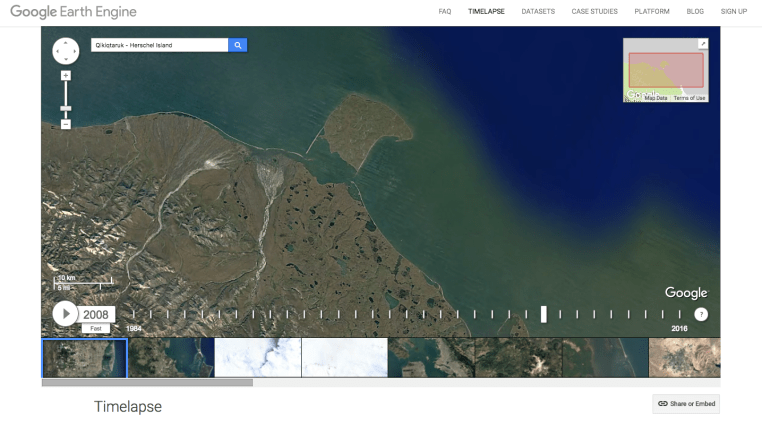
Screen Shot 2017-12-12 at 22.17.15
Google Earth Timelapse, winding back time on Qikiqtaruk – Herschel Island our Arctic research site.

Refreshed after heaps of pastries and coffee, the conference headed into the first topical sessions. Alas, we can barely scratch the surface of the vast array of talks on offer here. Justine Hudson method’s of assessing Hudson’s Bay’s beluga whale stress level using snot samples was much discussed on twitter and made an engaging talk with videos of curious belugas “donating” their snot to science. Memorable also were Benjamin Lange’s findings that multiyear sea-ice supports much more algae life than first year ice. We on Team Shrub appreciated hearing about Zoe Panchen’s research on tundra plant phenology showing that microclimate matters more than latitude or elevation for flowering in the Canadian High Arctic.  And Team Shrub was also a fan of Esther Frei’s work on plant trait change over time and her beautiful figures!  We also really liked pondering future fox housing using Florence Poulin’s new index of Arctic fox den vulnerability.

The scientific part of the day concluded with the first poster session, with legions of well designed posters (every conference should have such a great reward for poster awesomeness!) and an astonishing amount of great science. Ruminating in front of our fake log fire we remember Jeffery Saarela and Paul Sokoloff’s enthusiastic poster presentation – working with the Canadian’s Museum of Nature, they are sampling plants all across the Arctic islands to improve our understanding of high Arctic biodiversity. Also sticking out was Sarah Shakil’s poster on chemical composition of slump discharge on the Peal Plateau in the Yukon and Christine Anderson’s beautiful poster about her exciting proposed PhD research on shorebirds in a changing Arctic.

Now we are all tired from a long day of sciencing, talking at our posters, braving the still raging blizzard and running away from snow-spitting Quebecois snow ploughs on our way home to the apartment. After two exciting days, we’re looking forward the great Arctic science to come and take up Allen Pope’s challenge to kick him off the top of the twitter leader board. So keep your twitter ears pricked and see you tomorrow!


by Jakob and Team Shrub

p.s. You can also catch up here on what’s happening across the pond at the the Ecology Across Borders conference in Ghent.

Ecology Across Borders: round-up so far

It is snowing in Ghent, too. Delayed or cancelled flights/trains have made travelling a challenge, but as the weather is settling at least a tiny bit, more and more people are arriving to the Ecology Across Borders in Ghent, Belgium. A snowman with a name badge greats those that managed to reach the conference venue. Outside, the cold wind pinches your skin and freezes your toes. Inside, the magic and excitement of science, plus a cup of tea or several, warms you up.


Team Shrub members are currently attending two big conferences – Ecology Across Borders (EAB) in Belgium and ArcticNet in Canada – one might say, we are almost on a conference tour. EAB is in full swing – two days into the conference, we are happy to report that conferences really can be a hub of science joy, discussion, criticism and ideas on how to take ecology further.

Here are our conference highlights so far.

  • Ecology Hackathon

On Monday, Gergana joined the full day Ecology Hackathon. Our goal was to make an R package to download and harmonise differed gridded datasets to facilitate their use in answering research questions. We have written code and drafted the key goals of our package, and are excited to continue building on this.


  • Speed review from the BES journal editors

The speed review session was a great opportunity to get feedback from the editors of some of the BES journals. The session was very useful and  it was great to meet some of the editors and talk about the winning elements of a manuscript.

  • GBIF stall in the exhibition hall

Gergana had a riveting discussion with Dmitry Schigel from the Global Biodiversity Information Facility (GBIF). Gergana is using GBIF data in her analysis of how rarity metrics (geographic range, mean population size and habitat specificity) affect population change, and it was fantastic to learn more about GBIF and how to best use GBIF data. We love open source data, and we are looking forward to continuing using GBIF – both in our research, and in teaching at Coding Club.


  • Catching up with people and meeting others for the first time

It’s exciting to see people you haven’t met with for a while, to chat about science and life, and share the conference experience. Equally, it is exciting to meet new people, to ponder a subject area you’ve never though about before, or to see your own area in a different light.

  • Taking it all in – three floors of people enthusiastic about science, a buzzing conference venue, beautiful photos spread around, and lots of inspiration – it is worth to stop running for a moment (though Gergana finds that hard!) to just breathe in the ecology magic.

For those of us that didn’t bring appropriate footwear and are walking around in socks, the conference very much feels like home! And what better home for an ecologist than one where we get to share and discuss our research, pick up new skills along the way and start new collaborations.

Today has been a particularly jam-packed day for Anne and Gergana, with a workshop and talks!

  • Workshop: Transferring quantitative skills among ecologists

Coding Club brings together people at different career stages to create a supportive environment for knowledge exchange and collective advancement of quantitative skills. We combine peer-to-peer workshops and online tutorials to promote statistical and programming fluency. In our EAB workshop, we used a tutorial on analysing big data in ecology to demonstrate how we can deliver quantitative training across academic institutions, after which we made our own tutorials and uploaded them to GitHub!

Interested in learning how to write coding tutorials and create a positive space for knowledge and skills exchange? All of our workshop materials are online:

Transferring quantitative skills among scientists


We were thrilled that many people attended and engaged with our workshop – it’s fantastic to meet more people keen to build a community around coding and quantitative training!

  • Talk: Does rarity influence population change in the UK and across global biomes? (Gergana Daskalova)

Species’ attributes such as rarity status, distribution and taxa are often assumed to predict population declines and extinction risk. However, empirical tests of the influence of rarity on population change across tax and biomes have yet to be undertaken, hindering proactive conservation. We combined open source data from the Living Planet Index, the Global Biodiversity Information Facility and the IUCN to examine (1) the effects of rarity on rates of vertebrate population change in the UK, (2) the variation in global vertebrate population trends across biomes, and (3) the relationship between detected population change, species’ conservation status, and study duration.

  • Talk: Consequences of environmental change in tundra ecosystems: lessons from the International Tundra Experiment (ITEX) (Anne Bjorkman)

Much of what we know about tundra change has been made possible by the International Tundra Experiment (ITEX), a circumpolar network of experimental warming and long-term monitoring sites established in 1990. This network uses a standard protocol to quantify changes in plant abundance, species composition, and phenology in response to experimental and natural warming. These datasets have contributed to several syntheses of tundra community, functional, and phenological change.

We are excited for what the next two days of EAB have in store for us, and of course, we can’t wait to hear more from Team ArcticNet!

By Gergana

Arctic Change 2017: Monday round-up

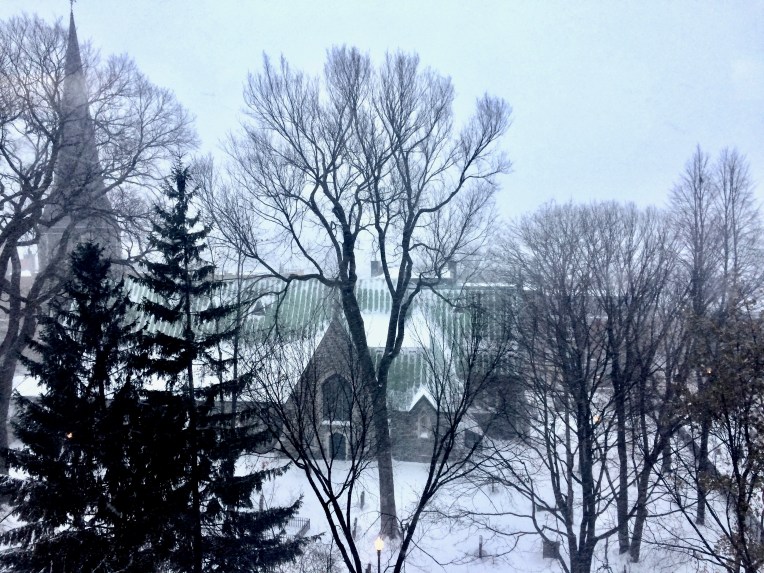
It is snowing in London. Roll on the inevitable British winter – the blocked roads, the cancelled flights, the closed schools and the queues at petrol stations. Outside our «charmant appartement» here in Québec City we look out on snow piling high on church towers, listen to the sound of crunching boots and catch our breath in the -15°C air. Winter may have arrived in La Belle Province, but the Arctic Change 2017 conference is in full swing.

We arrived this morning in the huge Centre des congrès de Québec to the chatter of Arctic researchers of all ages – from the long stockings and tartan skirts of schoolgirls to the suitcase wheeling suits of professors. Everything about a conference was soon underway. Bonding over velcro in the poster hall. Unexpected feedback in the plenary. A sudden lack of technical support at the critical moment. In a room full of excited scientists, none of it really matters.

Today was the ‘Student Day’, a chance to warm up after the main event kicks off tomorrow. The highlight for us by far was the student elevator pitches – one slide and one minute to sum up a research project. We were blown away by the quality and range of work underway across the Arctic, and the quality and range of talks! Ukelele songs and caribou cams, teabags and drones, Facebook, fishing, birdsong, belugas…the list goes on.

DQxuw1fU8AAqTel (1).jpg
One minute, one slide

The rest of the day unfolded in a series of meetings, workshops and panel discussions. We enjoyed learning about international collaboration, data management and policy making, among others. Most of all, we enjoyed the chance to catch up with old friends and make new ones (still looking for two months at sea anyone??), before retiring to the Arctic-themed pub quiz to end the day.

It’s now 10pm and the snow is still falling. Bring on tomorrow.

IMG_8700.jpg
Enjoying snowy Québec!

If you want to meet any of Team Shrub or find out about our work, you can catch us at:

Presentations:

MON06 – I. Monitoring, Modeling and Predicting Arctic Biodiversity
(Wednesday, 10.30-12.00, Room 203)

10.45 – Isla Myers-Smith: Attribution of ecological change to warming across the tundra biome – a summary of recent data syntheses
11.15 – Jeff Kerby: Meso-scale Arctic ecology: Leveraging the High Latitude Drone Ecology Network (HiLDEN) to address longstanding knowledge gaps

MON05 – I. Arctic Remote Sensing: Improving Arctic Monitoring of Sea Ice, Snow, Glaciers and Permafrost for Wildlife Preservation
(Thursday, 10.30-12.00, Room 302 B)
10.45 – Jakob Assmann: Drone imagery reveals scale mismatch between satellite-observed tundra greenness and on-the-ground vegetation monitoring

ECO13. Arctic Tundra and Vegetation
(Thursday, 10.30-12.00, Room 303 A)
10.45 – Haydn Thomas: Changes in plant functional traits across a warming tundra biome: Linking vegetation change to ecosystem function

MON05 – II. Arctic Remote Sensing: Improving Arctic Monitoring of Sea Ice, Snow, Glaciers and Permafrost for Wildlife Preservation
(Thursday, 13.30-15.00, Room 302 B)
14.30 – Andrew Cunliffe: Monitoring Arctic changes with drones

ECO14 – II. Arctic Wildlife
(Thursday, 13.30-15.00, Room 301 B)
16.15 – Cameron Eckert: Identifying key wildlife movement corridors on Herschel Island-Qikiqtaruk Territorial Park

INT03. Arctic Cooperation in Action – the UK-Canada Arctic Partnership, 2017 Bursaries Programme: Aims, Results and Next steps
(Thursday, 15.30-17.00, Room 303 A)
16.45 – Isla Myers-Smith: Quantifying the drivers of rapid tundra vegetation change – increased productivity and permafrost thaw

Posters:

156 – Sandra Angers-Blondin: Reading between the rings: How does competition affect the climate sensitivity of shrub growth?

158 – Haydn Thomas: Decomposition patterns across the tundra biome: Litter substrate explains more than environment.

159 – Jakob Assmann: Snow-melt and temperatures – but not sea ice – explain variation in tundra spring plant phenology on Qikiqtaruk – Herschel Island

5 Steps to Becoming an Awesome Field Assistant

Going into a field season for the first time can be a bit overwhelming. You’re about to spend a couple of months in a strange land, doing strange tasks with very strange people. You might feel like you’ve suddenly forgotten everything about science, or that you’re definitely not up to walking up that mountain. Do you have the right gear? The right attitude? Are you even the right person for the job?

To help you out, here are Izzy’s top five tips that will help you have the best and most productive field season.

1. Be prepared to work weird hours

In most cases you will be living on the same schedule as your supervisor. That means work will keep going until you’re finished. From late night trips to the lab or waking up to shrub talk, you never know when you might be needed. At first in can be overwhelming, but it’s a great way to engage with the material and experience. You also end up feeling really hardcore and proud of yourself after a long day!

2. Take advantage of every opportunity (sleep when you’re home)

Living in a new place with new people will definitely bring a lot of opportunities to take advantage of. Whether it be going on a hike or taking a tour of the nearby ice-fields, you can always find something new to try. I think saying yes to everything (within reason) is the best way to go about your field season. You will end up meeting a lot of new people and seeing a lot of new things along the way. I have to say, some key memories of my field season are things I have said yes to: going to a lecture with Charley Krebs and seeing my first grizzly bear on the way, and going on a tour of the ice-fields – absolutely amazing. Just say yes!

Related to that, you are only in this new place for a few months out of, quite possibly, your whole life. There’s no reason to go to bed while the northern lights are out – you can sleep when you’re home!

24259367_1720289814670347_1217086525_o
Feeling on top of the world (and a little bit cold)

3. Do things before you’re told & be confident in working independently

Often times the supervisor you’re working with has countless things to do that need to be delegated. If you really pay attention and engage with the tasks at hand, you’ll be able to help them along the way by clearing up any bits that may be left to do. Furthermore, being able to work independently will greatly improve your confidence way beyond the field. I know that for me, I was not a very confident worker and would often seek clarification more often than needed. Being in an isolated location might mean you don’t have the luxury of always asking for help, so you end up having to trust what you think is right. This is definitely frightening at first, but even after the field, I’ve noticed that I trust my knowledge a lot more. Being able to help organise tasks on your own is a great skill to work on and you’ll also be removing a bit of your mentor’s stress!

24197391_1720289918003670_1025402644_o.jpg
Izzy Rich (the common garden bed. Also the field assistant.)

4. Challenge yourself

Going to the field was undoubtedly one of the hardest things I’ve done in my life. I kept telling people “wow who knew I was such a city kid,” but it turns out I am. Being in a remote location, where sometimes I only saw one other person, was extremely shocking to me. It was an incredible learning experience to learn to be alone so intensely. Taking part in long hikes was another shock. Some people may say the hikes I did were not very long, but for me, I was genuinely climbing a mountain in reality and my mind. The emotional barrier of trying such drastically new things was hard to break, but everything you learn and the way you develop as a person when you challenge yourself is something that you will carry for the rest of your life.

DSCN8515.jpg
Scaling literal and metaphorical mountains

5. Take a lot of pictures

Take a lot of pictures so it doesn’t all feel like a dream!

By Izzy