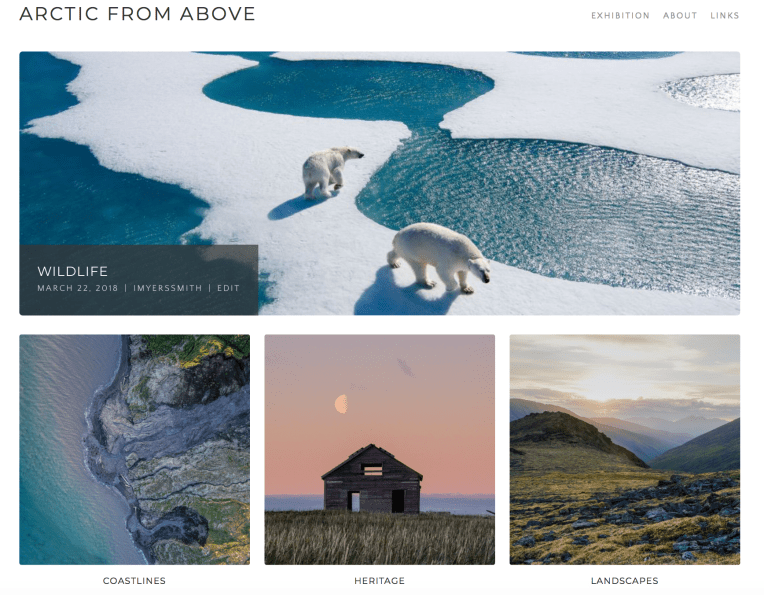
Our scientific research expeditions to the Arctic often reveal dramatic landscapes, exciting wildlife encounters and lots of natural beauty. We are always keen to widely share those experiences, and one way to bring the Arctic closer to people is through photography. This year, we are continuing our science & art outreach work (you can read more about our outreach events at the Edinburgh Science Festival last year here) by organising a second photography exhibition. This time, in addition to the physical exhibition, we also have an online exhibition, so that anyone with internet access can get a glimpse of Arctic environments, wildlife and ecosystem changes.
We present photographs of Arctic tundra landscapes and the plants and wildlife that inhabit them, captured as a part of scientific research expeditions to the rapidly warming Arctic. Images are captured from above using drones, helicopters or planes and on the ground as we hike out to our research sites. Some of these images are part of scientific datasets used to model the 3D structure of the tundra environment.
This work represents the interface between science and art, where the process of data collection has produced imagery that communicates the reality of global change and captures the patterns and beauty of remote Arctic ecosystems.
You can explore our photography exhibition online here!
Arctic Above – Exhibition in the Main Library, University of Edinburgh
If you are based in Edinburgh or visiting the city to experience Scottish spring, you can also check out our photos in the Main Library of the University of Edinburgh, first floor on the right. It’s always exciting to see our photos printed in large! It is also cool how even though we all have distinct photographic styles, our photos complement one another so well! We hope those who visit our online exhibit as they make their way into the Library to study for their exams or out to enjoy a bit of spring sunshine get a glimpse of what it is like to study the changing ecosystems of the Arctic.
Exhibition prep in the Main Library
Exhibition prep in the Main Library
The Team Shrub Arctic Above Exhibition all set!
Sandra and Gergana set up the exhibition in the Main Library – feel free to stop by to check out the photos and tell us what you think on Twitter – @teamshrub #ArcticAbove!
At over 65 sites around the world, 100s of international researchers with several long-term monitoring protocols and one common aim are working to understanding how the tundra biome is changing.
The ITEX (International Tundra Experiment) network brings together researchers studying the responses of Arctic and alpine plants and ecosystems to global change, with a particular focus on climate change. This synthesis of observations across the tundra has improved our knowledge of the changing tundra plant communities (Elmendorf et al. 2012a, 2015), their responses to experimental warming (Elmendorf et al. 2012b) and the changes to and climate sensitivity of the phenology – timing of leafing out and flower of tundra plant species (Oberbauer et al. 2013, Prevéy et al. 2017). Here, we give you a taster of the research findings that Team Shrub presented at the meeting.
Earlier in April, the 2018 ITEX meeting in Stirling brought together many of the researchers part of the ITEX network to share key findings of their work on how tundra ecosystems are changing and what that might mean for the planet. The meeting kicked off with a field trip to the Scottish hills near Dollar. Through rain, wind and sunshine, our hike reminded us of the days we’ve spend in the Arctic. Amidst the grasses and mosses, there was another flashback to our Arctic days – Eriophorum vaginatum! Growing in the wetter parts of the hills, we found quite a few cottongrass tussocks, an exciting sight for us tundra flora enthusiasts!
Atmospheric Scottish vistas from the pre-conference hike
Eriophorum vaginatum!!!
The castle in Dollar
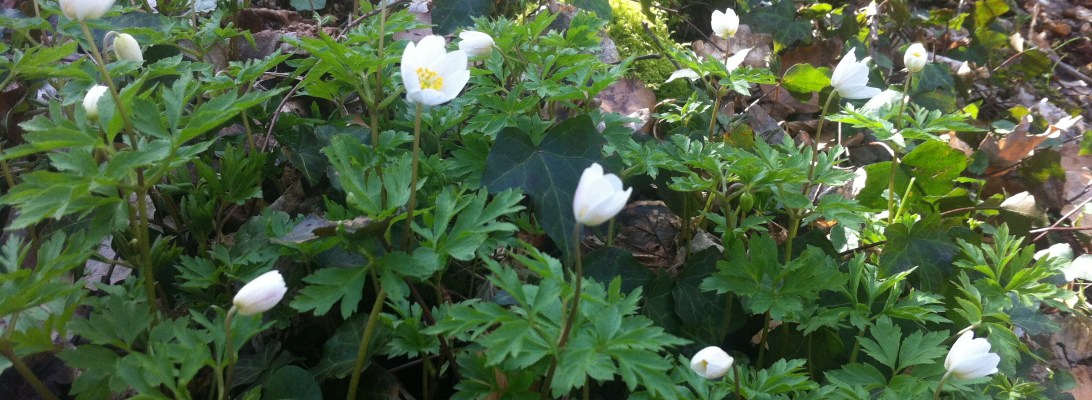
In the woodlands in Dollar, spring was in full swing – singing wood warblers, beds of wild garlic and primroses in bloom. In typical scientist fashion, we made many stops along the way to talk about the different species we encountered.
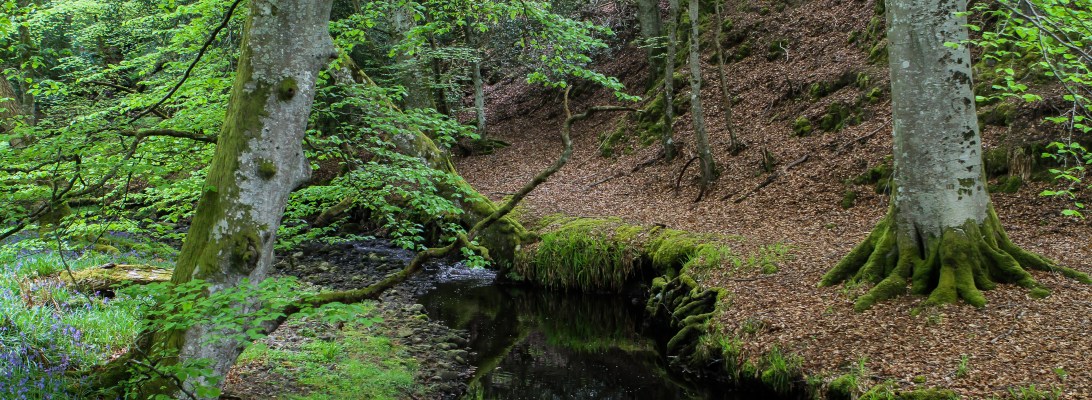
Almost perfectly round pools along the stream and mossy cover all around us gave our hike a fairytale-like feel!
Wild garlic almost in bloom
A carpet of woodland plants
Mossy tree
Scientists – always pointing at one thing or another!
We made it to the top of the hill, took in the nice view and pondered the landscape around us and how it came to be. How far did the natural treeline used go in Scotland and how have these landscapes changed through time? Has Scotland always looked a bit like the treeless tundra biome?
Our group photo from the top of the hill
Next up it was time for some science. Here is a brief summary of the team shrub presentations at the conference.
Gergana presented the key findings of the long-term monitoring on Qikiqtaruk-Herschel Island, among which were increased vegetation cover, less bare ground and a deeper active layer. It was particularly exciting to share the results of the ITEX species pool protocol – Gergana’s absolute favourite protocol! We had a great time during the summer walking around the long-term vegetation plots and recording the different species found across the landscape. Knowing more about the regional species pool can help us predict how local biodiversity trends might change in the future. For example, there are two plant species, Saxifraga nelsoniana and Parrya nudicaulis, that were found within five meters of the vegetation plot, yet they have never been recorded inside it so far.
Haydn presented all about tundra traits and what they are telling us about the rates of change in decomposition with vegetation change in the tundra biome. His take-home message was community-level estimates of tundra decomposition haven’t changed much over time and future change will likely be slow. Anne presented about the changes or lack there off in species and functional diversity over three decades of tundra monitoring. And in some ways it is a similar story – even though there are strong spatial patterns in species diversity from the warm to the cold reaches of the tundra biome, functional diversity doesn’t change as much and species diversity isn’t changing rapidly over time.
Haydn telling us about traits and decomposition in the tundra
Anne presenting on species and functional diversity change over three decades of tundra monitoring
Sam presented a poster on his undergraduate dissertation about the amount of carbon stored in the above-ground biomass on Qikiqtaruk. And, Mariana presented a poster about the rates of shrub encroachment across two very different biomes that are experiencing similar changes – the tundra and savanna. It was a lively poster session with lots of interesting discussions that continued on over a delicious fish supper in the down of Bridge of Allan.
Sam presenting a poster about his undergraduate dissertation research on carbon storage in the aboveground biomass on Qikiqtaruk-Herschel Island
Mariana presenting her poster on shrub encroachment in the tundra and savanna biomes
The next day, Isla summarized the evidence for the detection and attribution of tundra vegetation change to climate change including: phenology change, vegetation change, climate sensitivity of shrub growth, a warming of the combined thermal niches of plant communities and community-level plant trait change. Taken together, these data syntheses provide compelling evidence for the detection and attribution of tundra vegetation change to climate warming, but the evidence also points to variability in plant responses and the importance of other controlling factors such as soil moisture, topographic context, herbivory and permafrost thaw. Isla also presented on behalf of Jeff Kerby and shared the initial results of the High Latitude Drone Ecology Network and discussed how drones can help us to understand the ecological context and representativeness of long-term ecological monitoring studies like the ITEX network.
Sandra told us all about her findings that temperatures rather than growing season length best explained variation in shrub growth. Her research also suggests that the interpretation of growth ring data is more complex that we first thought with growth rings likely representing an integration of plant responses to climate and other biological factors from both above and below ground. In the same session, Janet made an impassioned plea for tundra ecologists to make their data public emphasizing the power of open and available data and the resulting data syntheses with a focus on the results of the plant phenology syntheses that she has been leading.
Sandra telling us about how increased growing season length influences shrub growth
Janet Prevéy sharing findings on phenology changes across the tundra biome
And finally, Jakob presented his work on the drivers of tundra phenology changes, looking at snowmelt, temperature and sea-ice. It turns out that snow melt, followed by temperature, best explains variation in plant phenology with localized sea ice not being a significant predictor. Jakob’s excellent talk won best student talk! Congrats Jakob!
The final day of the conference after a Scottish ceilidh dance focused on discussions of what will be next for the ITEX network. What questions should the tundra ecology community tackle in the coming years? How can we integrate new technology into the existing tundra monitoring protocols? What is the future change we can expect to observe in the rapidly warming tundra biome? Stay tuned for the next ITEX conference in a couple of years to find out more about the next stage of tundra ecology research and data synthesis!
The first light was tentatively breaking through the Edinburgh clouds as we braved the early morning and ran towards the train station. Four people, one mission – catch an early morning trend to St Andrews to attend the 2018 Scottish Ecology, Environment and Conservation Conference! With unexpected delays and ticket machines not working, it was quite the achievement that we did actually make it in time. Team Shrub was at last year’s edition of the conference, which was great fun, so I was excited to take part again this year.
What made this conference extra special for me was that I got to share the experience with an enthusiastic and knowledgeable group of 4th year undergraduate students from the Ecology and Environmental Sciences programme here in Edinburgh. Struan, Jack and Fiona all took the Conservation Science course last semester and were very keen to learn more! It’s so exciting to share the research journey with students and then get to see them present the findings!
Struan presented his findings on how paths in Cairngorms National Park affect bird diversity – he did a great job at outlining the motivation behind the study, which was a great reminder for us to think about not only what we did, but also why we did it. Something to ponder at each stage of your analysis, from the very first formulation of research questions to writing up the results!
Struan presenting his honours research on the effects of paths on bird diversity in the Cairngorms
I really enjoyed the SEECC 2018 conference. It was the first science conference I had attended and I found listening to what other people have been researching a very interesting experience, particularly as there was some research which overlapped with my own. My favourite part of the conference was the presentation I did on my dissertation which really gave me a flavour of what presenting your own scientific work is like.
Struan Johnson, 4th year Ecological and Environmental Sciences student
It was also my first time sharing some of the preliminary findings of my PhD! Exciting times. A nice coincidence was that the IPBES meetings were happening at the same time, so my post-conference reward for myself was going through the regional summaries for biodiversity change and its drivers.
Gergana presenting some of the preliminary results of her work on forest cover change and biodiversity trends
The IPBES reports were released same time as the conference – an exciting coincidence!
All around the world, forests are lost, forests are gained – what does that mean for biodiversity?
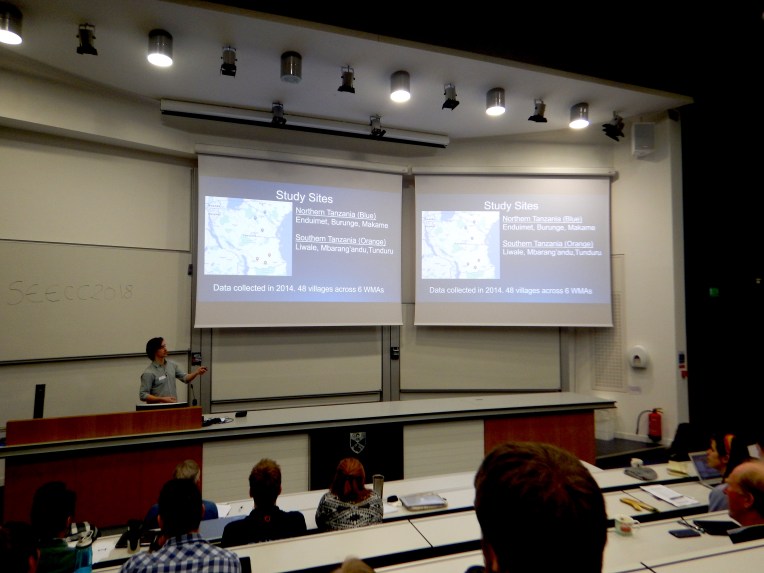
Next up, Jack presented his dissertation project, which investigated the links between wellbeing and environmental threats in Tanzania’s Wildlife Management Areas. Jack was a great speaker on quite the difficult topic!
Jack presenting the findings of his honours dissertation on how wildlife management areas influence human well-being
I thought the conference was very well run, full of interesting and insightful topics and the people presenting were very passionate. It was really nice being able to discuss a wide range of ecological issues with people with in depth knowledge and an encouraging platform for even an undergraduate student to present their work.
Jack Cunningham, 4th year Ecological and Environmental Sciences student
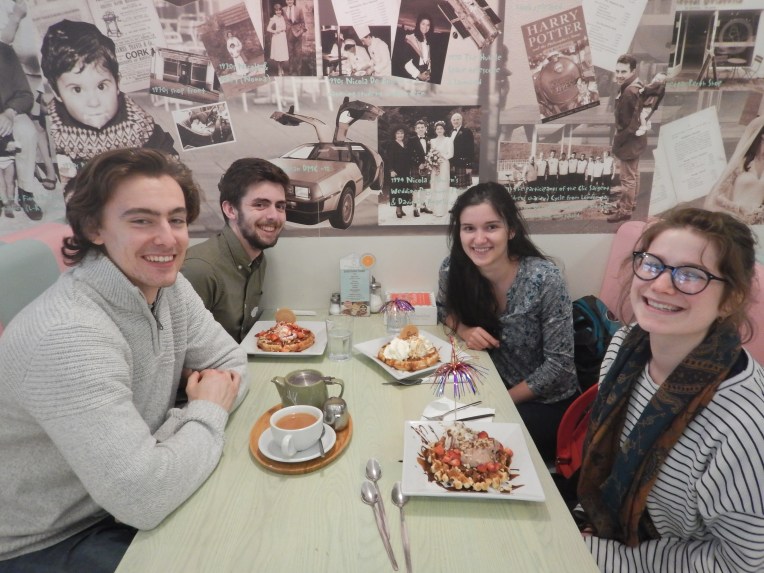
Post-conference waffles and ice cream – a great ending to a jam-packed day of science!
I found it a thought-provoking day, and was interesting to hear about the variety of academic research across Scotland. I enjoyed the relaxed atmosphere, with everyone attending (speakers or not) very approachable and eager to talk about current research!
Fiona Stephen, 4th year Ecological and Environmental sciences student
For me, a trip to St Andrews is not complete without ice-cream or fudge donuts… or a combination of the two! We had a great time at the conference and had a very jolly and inspired day full of science!
At the beginning of March, something strange happened here in Edinburgh – a snow storm! A proper blizzard and what very much looked and felt like real snow, real enough to cause a bit of traveling havoc! On my way to Ghent, it was Beast from the East – a standard snow storm really, but quite unusual for for the rainy Edinburgh winter. On my way back to Edinburgh, of course, came Beast from the East number two – a smaller snow storm, but still enough to make the ground go white. Though I had storms accompanying me all along the way, my journeys all went safely and even more excitingly, they were full to the brim with science!
Coding Club is growing! It’s quite exciting, and one of the best parts is learning about similar initiatives around the world – the joys and challenges of coding can definitely bring people together. At the Ecology Across Borders conference in Ghent last December, we organised a workshop on sharing quantitative skills among ecologists – seeing so many people keen to only get better at R, but also share their knowledge with others, was definitely one of the conference highlights for me. So imagine how exciting it was when I got the invite to go back to Ghent to lead a Coding Club workshop for EVENET – a network of ecologists from different institutions around Belgium.
Introducing the workshop themes as we’re about to start coding away
Spreading the GitHub love!
The theme of the workshop was developing an efficient and reproducible workflow, so we squeezed in as much data manipulation, visualisation, modelling and then reporting using Markdown into a day-long workshop. If you’re keen to find out about the tidyverse collection of packages and how you can use them to streamline your research, you can check out the tutorial online:
I’ve been dreaming of visiting a research group – it sounded like something I would really enjoy! I love exploring university campuses and research buildings, checking out the posters on the walls, “feeling the science in the air”, learning about new research and getting to hear different perspectives on my work as well. Visiting the Forest and Nature Lab at Ghent University was indeed a great experience – I shared the preliminary findings of one of my PhD chapters for the first time (how does forest cover influence biodiversity trends?), I learned about a lot of cool forest research and of course, I find land-use history fascinating, so I was very intrigued by the post-agricultural forests in Flanders and the effect of time since last agricultural activity.
A particularly inspirational moment was getting to walk around the research forest near Gontrode. A research forest! As much as I like coding away with a cup of tea, it’s nice to complement that with seeing real-life plants and animals. I think strong academic communities are so valuable, and in Ghent, I got a small glimpse of such a community! We are all busy and at any point in time, we could be doing many different things. I will definitely remember the feeling of walking around the research forests with a group of PhD students, each showing me some of their experiments and sharing their science.
Warming chambers in the forest
Signs of spring arrival
I had lots of time for daydreaming on my way back to Edinburgh, and I have to say, 12 hour delays sure feel more poetic when 1) you have code running in the background, so you don’t feel totally inefficient, and 2) you are dreaming of future research directions and field research stations!
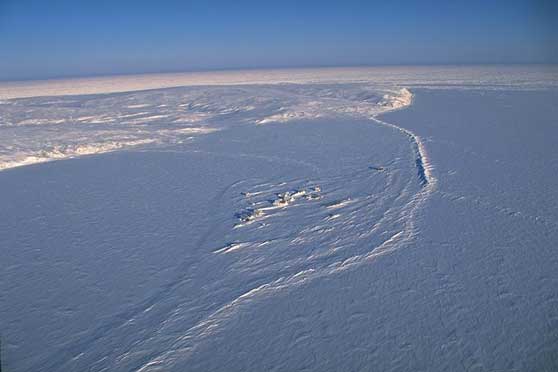
On a cold and distant island the stars of our science are sleeping. Buried under a thick winter blanket, Qikiqtaruk in winter is exactly what many people imagine when I say I work in the Arctic: awash with snowdrifts, locked in sea ice, home for polar bears and not a huge amount else.
Qiqiktaruk in winter
Yet here on Team Shrub we study plants. Come the summer sun, green tendrils of life emerge from the snow and the hardy, beautiful and fascinating plant life of the tundra begins to grow. Diverse in the manner of tropical rainforests it may not be, but these cold lands are nonetheless brimming with more life than you might think, featuring old favourites that adorn the hills of Scotland to wacky monstrosities that seem to spring out of some primeval past.
In this series we will be exploring some of our favourite species from our most northern field site, starting with our namesake: the shrubs.
The Shrubs
What makes a shrub? Such has been the dinnertime conversation at many a Scottish Feast. In short: short. Woody. Multi-stemmed. Sometimes evergreen, sometimes deciduous, always beautiful.
The willows
Qikiqtaruk is home to a grand total of nine willow species. Not bad for an isolated Arctic island. The Salix genus dominates much of the upper shin-high canopy, though you can find yourself wading through some of the bigger fellows. Bjorn even reaches chest height. Deciduous, green-leaved, the willows add a certain magic to the tundra as their fluffy seed spirals in the air on a breezy day, while bright red catkins dot the tundra floor underfoot.
Salix pulchra
Possibly our favourite shrub on the island. This beautiful willow surely lives up to its name: long ruby stems and startling emerald-bright diamond leaves, giving Salix pulchra its common name, diamond-leaf willow. On Qikiqtaruk Salix pulchra grows mostly along the ground in large, clonal mats that creep between tussocks of cottongrass and shelter small white Stellaria flowers. It’s one to watch though, as further south this willow can reach well over head height. Here, where the weather is sheltered and nutrients seep from the permafrost, Salix pulchra grows faster, bigger, redder, standing out from its neighbours atop the palsas, while on the hilltops we have already seen a tripling in its canopy height since we first started recording in 1999.
Salix pulchra leaves catching the sunlight. The beautiful willow is a Western Arctic specialist found across tussock tundra and mountain landscapes of the Yukon and Alaska.
Salix richardsonii
One of the giants of Qikiqtaruk, Salix richardsonii, or Richardson’s willow, is the most common tall shrub on the island. It grows mostly in wetter, sheltered areas such as river floodplains, where nutrients flow freely and life is as easy as it gets in this bastion of land in the Arctic ocean. Forming a dense, shrubby canopy of bright green leaves, Salix richardsonii nonetheless has a rather grizzled visage, giving it our nickname ‘Old Man Willow’. Twisted branches and flaking orange-brown bark, flecked with white specks of age or hardship. Fat, hairy stipules easily mark it apart from other willows. A canopy bully, Salix richardsonii is now dominating areas where it can grow, rapidly expanding in many parts of the island as the climate warms.
Encroaching Salix richardsoni is taking over the Ice Creek watershed on Qikiqtaruk. This is one of the tallest willows on the island and elsewhere in the Arctic where in can dominate tundra landscapes with dense, metres tall and sometimes impenetrable thickets of willows.
Salix arctica
This small willow is a remarkable example of the success and resilience of plants in these cold lands. Salix arctica, the Arctic willow, has the most northernmost geographic range of any woody plant, reaching all the way to the north coast of Greenland at 83 degrees north. A ground-hugging, prostrate woody shrub, it spreads woody limbs akimbo, stretching out in all directions along the top of the permafrost. Thin stems become roots, become stems again and it advances clonally, covering much of the surface until it is impossible to tell where one plant begins and another ends. Even if the main “trunk” is destroyed or decays, the plant will not die: an attempt at immortality. Unlike many of the other dwarf willows, Salix arctica eschews the small leaves and catkins of its fellow family members, and sticks to the strategy of the taller shrubs that bigger is better. Big, fat leaves emerge from the brittle stems, which giant fluffy catkins can strike up from the ground surface several times taller than the rest of the plant. Unusually, on Qikiqtaruk even the leaves and stems of Salix arctica strike upwards for the sky, possibly a hybridisation of one kind or another, and can stretch up even as much as 20cm from the soil.
Salix arctica the Arctic willow with flowers blooming in spring. This is one of the most widely distributed plants across the tundra biome found from the Rocky Mountains of Colorado to the very tip of Greenland.
Salix reticulata
Just like Salix arctica, this dwarf willow hugs the floor with brittle stems and clonal creeping growth in all directions. The thick, leathery leaves of this plant give it its common name: net-leaved willow, which are criss-crossed and pocked with deep grooves. Once fallen in winter, these hardy leaves last, resisting decomposition and creating a crunching carpet underfoot.
The waxy leaves of the net-leaved willow, Salix reticulata. Like with Salix arctica, this is a very widely distributed willow found in much of the Arctic, the Alps and even in Scotland!
Salix polaris and Salix phlebophylla
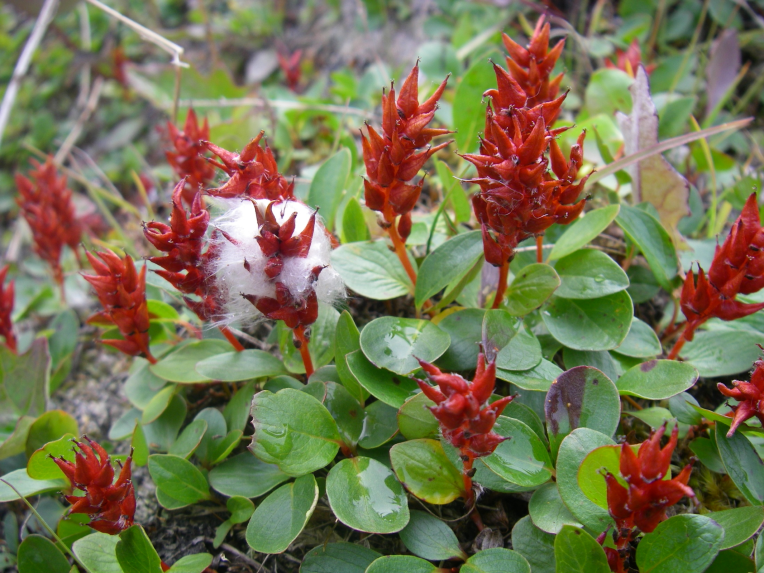
The smallest of Qikiqtaruk’s willows, these two species take you down onto hands and knees to appreciate their tiny round leaves and stalk-like stems. Hugging the ground in dense mats, often on the drier sections of hillsides or edges of tussocks, I often have trouble telling these apart from leaves alone. Yet catch them right in the season, and the red catkins of the polar willow (Salix polaris) stand out as one of the brightest flashes of red on the tundra, flecks of delicate colour, blood-rich, that in a matter of days dissolve into white and wind.
The bright red catkins, fluffy white seeds and verdant green leaves of Salix polaris often remind Isla of the colours of Christmas!The tiny 2 – 4 mm long leaves of Salix phlebophylla covering the ground in a mat. Named for the skeleton leaves it ‘leaves’ behind year after year, this is one of the smallest willows in the world!
Salix glauca and Salix niphoclada
Two of the rarer tall shrubs on Qikiqtaruk, grey willow (Salix glauca) and snow willow (Salix niphoclada) can be a challenge to find, but occasionally stand out on the hillside where some seed has found its way to establishing. The grey-tinged haze of glauca willows sets them apart from the rest, while the sometimes rose-tinged stems and somewhat brighter leaves of niphoclada can cause us headaches when we search for Salix pulchra to sample. These two willows with green leaves covered in fine grey hairs and stems with a blue-green and waxy look to them can be indistinguishable when they have no visible catkins, which is much of the time, so they are often clumped together in our analyses.
Less majestic than Salix glauca in other parts of the Arctic, here on Qikiqtaruk this willow can only eek out an existence in the warmest microclimates of south-facing slopes.
Salix alaxensis
Finally, the Goliath of Arctic willows. Salix alaxensis grows tall and often somewhat spindly up on Qikiqtaruk, almost buddleia-like, as if it wants to reach the sun and doesn’t care how it gets there. The leaves are grey-green, but a bright, fluffy white underneath – lannate, densely villous or tomentose if you will. Did you know there are over 20 botanical terms for being hairy! Certainly easy to identify. We have only recently discovered Salix alaxensis, the Alaskan willow, on Qikiqtaruk, though since individuals are already well established, thus it must have been evading detection for many decades.
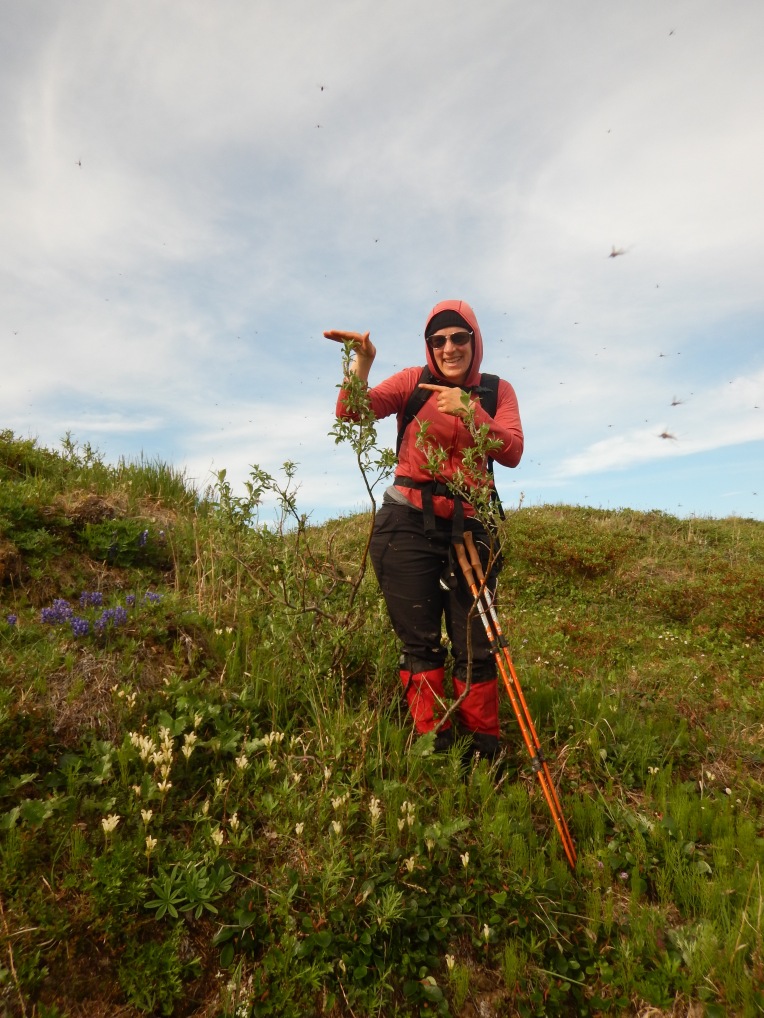
Isla with a particularly tall Salix alaxensis found on Qikiqtaruk in the summer of 2016 on a particularly buggy walk back from the retrogressive thaw slumps along the coast.
The birches
Betula nana and Betula glandulosa
If you spend much of your time tramping about the high hilltops of Scotland you may already be familiar with dwarf birch. Small, thickety and brittle, the dense brown stems of Betula nana orBetula glandulosa have snagged many a bootlace and tripped many a toe. Still, I love the Betulas for their leaves alone, some of the most perfect forms on the tundra. On Qikiqtaruk, Betula nana holds sway on flatter patches of hilltop; a low growing shrub that announces its presence as a darker green blur on the landscape, or from the waft of crushed Labrador teaunderfoot, which tends to grow alongside birch. Unlike many other tundra sites, where Betula has run rampant as the climate warms, it so far seems to be losing out to the willows here, though in some places the dense, spotted branches form an impenetrable tangle across whole swathes of tundra. As for the difference between nana and glandulosa, the latter is taller, larger leaved, greater noduled. Or not, as the case may be – perhaps they are one species after all, marked apart not by genetics but simply variation.
A very dwarf birch, Betula nana/glandulosa – is it one species or two? – nestled amongst compatriots including Rhododendron tomentosum and Vaccinium vitis-idea (see below).
Tundra tea
Rhododendron tomentosum
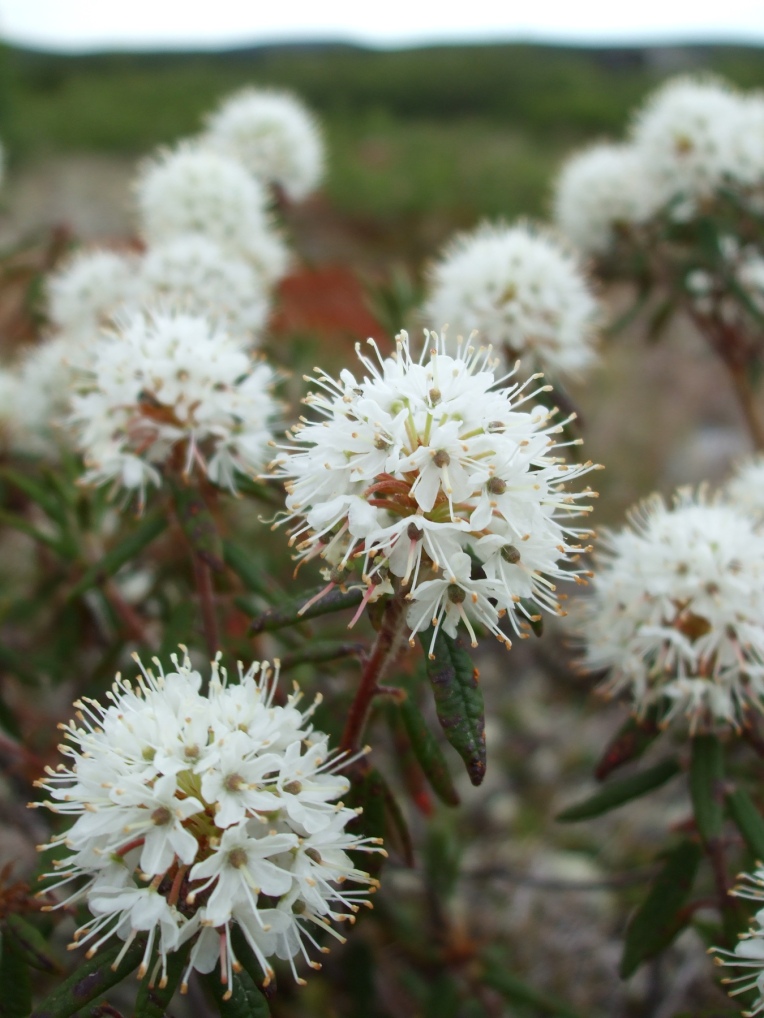
A hero of the Arctic smellscape, Rhododendron tomentosumis another favourite of ours. The shrub itself is part beautiful: white flowering baubles full of rich scent, rusted felt underside of leaves, and part ugly: the ash-black branches spindly, frail and commonly dead, dark leaves often matted and speckled, a formless shape creeping amongst better rivals. But altogether outstanding are the leaves themselves. Rhododendron tomentosum, marsh Labrador tea, may not quite have the glamour of its more grandiose and much less marshy southern cousin, but its leaves still bear the scent of a thousand tundra days; that unmistakable and uncapturable spice of terpene and midnight chlorophyll. This is a shrub that makes trait work bearable, and often one that prompts a pocket full of leaves for the walk home.
We are crazy about the fragrant smell of Labrador tea (Rhododendron tomentosum), Ledum (its old name), I got to get some!
The berry bearers
Arctostaphylos rubra (Arctous rubra)
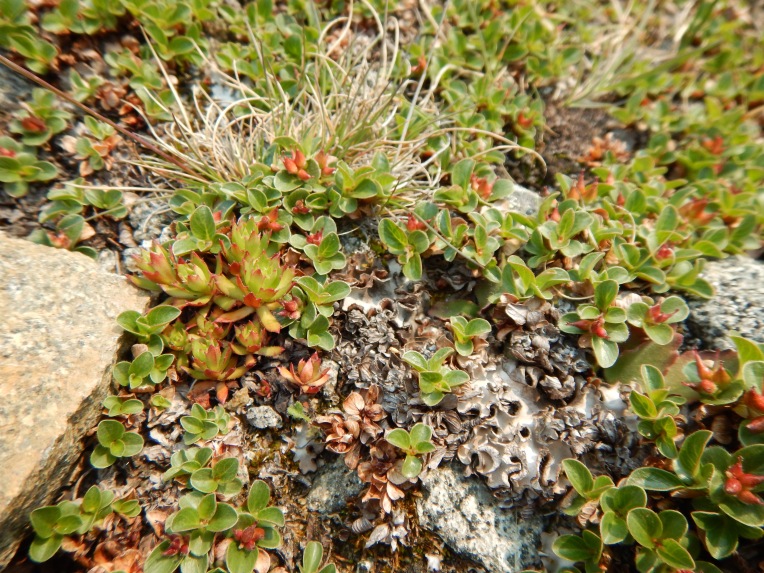
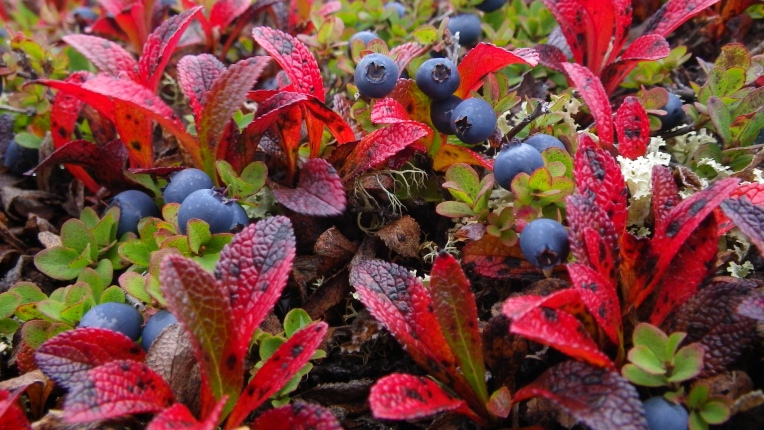
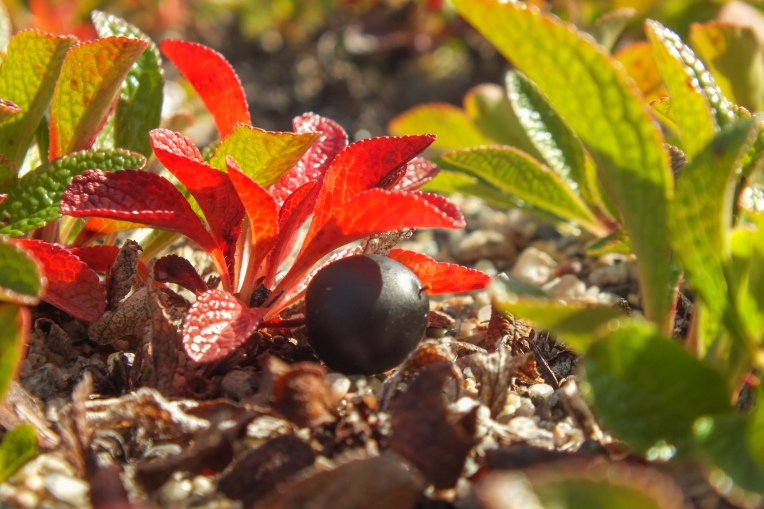
One for the photo albums. A. rubra, or bearberry, is certainly one of the more iconic tundra shrubs due to its bright, Rudolph-red leaves that can stain the bare tundra at certain times of year. Another prostrate-growing shrub, the ovate, vein-y leaves can bear a resemblance to the leather coins of Salix reticulata when green, though are stretched and less waxy. It is when the winter begins to draw in that Arctostaphylos rubra sets itself apart as the leaves turn, and formerly invisible patches of bearberry shine out. Red too, the berries that hide in amongst the leaves: a food source for humans and wildlife alike, though their diuretic properties also lend themselves to herbal medicines and may explain the preponderance of stained bear poo littering the tundra in autumn. A closely related species, Arctous alpina, looks almost identical except for the red berries that turn black when ripe.
The bright red leaves of Arctostaphylos rubra in the autumn intermixed with some Vaccinium uliginosum.Arctous alpina the black berries of alpine or ‘black’ bearberry.
Vaccinium vitis-idea and Vaccinium uliginosum
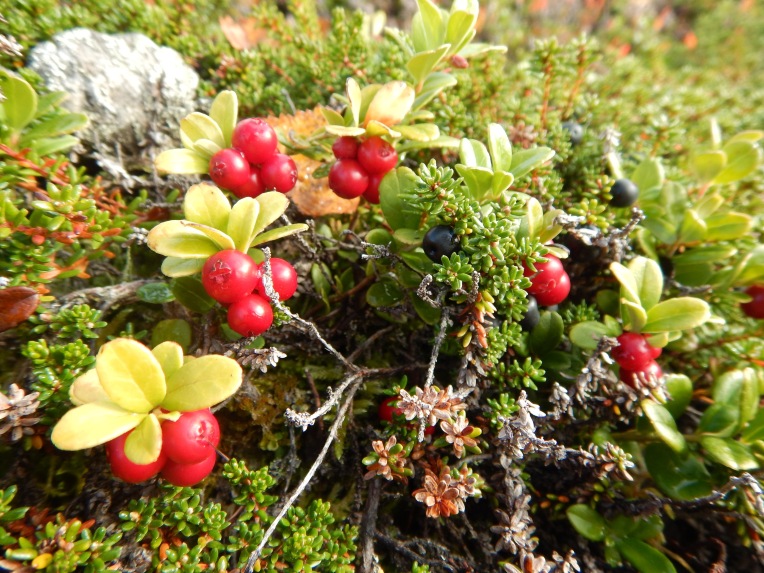
Another set of plants that will be well known to hillwalkers, the Vaccinium genus is the main fruit bearer for local people and hungry researchers. The smallest, Vaccinium vitis-idea (Ligonberry, cranberry, cowberry – you name it!), carpets the surface with tiny, glossy leaves and even glossier red berries where cover is sparse and soils fairly dry. In places the leaves can turn to a deep, merlot red, or still drip with pink-white cowbell flowers. Harder to find on Qikiqtaruk, Vaccinium uliginosum (blueberry, bilberry etc.) rise higher from the undergrowth where soils are wetter, their berries blue, stems tough brown-green and leaves thinner and more leathery.
Vaccinium vitis-idaea (and Empetrum nigrum). These Arctic cranberries make a delicious pie and jam if you have the patience to pick enough!
Rubus chamaemorus
Cloudberry, baked apple, or knotberry in England and averin in Scotland is best known on Qikiqtaruk as aqpik. This is one of the most prized of berries in this part of the world and when perfectly ripe is a delicious topping to pancakes, makes an excellent jam or is the perfect snack when stopping across the tundra. Quick to turn from unripe to rotten, finding your patch of cloudberries in season on Qikiqtaruk can be a challenge. It is rare out there, preferring the wetter habitats on the edges of ponds or in ice-wedge terrain.
The delicate salmon pink berries of ripe aqpik or cloudberry.
Empetrum nigrum
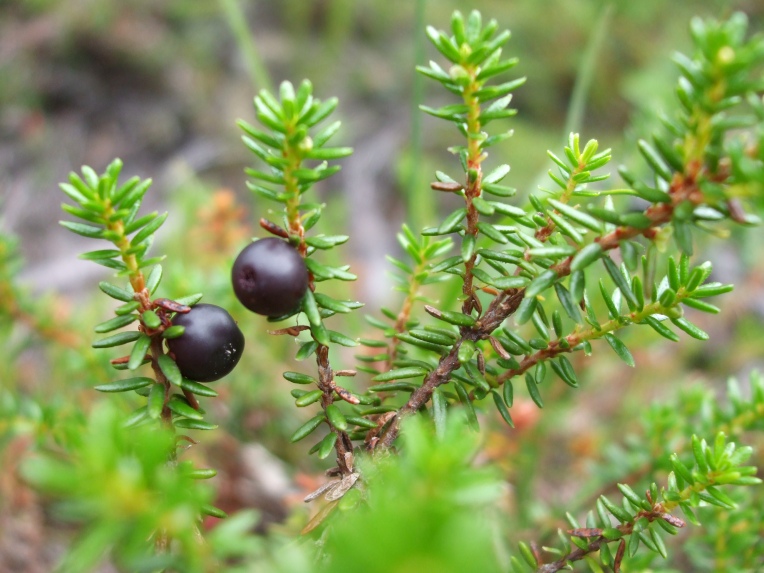
A heathery-looking dwarf shrub that is equally at home in the Scottish Highlands, on mountaintops around the northern hemisphere, under conifer canopies of the boreal forest, and in vast swathes of tundra. Also a clonal shrub, Empetrum nigrum can form dense mats stretching uninterruptedly for meters, or even tens of meters. Its super-power is allelopathy: the leaves contain toxic chemicals which, when leached into the ground after the rain, hinder germination or growth of other plant species. Fun fact: the wood smells delicious when boiled in water (don’t ask, and probably don’t drink).
The bright leaves and black berries of Empetrum nigrum
The dwarf evergreens
Dryas integrifolia
The spear shaped leaves of the mountain avens is to me another iconic shape of the tundra. Whether forming into a sharp coniferous tip, or padded out into the more billowy, deciduous-tree form of Dryas octopetala, these OS map symbols of leaves are unrecognisable wherever they grow. But for many, Dryas integrifolia is best known for its flowers – the perfect white circles that polka-dot the tundra floor – and for the twisted filaments that are the phoenix seedhead, catching the sunrays and diffracting light and themselves across the tundra air.
The bright white flowers of Dryas integrifolia.Twisting filaments of Dryas integrifolia as the flowers set seed at the end of the summer.
Cassiope tetragona
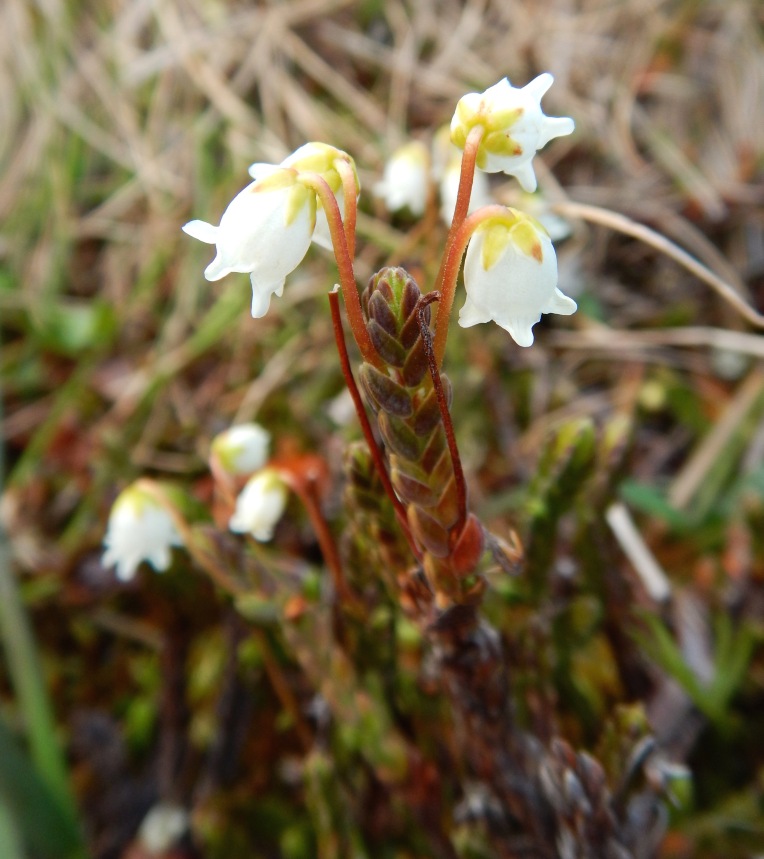
Growing amongst the rocks and along the dry hillsides, the weeping white bells of Arctic bell heather are another distinctive site at the height of a tundra summer. A relative of the glorious purple heather of the Scottish hills, Cassiope tetragona is similarly small and woody, minute spear-shaped leaves wrapped tight into the stem, forming scaly round limbs. As the season turns, these stems gradually shift from green to orange-brown, giving the tundra an almost burnt look, flowers rusting away to leave the brittle seed heads proud to the wind.
Cassiope tetragona with four flower heads as per it’s name is one of the longest lived of tundra shrubs, with individuals being found that can be dated back to over 200 years.
Bonus: The uncategorised
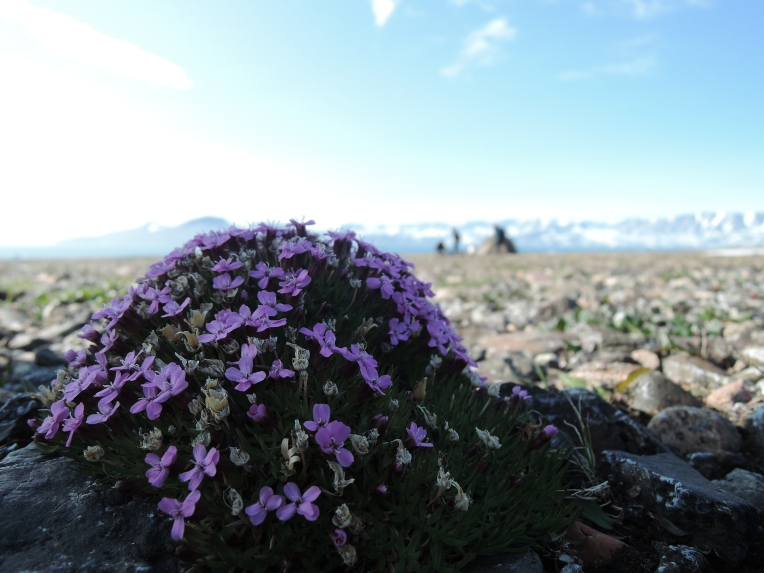
Silene acaulis
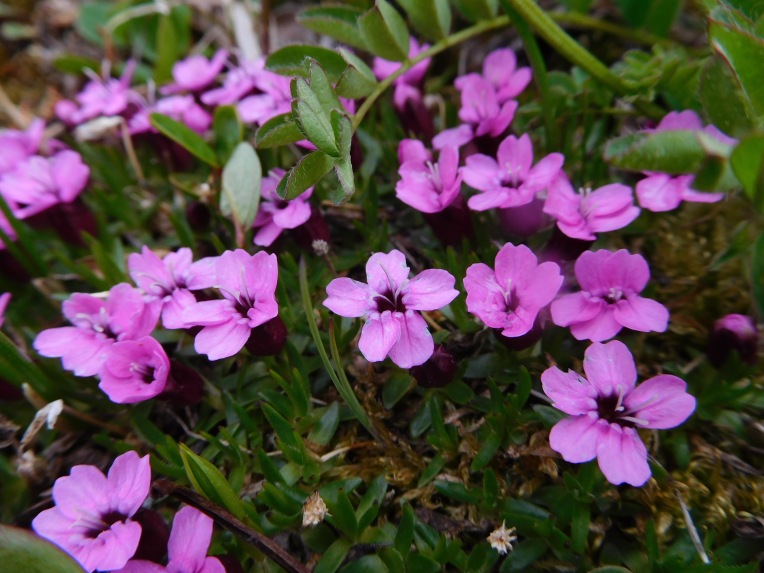
If you’ve reached this far, well done for getting to the end. As a special bonus, I’ve included Silene acaulis, better known as moss campion. There is some confusion here as to whether Silene acaulis is best classed as a shrub or a forb. Silene as a genus refers to the campions, delicate flowers of field and rocks, all pink and white and herbaceous green leaves. Yet the harsher climates to which Silene acaulis has adapted produces a hardy, cushion-like shrub, past leaves compressed into woody stems. For myself, I class this bright plant as a forb, yet since I have seen it classed otherwise so under some schemes, it is worth a brief mention here.
The resilient and secretive Silene acaulis
Beyond confusion of classification, Silene acaulis is by no means one to be relegated to the bottom of any list. It grows where often nothing else will, building a bivouac out of its own sharp leaves against the elements. Within this thick shell, the plant can grow to engulf surrounding rocks occasionally supporting other tiny plants as they grow through chinks in its armour. Most spectacular are the pink-purple flowers, which at the height of the summer dot these minuscule mountains like dewdrops, or like pins in a pin-cushion. Silene acaulis is rare on Qikiqtaruk – the soft, undulating landscape means there are few surfaces too harsh for competitors. But I have seen one once, in passing, making a mental note to come back to sample it later. I have never found one since.
A rare find for Qikiqtaruk, a bit of Silene acaulis, spotted by Isla in the summer of 2017.
We love big bold questions. Synthesising data over large spatial and temporal scales and bringing together information from different sources to support our findings. Along the way, we have our trusty SuperShrub (our mini-supercomputer), but there are some things even SuperShrub can’t handle, or can’t do in the most efficient way. So how can one extract NDVI, land cover, climate data and more over thousands and thousands of kilometers and across many, many days, months and years? Why with the Google Earth Engine!
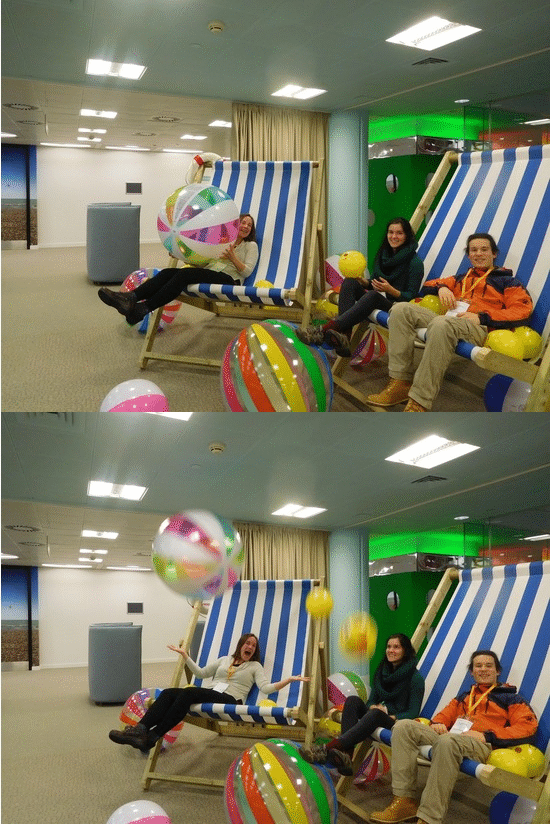
Hanging out at the Google Academy in London – where life is a beach!
Last week, Isla, Jakob, Sam and Gergana headed to London to attend a training workshop led by Noel Gorelick and Nick Clinton.A rainy morning in London with travel delays for some and generally long train rides for all wasn’t a particularly promising start, but it turns out we were off to the beach. We escaped the cold and rain at the Google Academy, where there was a strong beach theme, with colourful beach balls, giant beach chairs and even sand and faux sea grass in the corners of the room. With dreams of working with MODIS, Landsat, Hansen data and more, we were ready to tackle JavaScript and see how we can use the Earth Engine to expand our research horizons. And what did we learn??? Read on to find out.
They even have inflatable unicorns at the Google Academy!
The Earth Engine is fast. Very fast!
Gergana: Being able to quickly access and extract land use information for thousands of locations around the world is a key part of my PhD research on the drivers of biodiversity change. I had heard the Earth Engine is fast, and I knew that one of the datasets I am working with, the Hansen et al. Forest Cover Database, is accessible through the engine, but I am also stubborn and I love R! So many a day were spent trying to push R and SuperShrub to their limits… and well, the code never finished running, as I stopped it after a week of waiting! That is why I was pretty excited to see the Hansen database mentioned in the presentation prior to the workshop, and I couldn’t wait to try extracting information. I adapted some of the code we learned in the workshop and a bit of code I found online, and what do you know, 42 seconds (only 42 seconds!) later, I had a csv with thousands of rows specifying the forest loss and gain in 2001-2014 for the areas I was interested in. Amazing!
A zoomed in view of forest cover change based on the Hansen et al. database. Red is loss, purple is loss and gain and blue is gain.
The Earth Engine is flexible!
Isla: In a one-day workshop, we covered a lot of ground – from pixel classification, spectral unmixing to phenology analyses. We had a chance to explore the greening of our focal field site Qikiqtaruk – Herschel Island all the way up to the greening of the Arctic! We knew that the Earth Engine was a powerful platform, as some of us had dabbled before, but it is great to finally get a better understanding of what the possibilities are. The Earth Engine could be a game changer for earth observation. Below you can see MODIS NDVI trends for our focal research site all the way up to the Western Arctic at 1 km resolution, all calculated in under 10 minutes. You can see pixels with active coastal erosion and permafrost thaw slumping getting browner and the less disturbed tundra vegetation getting greener at the local scale and the patterns of greening and browning in the Western Arctic region.
The greening of the Arctic from Qikiqtaruk to the entire Western Arctic calculated using the Google Earth Engine. Green pixels are sites where the normalized difference vegetation index (NDVI) is increasing (robust regression), brown pixels are where the NDVI is decreasing. You can see browning pixels in areas influenced by active coastal erosion and permafrost thaw slumping at the local scale plot and greening pixels where we have evidence of tundra vegetation change. And at the larger scale you can see the strong greening pattern in the Western Arctic near our field site.
Taking time out of our usual routine to learn new things is important.
Team Shrub recently met to discuss our New Year’s resolutions, and one of our general life goals – “to keep learning new things” – was pretty high up on that list. It’s not always easy to make time for new things in our busy lives, but sometimes it is just something that you have to make happen. Even if it involves taking many trains and feeling motion sick on every single one! As much as we love coordinating Coding Club and teaching students quantitative skills at the University of Edinburgh, it’s also nice to be the one being trained and getting to attend a coding workshop from time to time!
So, for Team Shrub, harnessing the power of the Earth Engine might allow us to expand our horizons from scaling from plots to landscapes to the entire tundra biome and to quantifying the drivers of biodiversity change around the planet. And now that the training is over, we can’t wait do dig in deeper and explore our earth observation research questions in a whole new way.
Being a field assistant for the first time isn’t always easy. Following on from Izzy’s recent post, here are five more great tips from Cameron on how to be an awesome field assistant (and to have an awesome time).
1. Apply for funding
Being a field assistant costs money. In many cases you might be employed by an organisation, research group or researcher to carry out the role, in which case they will be covering your costs. However, you may be required to (or want to) provide funds yourself. But don’t fret! There are plenty of funding opportunities hidden out there for the proactive field assistant to find. Most funding requires you to submit a proposal outlining what you will be working on and how much you think it will cost. Once you have drawn up a proposal for one funding application it is easy to tailor it for others. Keep an eye on the submission deadlines and apply to as many funds as possible. In my experience, funds for undergraduates aren’t very competitive, so make use of them!
Information for funds available for University of Edinburgh Students can be found here.
Cameron fishing for funds
2. Take good equipment
When you are setting up experiments in a snowstorm, or climbing mountains before breakfast, you quickly learn to appreciate the value of good equipment. However, if you haven’t been in the field before it can be hard to figure out what sort of stuff to bring with you. For me, the most important bits of kit are good waterproofs, a decent backpack, and an excellent pair of walking boots (we had a pair fall apart this summer). If you are going to spend a lot of time in the field you should treat yourself to some nice gear. It’s totally worth the investment and good quality stuff can really improve your comfort and safety. Why not add the cost of a beautiful jacket and boots into your funding application (for health and safety reasons, of course)?
Just another summer’s day in the tundra
How to mend a broken sole
3. Ask lots of questions
“Why are we digging up old tea bags from the ground and what’s the deal with all of these dead leaves?”
Take the opportunity to learn as much as you can from the people you are working with. Asking questions and figuring out why you are doing a task can really help you get more out of your time in the field and cement knowledge learned in the classroom. You will also likely be working with people further on in their career than you. If you are thinking about a career in academia, take this chance to pick their brains about all aspects of academic life.
Haydn showing us the ways of the shrub
4. Take the bad with the good
Hopefully you will experience many great things during your time as a field assistant but you might also experience some pretty bad lows. The work can be gruelling and the days long. A healthy mentality is key to enduring the bad moments and enjoying the good. Make sure to talk to your team if you are having difficulties, and look after yourself. It really is worth it at the end.
Conquer your mind and you can conquer the tundra
5. Let yourself be enchanted…
Fieldwork can take you to some truly special locations. We get to explore hidden valleys, shadowy forests, and secret little places far from any path. Please take some time, in-between sampling and recording data, to fully appreciate the wonderful environment and people around you. Not only does this add to your overall experience, it can also turn you into a passionate advocate for these incredible areas. Tell the stories of these places anyway you can, be it on Facebook, in prose, or down the pub. The more people know about your field site, the less likely it will fade into obscurity and be lost.
Like an Arctic willow in the tundra sunshine, we soaked up the beautiful rays of knowledge and delved further into the active layer of understanding. We grew taller and bushier as new members joined the team, and branched out into new areas of research. We bore fluffy research paper catkins, for our ideas and findings to be spread on the breeze of scientific discovery, and we put down new roots, to support, work with and learn from others in the future. And, of course, we had a thoroughly enjoyable time doing it all.
So as we look forward to all that 2018 brings, we are taking some time to revisit the year gone by, our favourite blog posts, and just how far we came in 2017.
Looking ahead: After a politically turbulent 2016, who could know what 2017 would hold? We spent the start of the year looking ahead with some trepidation, some anticipation and a good dose of excitement.
Decomposition in the cold. We kicked of a busy year as Haydn and Isla headed on a tour of Denmark and Sweden to attend the Oikos symposium on Decomposition in Cold Biomes (https://globalsoilbiodiversity.org/content/oikos-satellite-symposium). It was appropriate as the temperatures had dropped that week and it was quite snowy and chilly in beautiful Lund, Sweden as we chatted about cold-weather decomposition while cosy inside.
Taking a tea break in Umeä
To Aberdeen. In March, it was our first Team Shrub trip to Aberdeen. We had a beach coding holiday and attended the Scottish Ecology, Environment and Conservation conference with Gergana, Haydn and Sandra presenting. We teamed up with Francesca Mancini from the Aberdeen Study Group to lead a coding workshop on efficiently analysing and visualising big-ish data in ecology.
Jumping for joy at the thought of more coding!
Glimpses of our future? By April, we had a wee glimpse into what 2017 might have in store for us through a traditional Bulgarian pastry dish with our fortunes inside!
Tundra Greening and Browning. Also in April, After a lab trip to Durham, Haydn’s home town, to talk permafrost for a day at Durham University. Andy and Isla went to the home of the Crucible, the land of snooker, the (real) region of Robin Hood, and the heartland of the only English football team named after a day of the week. (Also the home of the Arctic Monkeys – who incidentally haven’t spent much time in the Arctic). If you haven’t guessed yet, we went to the town of Sheffield for the ‘Arctic Browning Workshop’. The Arctic is warming and satellites have shown a fair bit of greening, but recent evidence suggests a decrease in the rates of increasing greenness at high latitudes and some browning events. The theme of the workshop was exploring that Arctic browning and what might be causing it.
A trip to the Highlands. Also in April and before the field season, Team Shrub headed to the highlands to show our visiting scholar Jeff Kerby and our summer drone pilot Will Palmer the beautiful countryside in our own backyard.
Traits. In June, Haydn, Anne and Isla headed the deep South of the UK to almost tropical temperatures at the University of Exeter. We were at the New Phytologist 39th Symposium on Trait covariation. Whether in the symposium sessions or out on Dartmoor, we had a great time pondering plant traits from the tropics to the tundra.
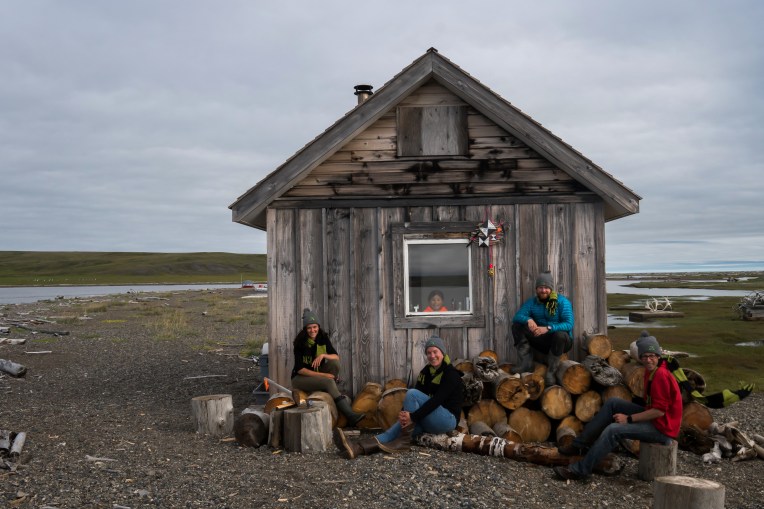
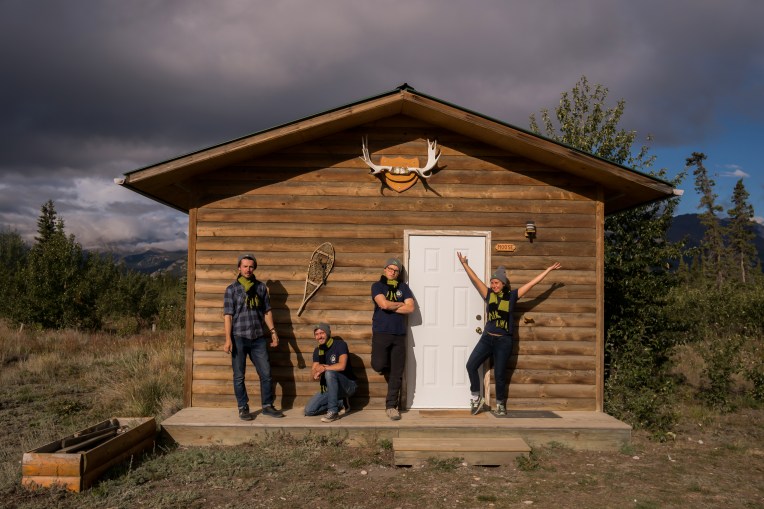
The Field Season. Suddenly it was the field season. Team Shrub divided into two teams: Team Drone and Team Kluane to concurrently conduct our data collection on either end of the Yukon. From drones, tea bags, phenology, stories, sounds, smells, feasts, birding, to reunions many adventures were had and a ton of data was collected. We managed to capture over 100,000 images or more than two TB of data with our drones, to dig out over 300 tea bags from the ground, and to fill several field books or iPad spreadsheets with numbers and notes. It was a productive period and we are still working away on processing the data.
Team Shrub together at last!
New beginnings. This September marked the start of Mariana’s and Gergana’s PhD research. Mariana is modelling how plant species distributions will shift under climate change at two extreme biomes – the tundra and the savannah. Gergana is quantifying the effects of land use change on global and local patterns of species richness, abundance and composition. Sam, Claudia and Matt have joined Team Shrub for their honours dissertations. The data presents will soon be rolling as new student projects come together and our first three Team Shrub PhD students finalise their dissertations over the coming months.
First day of being a PhD student for Mariana and Gergana!
Coding. Coding Club celebrated its first birthday! Coding is a big part of our work on Team Shrub, we use coding in our research, teaching, our lives in general… where would we be without it. Perhaps a bit less constantly frustrated, but also without those moments of glory when everything runs error free! We even made up a fictional journal for the Conservation Science course that Isla organises and Gergana and Mariana are tutors on. You can find out more about AQMCS (Advanced quantitative methods in conservation science) here – Same data – different results? ConSci 2017 introduces AQMCS!
Conservation in the Cairngorms. In early October, members of Team Shrub took our annual pilgrimage up to the highlands of Scotland for the weekend fieldtrip on the Conservation Science course. With all sorts of weather, mountains, drones, delicious cake and an epic music jam, fun was had by all!
Learning about conservation in a majestic landscape
Biodiversity, the New North and the science/policy interface. Also in the month of October, along with keen undergraduates from the Conservation Science course, we went along to the Spotlight on Scotland’s Biodiversity conference. For the undergraduates involved, it was their first ever conference. It was pretty inspiring to see the next generation of conservation scientists getting the opportunity to talk with the Scottish experts in the field. A few weeks later in November, we headed to the “Scotland and the New North” policy forum, where Isla got to hold the door for Nicola Sturgeon! A new focus looking Northward for Scotland could mean new things for Team Shrub research in future.
What will Scotland’s new focus northward mean for Team Shrub?
Also in November, Mariana attended two policy-related events: the EEB Changing Landscapes conference in Edinburgh and the BES “Understanding science policy in Scotland“ workshop in Stirling. The first was a high-level event where major conservation organisations discussed the future of nature in Europe; while the second zoomed into Scotland to understand how science can feed into the policy-making process.
Writing. In November, Team Shrub had our first official writing retreat. We have been talking about having a writing retreat for years and finally things came together with a chance to focus on our writing goals, away from distractions. We were so inspired that we are planning on having a residential writing retreat sometime in the Spring of 2018 – where we can go from one day of super high productivity to hopefully a long weekend.
Dual Conferences. In December, Team Shrub headed to two big conferences happening at the same time! You can read about our parallel conferences experiences here. At Ecology Across Borders in Ghent, Belgium, Anne, Mariana and Gergana joined over 1500 ecologists to take in lots of exciting science, go to workshops, meet new people or catch up with old friends. Gergana and Anne gave talks, in sessions happening at the same time!
Best talk of today goes to @annebeejay. Amazing photos, excellent story about change in tundras and a very enthusiastic speaker #EAB2017
At Ecology Across Borders, we also led a Coding Club workshop, titled “Transferring quantitative skills among ecologists”. We shared our approach to teaching coding to keen participants from the conference. All of our workshop materials are online: Transferring quantitative skills among scientists. You can also check out the Coding Club website to find all of our tutorials as well as information on how you can join our team and organise workshops at your home institution.
#EAB2017 Workshops done! Quite amazed by the work of the @our_codingclub seems they've found a very nice working system for students of all degrees to find and give support in coding! Nice work really!
The other half of Team Shrub, Isla, Sandra, Haydn, Jakob, Andy and Jeff went to Quebec in Canada for the penultimate ArcticNet meeting – Arctic Change 2017. You can check out the daily round-up blog posts about the conference here – day 1, day 2, day 3 and days 4 and 5. A pinnacle moment for Team Shrub was Haydn and Jakob winning the top two prizes from the conference elevator pitch contest!
Rejections. When we drafted our goals for 2017, we also set out our rejection goals. The idea behind rejection goals is that if we never get rejected, then maybe we aren’t aiming high enough. We decided to collectively aim for 50 rejections. So how did we do? We counted 23 rejections out of our goal of 50. Now perhaps we didn’t manage to count every single rejection this year, some of them we would rather just forget, but can we count the fact that we didn’t achieve our rejections as one additional fail? Then technically we are at 24 out of 50?
Team Drone on Qikiqtaruk – Herschel Island in the Northern Yukon.Team Kluane at Outpost Station in the Southern Yukon.
Outreach. At Our Dynamic Earth, we shared the excitement of using drones for science. At the Edinburgh Science Festival, we explored art as a way to communicate science. We put together the photography exhibit “Arctic from Above” and developed collaborations with Simon Sloan, Archie Crofton to explore how art and data interface and ASCUS looking at tundra shrubs as time machines. Then at Curiosity forest, part of Explorathon 2017, we used drone simulators and cool dendrochronology samples to learn about how to study Arctic change.
There were also many jolly meals and trips to the pub. Many heated debates as we discussed science in lab meeting or over lunch. There were many moments of coding frustration followed by a sense of achievement as we worked through our scientific goals.
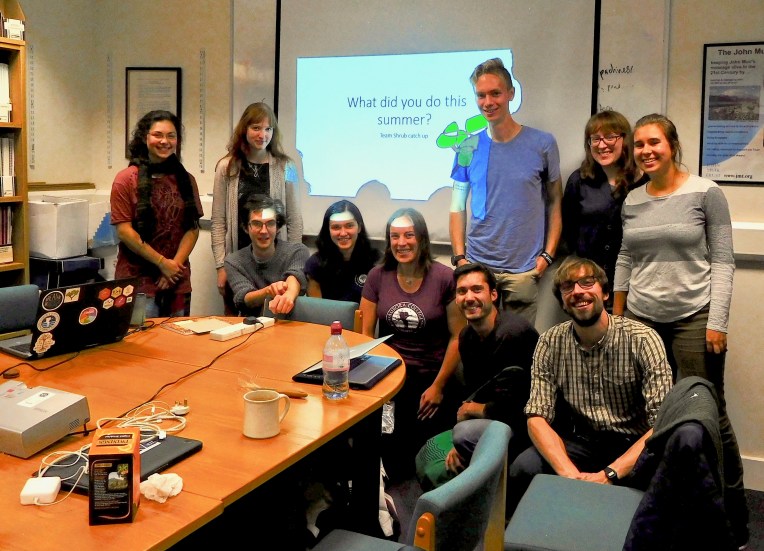
One of many lab meetings!
So those were some of the Adventures for Team Shrub in 2017.
What will 2018 hold? We already have some exciting things to share with you over the coming months, and many more in the pipeline. Hopefully we will also have some fantastically fluffy catkins this year: keep your eye on the breeze.
So from all on Team Shrub, a very happy new year and we look forward to sharing with you, working with you, and learning from you in the year to come.
We hope that through our words and photos we’ve provided a glimpse into life as a scientist and what the research journey involves. Indeed, things don’t always go to plan. But sometimes expectations are surpassed, or what initially seemed bad doesn’t turn out that bad after all.
It’s been a great year for Team Shrub (stay tuned for our blog post on our highlights from the year!), and as 2017 comes to a close we would like to reflect on those 54 blog posts and share our very favourites.
The votes are in. Here are the results, in no particular order: our ten favourite blog post of 2017!
Yukon Parks ranger Edward McLeod shares his perspectives on working as a park ranger and the collaboration between the rangers and researchers here on the island.
Fieldwork and stories tend to go hand in hand – funny stories liven up those moments when no field plan seems to work, and evenings after a day’s work can quickly go from quiet to lively chatter. Stories are how we communicate both our daily lives and our science.
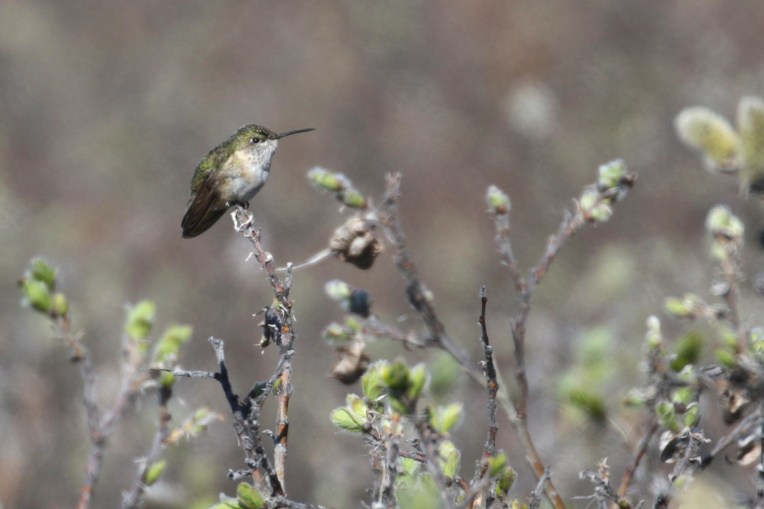
It was little more than a flash in the willows, just for an instant and then vanishing, but one that stopped me in my tracks. Could that have been a hummingbird?
Yukon Parks Conservation Biologist Cameron Eckert shares fantastic stories of bird sightings on Qikiqtaruk. Cameron has studied the birds, wildlife, and ecosystems of the Yukon’s North Slope and Herschel Island for the past 25 years, and he works with Yukon Parks Rangers to coordinate the island’s ecological monitoring programme.
Perhaps it was when I was waving to someone with a rusty hammer across a dusty runway, dragging a sledge full of dead leaves. Or perhaps it was when digging sunflower seeds out of the snow at 6am, while listening out for birdcalls and watching for bears. Or maybe when burying teabags on a wet mountainside, hoping they didn’t blow away in the wind. Whenever it was, I came to the realisation that this mad adventure called a PhD is soon to be over.
We have often asked you to imagine what it would be like to be here with us in the Arctic. Through words, photos and videos, we have tried to bring the Arctic closer to you. So close that if you just imagine, you may well see it. You could even hear it. If you ponder the many changes occurring on Qikiqtaruk Herschel Island, from changes in vegetation structure and community composition to changes in what our life is like here, and listen again, you could hear a change.
The Arctic – you can see it, you can hear it, and now, for a fuller experience, we present the Arctic smellscape of Qikiqtaruk, so you can smell it, too.
We are crazy about the fragrant smell of Labrador tea
Who knew there is such a niche for describing how a place smells! The Team Shrub blog – an experience for all senses! It might have started off as a joke, but smellscapes are totally a thing now, and Arctic Smellscapes is one of the blog posts that most often comes up in our minds when we think about the summer of 2017!
The Edinburgh International Science Festival was the perfect occasion to bring together beautiful photos with cool artifacts from our fieldwork for an event under the theme of “Arctic from Above” – Team Shrub’s first exhibition!
Shrubs are always there. They’re reliable little fellows, sitting quite peacefully on their little patch of soil. You can go up to a shrub, pat it on the head, give it a little hug… whatever floats your boat. Shrubs don’t care. You can come back the next day, the next day, the day after that, hey we come back year on year! Our favourite shrubs are still sticking around, stoically soaking up the sun and the storms and the deep snows of winter. Choose a shrub – they’re always there for you.
If you close your eyes and imagine you are with us, the soundscape of Qikiqtaruk is as magical as the landscape! All the sounds here are so much more distinct because usually it is so quiet – even a gentle wing flap by the nearby pair of tundra swans resonates through the air. We have all enjoyed taking quiet walks after a day of fieldwork – a time to look, listen and take it all in.
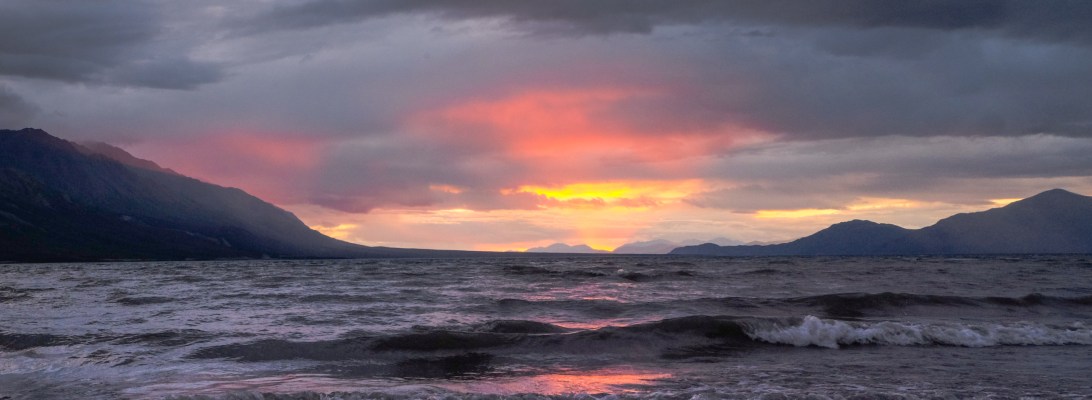
Sea ice and fog along the Arctic coast with the British Mountains in the background.
On the morning of our last day, everything came together. Beautiful belugas accompanied us on our beach walk towards the data loggers on Collinson Head. We had all the tools we required (well almost), we even managed to improvise a radiation shield out of wooden skewers and medical tape to fix the broken one on that pole. And once we removed all the screws without dropping them in the pond below the logger box and plugged in the cable without getting it wet, the data were on our laptop in minutes! It is a great feeling to leave your field site knowing that you have accomplished all of your fieldwork goals.
A lovely meal in the sunshine on the last day before the rain and wind came!
Page after page, we have been pondering patterns and processes in community ecology under the sounds of gusting winds and heavy rain. From one storm to the next, when our field days were cut short, we could sit by the fire in the Community Building (the oldest building in the Yukon) and delve in deeper into Mark Vellend’s “The Theory of Ecological Communities”.
We thoroughly enjoyed reading “The Theory of Ecological Communities” whilst on fieldwork at our remote field site in the Canadian Arctic. There is particular charm in reading about a certain ecological process, be it high- or low-level, and then observing it in action moments later in the field.
Isla’s copy of The Theory of Ecological Communities that looks like it has been eaten by a polar bear! But it was actually partially eaten by a dog. Clearly a book you can really chew on – some ecological theory you can bite into…
Highly commended (because there were a few ties in our top 10!):
And so we arrived, CV’s at the ready and slightly nervous, ready to discuss exactly what it takes to get your dream job. Here is a summary of our thoughts trying to encompass jobs from an undergraduate summer position, PhD or postdoc through to an academic job.
What does the future hold for Team Shrub? Сладка баница (or sladka banitza) is a new year’s tradition in Bulgaria, it is a pastry that is both sweet and salty representing both the good and the bad in life and it contains pieces of paper cooked in with fortunes written on them! Sure, it isn’t quite the new year anymore, but it is a bit of a new beginning for Team Shrub with new students joining the lab for the summer’s field season or as dissertation students for next year.
Did our fortunes come true? Isla has certainly learned a few super efficient dplyr tricks along with some dplyr frustrations and there has been a tiny bit of deep machine learning on Team Shrub in 2017. Though perhaps we haven’t yet found our state of research zen nor has that big grant come through… We can tell you more in our Highlights of 2017 blog post! Until then, thank you for reading and engaging with our blog post, we have loved sharing our research and the journey towards it with you, and we look forward to another year of blogging!
































 Team Shrub