Holiday Reading List

If your holiday is like mine, it is a chance to catch up on all the things that passed you by in the rest of 2017. Then, perhaps you will enjoy a few of the articles that I have been reading or re-visiting over the past couple of days. While explaining to my visiting family why I do the research I do, I have been drawing connections between past and current collaborators, the activities of Team Shrub over the last year and thinking ahead to future research possibilities.

The holidays for me is a time to sit in front of the Christmas tree and catch up on some reading, be it journal articles, all of the manuscripts I have been remiss on commenting on over the past few weeks or blog posts and magazine articles on topics close to my heart.

At the December ArcticNet meeting a couple weeks back, I had the chance to catch up with folks from the Canadian Museum of Nature and to ask after the world’s premier willow taxonomist George Argus. This reminded me of my visit with George during my PhD, when I spent a wintery day with him in at his farmhouse near Ottawa going through willow samples from my PhD field sites confirming my willow ID skills and hearing stories about Alaska back in the day.  Thinking about George got me thinking about my former officemate during my MSc at the University of Alaska Fairbanks Les Viereck and my former neighbour Ginny Wood.

Ginny told me in person of the incredible tale of the first assent of Denali’s South Buttress, then known as Mt. McKinley, the tallest mountain in North America. George Argus, Les Viereck, Morton Wood, Elton Thayer made the climb with Ginny flying the food resupplies in the spring of 1954. On the expedition, the very same George Argus that I met during my PhD, was left in a tent for over a week with injuries after tragedy struck high the team up on the mountain. The following article from back in 2002, gives a riveting account of the tale which is well worth checking out if you have never heard the story before. These science and conservation heroes of mine, make my own adventuring seem very tame. But I feel privileged to have got to know Ginny, Les and George during my MSc and PhD, and they remain a source of inspiration to this day.

Remembering Denali’s Greatest Rescue

H1DO_Thayer___Argus_in_tent
George Argus sticking his head out of his tent when stuck on Denali back in 1954.

Ginny would be appalled by the current political situation in the US.  She used to discuss with me the hubris of previous administrations – a word I will always associate with her. I can’t think what she would say now.  Ginny was a great proponent of wilderness preservation in Alaska and was the co-founder of the Alaska Conservation Society.  She was a key supporter of the establishment of the Arctic National Wildlife Refuge (ANWR) in 1960 when she lobbied U.S. President Dwight D. Eisenhower to establish the reserve.

This beautiful article by Christopher Solomon from November in the New York Times makes the recent passing of the tax bill and the opening of ANWR to development this month all the more poignant. This vast tundra region adjacent to the Yukon North Slope where Team Shrub has been working for several years is a fragile wilderness that is currently exposed to potentially dramatic impacts from climate change. ANWR truly merits protection from development and it makes saddens me deeply to see that protection lost.

la-mn-na-0823-ladies-jpg-20130312
Ginny Wood and Celia Hunter being recognized for their contributions to Alaskan conservation in 2001.

Reflecting on the North Slope of Alaska, makes me remember that it is also a place where my car was once broken into while I was on a five-day hike in the foothills of the Brooks Range. Some of my stuff was stolen including my back pack with a few telephone numbers in it, including Ginny’s number and that of one of my MSc supervisor. When a fisherman found the backpack floating down the Sagavanirktok River, he assumed the worst, but luckily I had just arrived back to Fairbanks and could let everyone know I was okay. It was also a bit of a challenge to make an insurance claim, as the car was broken into in the jurisdiction of Barrow Alaska even though Barrow was over 500 kms away with no connecting roads. There was a lot of confusion on the other end of the line when I tried to call in the break in. That car, Dr. J, met it’s end in a scrap heap this very year in 2017, after serving me loyally for over a decade and it is a vehicle I will greatly miss. Oh, the adventures that two-door Hyundai Accent without power steering and I had!

My travels to the North Slope of Alaska with my trusty car Dr. J back in the early 2000s when I was an MSc student at the University of Alaska Fairbanks.

Thinking about future development on the North Slope of Alaska, makes one consider the current rapid development in other regions of the Arctic.  This evocative article that appeared in the October issue of National Geographic follows the Nenets reindeer herders on their annual 800 km migration across the Yamal peninsula through the development of the Russian oil fields. I guess I knew about the article when it first came out, but I didn’t get a chance to read it properly until this holiday. The article features a colleague of Team Shrub, Bruce Forbes, who has been studying and working with the Nenets people for decades to understand their resilience in the face of change.

They Migrate 800 Miles a Year. Now It’s Getting Tougher.

One of the team, Jeff Kerby had a chance to visit Yamal this past summer funded by a National Geographic Explorer grant.  In this blog post, he recounts his time in Yamal during an unexpected heat wave working to set up exclosures to understand the impacts of herbivory and collecting drone imagery as a part of the 2017 data collection for the High Latitude Drone Ecology Network that Jeff and I have been coordinating. Fieldwork in Yamal seems much more challenging that our work in Northern Canada with soaring temperatures and thick clouds of mosquitoes, but the imagery that Jeff has put together is striking. Aerial shots of reindeer herds crossing the tundra looking like ants from above and fog flowing like a river past shrubby tundra. I wonder what secrets hi-tech drones will indeed reveal.

Indigenous Cultures and Hi-Tech Drones Reveal Secrets of Siberia

And if you haven’t seen it already, you should totally check out Jeff’s other Nat Geo contribution this year when his photography and story were featured in the April issue of the magazine. This time it is the Gelada monkeys of the Ethiopian highlands that Jeff highlights with stunning photographs and a compelling scientific story.

Where the World’s Only Grass-Eating Monkeys Thrive

On the Nat Geo theme, I wanted to give a shout out to this story about the “Trees of the Tundra” featuring Steve Mamet about treeline research in Churchill, Manitoba on the coast of Hudson’s Bay. In his quote, Steve highlights the importance of data collection in tundra ecosystems to fill in the gaps where sophisticated computers models make assumptions. Filling in the gaps is one of the main motivators of Team Shrub’s research as well.

Trees in the Tundra

Beavers, Canada’s iconic national animal, have also recently featured in the New York Times. In this December article, the Beaver is highlighted as an agent of change in the tundra in an article covering the research of Team Shrub collaborator Ken Tape. I first remember seeing tundra Beavers in Denali National Park during my time in Alaska. The Beaver is relatively at home in a treeless tundra as long as there are tall shrubs to chew on, so to is the Moose and other creatures more normally associated with habitats south of treeline. As they move into tundra ecosystems they may alter those landscapes in relatively permanent ways such as enhancing permafrost thaw as the New York Times article highlights.

And while we are on the theme of treelines, tundra and climate change, Steve, Jeff, Ken, myself and Team Shrub’s other collaborators Trevor Lantz, Rob Fraser and Carissa Brown are all featured in this online piece by Kate Allen in the Toronto Star on the impact of climate change on species distributions in the Arctic and beyond. Whether it is shrubs, trees or butterflies, climate change could be redrawing the map of where species live and thrive.

The Great Global Species Shakeup

Orca_floodplain_02_desktop
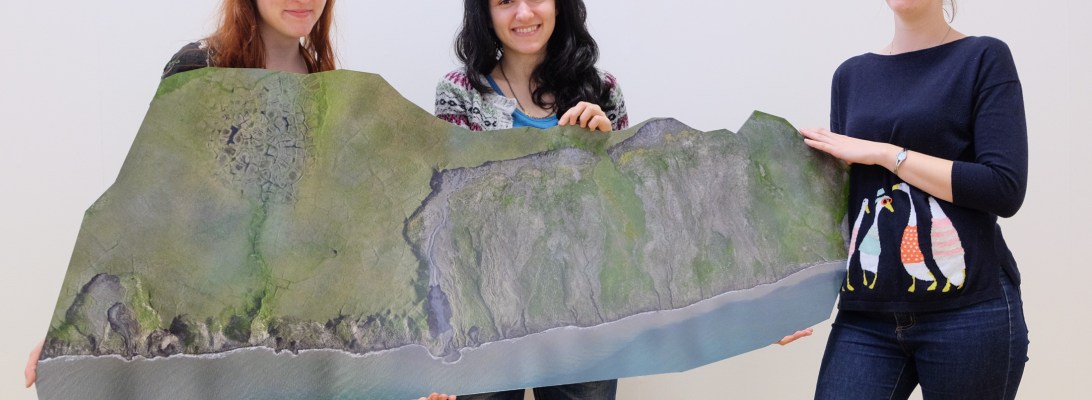
“Matched up photos of Qikiqtaruk-Herschel Island Territorial Park in the Yukon to visualize changes to vegetation, permafrost and coastal erosion” – from the Toronto Star

If you want to read a bit more about Team Shrub’s media coverage this year check out Jakob’s excellent interview with Camellia Williams in September about our drone research:

Capturing change in the Arctic

Or have a read of Haydn’s interview with Lesley Evans Ogden about the Tea Bag Index – using the humble tea bag to quantify controls on litter decomposition across the tundra biome.

Brewing Big Data: The Tea-Bag Index

tea bags

And, if you want to see some of the changes we saw first-hand in the Arctic this summer, check out the CBC coverage:

Researchers stunned by rapid rate of erosion on Herschel Island

DSCN5018
Coastal erosion near Pauline Cove this summer. Check out http://www.cbc.ca/news/canada/north/yukon-herschel-island-erosion-1.4253948 for the CBC article about it!

Finally, if you want to ponder how art and science can be brought together and how tundra shrubs can act as time machines to help us understand past vegetation change, check out our blog post about Team Shrub’s contributions to the Edinburgh Science Festival:

Team Shrub at the Edinburgh Science Festival

So, that is a wrap up of some of Team Shrub’s media coverage in 2017 and a taster of what I have been reading and thinking about this holiday break. Thinking back on colleagues of the past and current collaborations makes me wonder what 2018 has in store. The Arctic is likely to continue to experience rapid change, and hopefully Team Shrub will be there collecting and analysing to help fill in some of the key gaps in our understanding of tundra vegetation change. And maybe this time next year, we can update you further on some stories of Arctic change.

By Isla

Arctic Change 2017 – Thursday – Friday round-up

So, it is the end of the week Friday morning and the final plenary session of the Arctic Change 2017 conference. Team Shrub is not feeling quite as perky as we were at the beginning of this conference, in fact some of us are feeling rather beat! It has been a week of full on science – conferencing by day and preparing talks by night. Last night was banquet night, a big night for Team Shrub – thus the delay with the Thursday round up. So, to find out about our final days at Arctic Change 2017 here is the Thursday – Friday round up.

It was a very proud moment yesterday for everyone on Team Shrub, and for me in particular as their supervisor, when PhD students Haydn and Jakob swept the leader board in positions 1 and 2 for the 1-minute presentation pitch competition. From the very back of the banquet hall to the front of the stage, with shouts and whoops from the Team Shrub table, Jakob and Haydn accepted their awards (with or without shoes on)!

Check out their awesome pitch YouTube videos here on the Tundra Tea Bag Experiment and using drones to quantify Arctic Tundra greening:

Both Haydn and Jakob gave presentations on Thursday at the very same time. Forcing me and the rest of the team to have to choose!!! Haydn presented Team Shrub’s tundra plant trait research to link vegetation change via traits to changes in ecosystem functions. Jakob presented results from his PhD and the Shrub Tundra NERC project quantifying tundra greening across the growing season using drones and satellite data. Both Jakob and Haydn totally rocked their presentations to packed rooms with great feedback and engagement from the audiences.

Next, Andy presented about his work as a part of the Shrub Tundra project to quantify tundra change using drones. From coastal erosion, thaw of retrogressive thaw slumps to quantifying shrub growth – Andy covered a lot of ground very clearly explaining the rapidly advancing technology and awesome Arctic applications. It was super exciting for me to see our hard work over the past three years on the NERC funded ShrubTundra project presented by the team.

I gave a talk in the UK-Canada Arctic Collaboration session sharing the preliminary results of Team Shrub’s 2017 collaboration funded by the UK-Canada bursary programme. We are collaborating with the Arctic Ecology Lab and Trevor Lantz at the University of Victoria, Robert Fraser at Natural Resources Canada, Jurjen van der Sluijs at the NWT government and Eric Cheyne and Aurora College to quantify tundra shrub biovolume to understand the drivers of tundra shrubification in the Western Canadian Arctic. My talk hopefully convinced the audience of the power of collaboration, and how by teaming up with other groups through this collaboration and also the newly founded High-latitude Drone Ecology Network you can collect data and answer scientific questions beyond the reach of any one group. You can check out our recent coverage in the Toronto Star to find out more about how both Trevor’s group and Team Shrub are studying shrub change and permafrost thaw in the Canadian Arctic.

Over coffee breaks and post presentation chats we have made some great connections this week with collaborators old and new. Thanks to everyone who stopped by the Team Shrub posters or came to chat to us after our talks.

After banquet festivities including a performance from Iqaluit’s The Jerry Cans and some late night revelries at Le Sacrilège, it is now the final day of the conference and time to wrap up our ArcticNet meeting experience for the year.

In the final plenary, Louis Fortier spoke to us about the future of ArcticNet and we heard about Yukon College becoming Yukon University. The end of the week makes me think about what is in store for Arctic research in Canada and how UK researchers like Team Shrub can play a role. I hope over the coming years, we will be able to help to answer the key questions facing the Arctic research community such as quantitatively attributing tundra vegetation change to climate warming and testing the correspondence among different records of vegetation change from on-the-ground, drone and satellite records.

The Arctic Change 2017 conference was an excellent week for Team Shrub. A chance for us to present our latest research, meet and hang out with tundra scientists from across Canada and around the world, report back on current collaborations and establish new ones and all and all have a wonderful time in beautiful Québec City. Thank you to the NERC Arctic Office, the British High Commission in Ottawa and the British Ecological Society for supporting our travel. And it turns out that all of our tweeting activity during the conference has payed off, as with our with 73K tweet impressions, we were highlighted as the top tweeters at the conference!

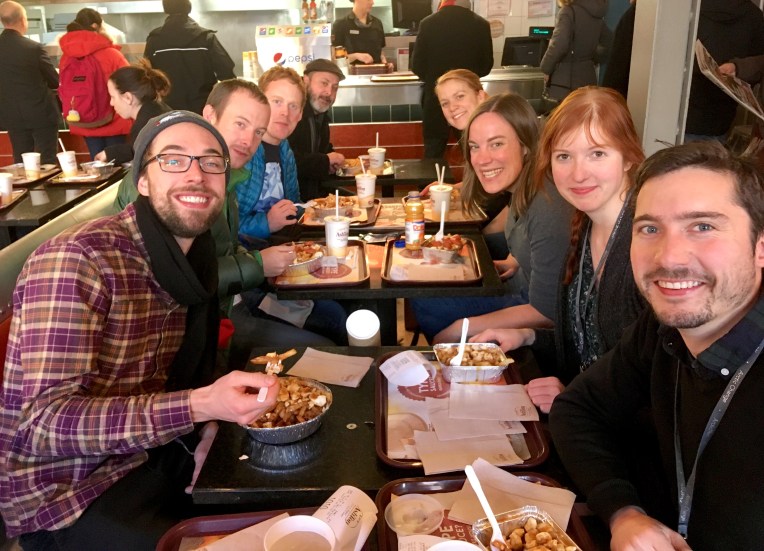
Now that the conference has wrapped there is time for one last meal of poutine. Until next time!

image1-1

By Isla

Will I stay or will I go

Over the last week and a half I have been on an epic journey from the UK to Canada and up to the Arctic to join the drone research crew at our remote Arctic field site Qikiqtaruk – Herschel Island, but I have been stopped at the final hurdle and am stuck in Inuvik.

Every morning I wake up wondering, will I stay or will I go. This is the third day in a row when I haven’t known whether I would make it into the island or not and I am still here. Yesterday I got tantalizingly close to the island, as we flew out there and couldn’t land due to the wall of fog that was enshrouding the island. I thought I could illustrate the trip with a bit of a photo essay, so that you can all experience the journey of flying out to the island and experience the shared frustrations and beauties of Arctic fieldwork with me.

The journey starts out at the float plane dock on Shell Lake near Inuvik.

float plane
The Cesna 206 float plane that is my transport to the island.

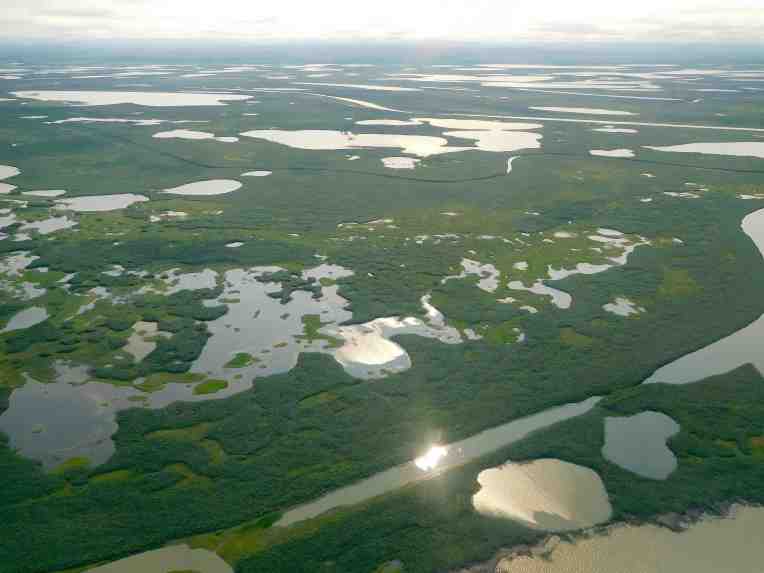
First, you take off and head out past Inuvik and across to the Mackenzie Delta.

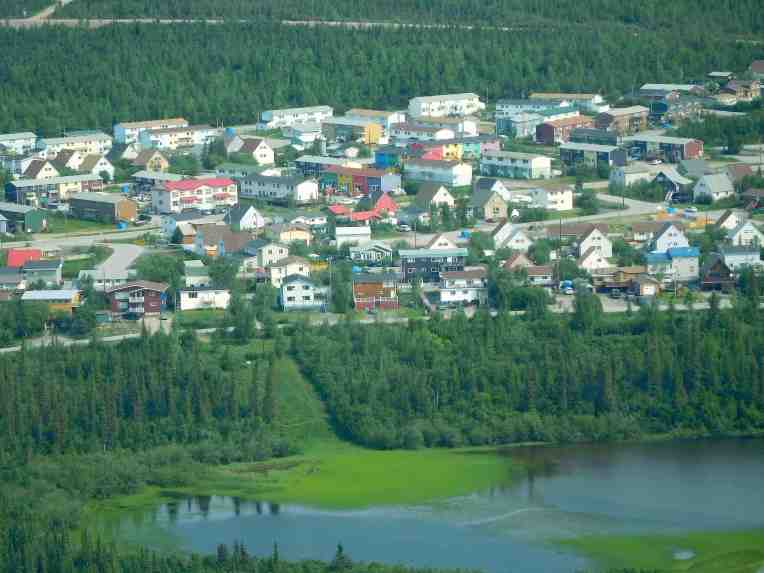
Inuvik2
The town of Inuvik.  Population 3500.

Here you can see the row houses where we are based when in town in the upper left hand side of the photo.

Inuvik
The Inuvik row houses where we stay when in town.

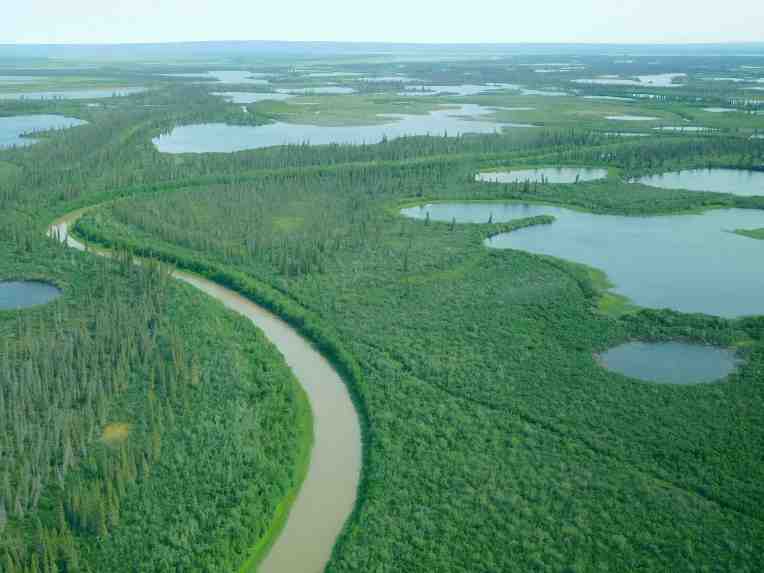
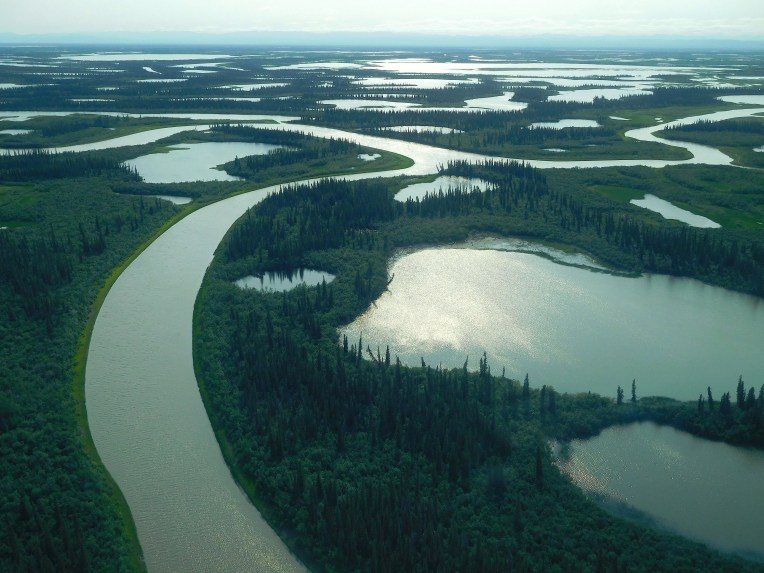
The Delta was shining in the sunshine yesterday (shining like a national guitar if you will), without a hint of what weather was to come.

Delta1
The Mackenzie delta in the sunshine.

Out on the Delta there are many beautiful shrubs like these that I captured from the air as we flew by.

shrubs
Shrubs on the Mackenzie delta looking very shrubby!

On the edge of the delta I spotted a moose and managed to get a recognizable photo!

moose
A moose in the water on the edge of the Mackenzie Delta.

Once out of the delta the plane follows the coast past Shingle Point, the nearest camp to Qikiqtaruk – Herschel Island.

Shingle Point
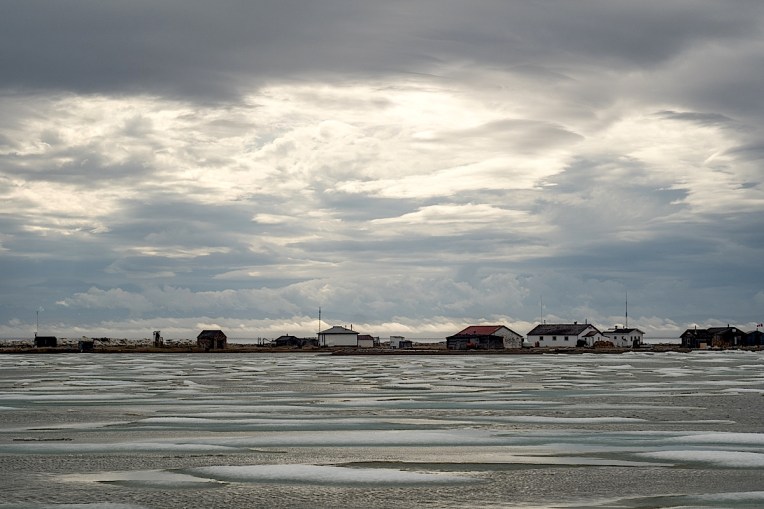
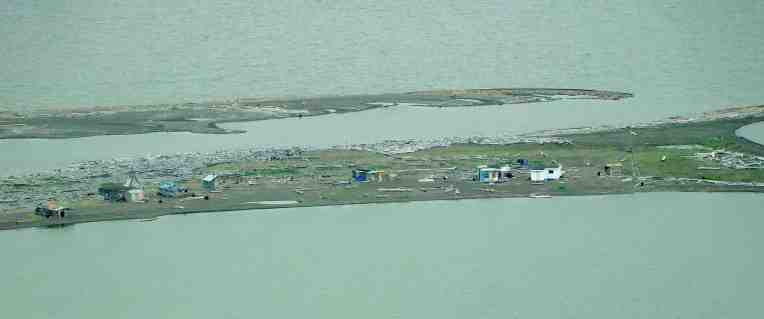
Shingle Point out on the Arctic Coast of the Yukon Territory. A fishing and hunting camp where the Shingle Games are held each year.

Here there was cloud cover, but the visibility was still really good, but soon after we left Shingle we hit a bank of fog.

Fog and mountains
Fog with the British Mountains in the background.
Fog
The sea of fog over the Arctic Ocean.

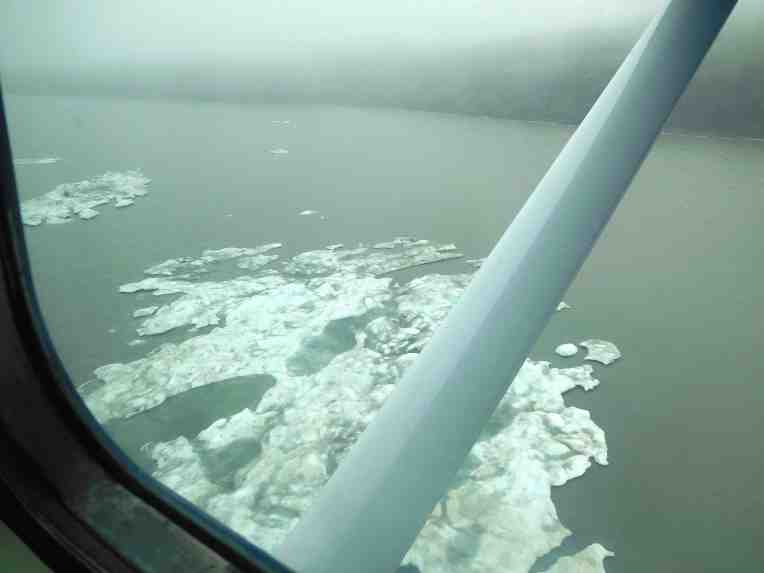
The fog was thick, but we thought we should fly out to the island to see if there were any gaps and indeed there were. We did manage to duck down under the fog and caught a glimpse of the North side of the island and sea ice in the water.

Slump on the north side
A retrogressive thaw slump on the North side of the island.
Sea ice
The north side of Qikiqtaruk – Herschel Island.

But the fog was just too thick, so we had to pull up and head back to Inuvik.  By the time we got back to the delta, the fog had rolled in there too.

Fog and delta
Fog above the Mackenzie Delta.

But soon, as we made our way back to Inuvik, we returned back to the sunshine.

Delta2
The Mackenzie Delta glistening in the sunshine.

A beautiful yet frustrating trip, as now we need to return with all that gear and try it again on another day.  The fresh vegetables are rotting away in the loaded float plane as I type.  Maybe I will fly in tomorrow, maybe I won’t.  Only time will tell.

Delta4
The twists and turns of the Mackenzie river are a metaphor for Arctic fieldwork.

By Isla

Our first days on Qikiqtaruk

It’s a mystical morning here on Qikiqtaruk – the fog bank has been moving in closer and closer, and now we can only see as far as a few meters away from camp. The bright blue forget-me-nots are vibrant enough to stand out of the mist, with their clusters of flowers swaying in the light breeze.

Pauline_cove_ice
Home sweet home when on the island – Pauline Cove – with rapidly melting sea ice in the foreground and fog bank in the background.

But it’s not just forget-me-nots that are growing – there is new life all around us. Amidst the fog, sandpiper and plover chicks are taking their first steps, willows, forbs and grasses are flowering, and as the snow and ice retreats, the island is becoming more and more alive. We have now been here for six days and the landscape is already very different to what we saw when we arrived on our first day.

chick
New life abounds in the Arctic at this time of year like this baby sandpiper chick.

After weeks of preparation, we boarded our plane in sunny Inuvik, and took off across the Mackenzie delta with beautiful views in all directions. The closer we got to Qikiqtaruk, the more sea ice was seen and the more the Arctic ambiance increased! We were joyfully greeted by park rangers Sam and Shane and conservation biologist, Cameron Eckert.

Within hours of us touching ground, we had seen several willow species, a polar bear den, birds most of us hadn’t seen before, a colourful carpet of flowers, and big chunks of ice moving across the sea – a great start of our fieldwork adventure. After taking in the beautiful views, we set out to find more ice, but this time underground! What in the world beyond Qikiqtaruk would surely be a mundane task, putting away bread, here is a lovely walk to an ice house covered with intricate ice crystals.

Over the next couple of days, we set up camp and our drone lab, and visited our field sites. We were happy to see that most of the markers on the drone plots had made it through the winter – having clicked on many of those markers whilst processing drone data over the winter, I enjoyed seeing them in real life, too! We also put out the big markers I made in Inuvik – we needed bigger markers which would be visible in all bands of imagery data we are collecting. Painting 90x90cm black and white squares in front of the Aurora Research Institute was a great conversation starter – I got to meet several drone researchers and learn about their work thanks to the markers!

We have successfully completed our first round of data collection, most of which aims to capture early season phenology of tundra vegetation. We have also set up plots to monitor how active layer depth changes as the frozen ground thaws over the summer – it was such a cool feeling to reach below the moss and feel the ground as solid as an ice cube! We have been inspecting individual plants in our plots marked out on the ground, noting their phenology stage and growth, as well as looking up in the sky, where our drones have been flying, giving us a landscape-scale view of the tundra below. One of my personal favourite elements of our fieldwork here is seeing how different methods and scales of investigation come together. From looking at below-ground processes, like decomposition rates and changes in active layer depth, moving to the surface, where beautiful Dryas flowers are opening their white petals, and up into the sky, where our drones are capturing how Arctic ecosystems are changing from above!

By Gergana

TeamDrone sent us that post over the satellite phone email.  Stay tuned for more updates as the field season progresses.

The Arctic fieldwork begins!

Happy Solstice everyone!

Team Drone arrives
Will, Gergana and Andy from the current Team Drone Crew on arrival on Qikiqtaruk on the 21st June 2017 – Jeff was off taking photos somewhere and miss the photo!

Team Drone has flown off from Inuvik and landed safe and sound on Qikiqtaruk – Herschel Island yesterday. The sea ice is still moving around in the waters around the island.  Sam the ranger said it was piling up in Thetis Bay in an impressive way a few days ago. You can check out the sea ice conditions in this satellite image below and live on the NASA website.

Photos and accounts to follow of Team Shrub’s arrival when Park Biologist Cameron Eckert flies off of the island later today. Cameron has recently had some really cool bird sightings on the island over the past week including a Calliope Hummingbird feeding on a willow flower and a Cape May Warbler foraging in the tundra, those are the first sightings for the island and the Hummingbird is a first for the Yukon and Beaufort Region! He supposedly has an awesome picture of the hummingbird.  Can’t wait to see it!

Team Drone has put the food in the ice house freezer and rested after the busy period of field preparations in Inuvik and has even had a chance to go out birding with Cameron before he leaves the island.  I am guessing they will be getting going on field data collection today.

Let the fieldwork begin!

by Isla

Team Shrub at the Edinburgh Science Festival

April has been a very exciting time for Team Shrub in terms of science outreach – we have teamed up with digital artists and videographers to communicate the key findings of our research in the Arctic to an audience from Edinburgh and beyond. We are thrilled to be collaborating with Simon Sloan, Archie Crofton and ASCUS to go beyond traditional means of science communication and use beautiful photographs, data visualisations and hands-on workshops to prompt discussion on the rapid environmental changes occurring in the Arctic. In addition to our wonderful collaborators, our outreach work is hugely benefiting from the excellent photography skills of our own Team Shrub members Sandra Angers-Blondin, Jeff Kerby and Anne Bjorkman. The Edinburgh International Science Festival was the perfect occasion to bring together beautiful photos with cool artifacts from our fieldwork for an event under the theme of “Arctic from Above” – Team Shrub’s first exhibition!

Arctic from Above

Preparations for the exhibitions were filled with much joy and trepidation – with drone imagery, shrub rings, photos of tundra plants and wildlife, tea bags, muskox fur and more, the exhibition encompassed many of the reasons why we love Arctic research!

Weeks of careful consideration of themes, colours and order culminated in an exciting chance to share our work with everyone who came along to the opening nights. With many questions and discussions, the exhibition room was buzzing with curiosity and enthusiasm. We were thrilled to see so many people engage with the dramatic changes the Arctic is experiencing, and ask meaningful questions – it is always refreshing to think about your work from a different perspective, and we really appreciated our chats with the exhibition visitors.

The Summerhall War Memorial Gallery is a wonderful home for our creative outputs, and there is still plenty of time to check out the exhibition before it closes on the 12th May! The vibrant and diverse atmosphere of the Contemporary Connections events, among which our exhibition “Arctic form Above”, is also captured in the video below. In the video you can also see moments from our second contribution to Contemporary Connections – a visualisation of shrub growth by Simon Sloan!

Contemporary Connections: visualising data in innovative ways

Sandra’s shrub ring photos and growth data served as inspiration for digital artist Simon Sloan to create a captivating video of shrub growth through time. It was fascinating to see data represented in a new and different way, and we hope to be collaborating with Simon again in the future to continue pushing the boundaries of innovative science communication! We were very impressed to find out that behind the beautiful imagery there is… code! Of course, our own R code sometimes results in abstract renditions of data visualisation, but that’s usually the result of a coding error, not a purposeful desire to create patterns and shapes where there would usually just be data points. The next Edinburgh Science Festival event in which Team Shrub participated, “Dialogues with the artists” gave us a glimpse of how we can highlight the beauty in data through graphic design software and the Processing programming software.

Check out the video about the exhibition featuring Team Shrub:

Dialogues with the artists

Through a series of talks by scientists and artists and follow up questions, the public got the chance to learn how collaborations between two seemingly very different disciplines – science and art – come to be, and what are the challenges and benefits of such work. We enjoyed learning about our fellow Edinburgh School of GeoSciences researchers including Seb Hennige who study Scottish deep-sea cold-water coral reefs and their artistic collaboration with Hannah Imlach entitled ‘From the Dark Ocean Comes Light, among several other great art-science projects. Isla and Sandra talked about the key themes of our research, what it’s like to work in the Arctic, as well as how we collect data. Following from the introduction to the dramatic environmental changes occurring in high latitudes, Simon shared what it’s like to bring out the creative side of data – turns out there is data clean up and formatting regardless of whether you are using the data for research, or art! It was fantastic to see how we can go from shrub ring photos and rows of numbers via processing code to a captivating video of shrub growth!

Communicating through video

We have also teamed up with motion designer Archie Crofton to communicate the big questions that we are investigating in our research.  Archie has put together a series of video clips inspired by our drone ecology research using drones to link on-the-ground measurements of tundra vegetation change to satellite observations of the greening Arctic.

Crofton_arctic_drones

Our art-science collaboration has inspired us for more outreach and we are very keen to continue fostering a discussion on Arctic change among the wider public! We would like to thank the Global Environment & Society Academy Innovation Fund for helping us bring these projects to fruition.

Our next two outreach events at the Edinburgh Science Festival will be a more hands-on experience of what it’s like to use shrub rings as indicators of environmental change through time, as well as what it’s like to be a drone pilot and what new horizons drone technologies open up for ecology!

Contemporary Connections: Exploring the Art in Data – Saturday 1 April – Friday 12 May 2017 at Summerhall

Tundra shrubs – Arctic time machines, with Sandra Angers-Blondin – Wednesday 12 April 2017 11:00 and 14:30 at the ASCUS Lab in Summerhall

Researching with Drones: Meet the ExpertsSaturday 15 April 2017 10:00 AM at Our Dynamic Earth

By Gergana

A fortune pastry for Team Shrub

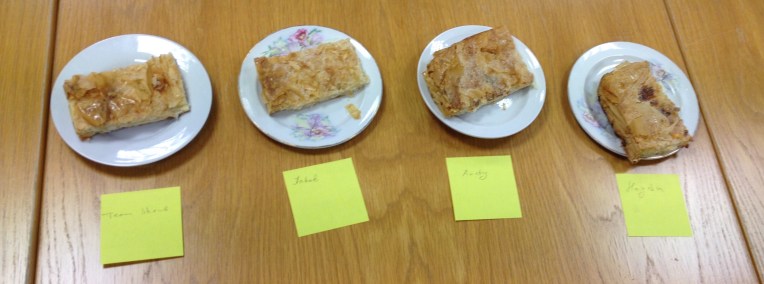
Today in lab meeting we ate a traditional Bulgarian pastry baked by our very own data manager and soon-to-be PhD student Gergana Daskalova.

Сладка баница (or sladka banitza) is a new year’s tradition in Bulgaria, it is a pastry that is both sweet and salty representing both the good and the bad in life and it contains pieces of paper cooked in with fortunes written on them! Sure, it isn’t quite the new year anymore, but it is a bit of a new beginning for Team Shrub with new students joining the lab for the summer’s field season or as dissertation students for next year.

As the most senior member of the team, it was my job to slice up the pastry and distribute the fortunes. So, to find out what is in store for members of Team Shrub, read on…

pastry

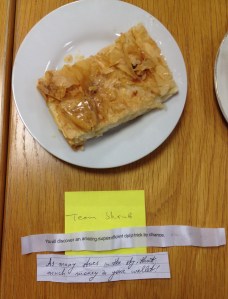
TeamShrub:

  1. You will discover an amazing super-efficient dplyr trick by chance. – Awesome! We hope that is one amazing dplyr trick per team member, so that we become even more super-efficient programmers. Perhaps, one day we can write a Coding Club tutorial with all of our new coding tricks!
  2. As many stars in the sky, that much money in your wallet (or research funding). – Yay! Future research funding! We don’t know when that funding will arrive, but I guess it is time to get some proposals submitted.

pastry2

Isla:

  1. You might not be looking for treasure, but you will find some regardless – perhaps during fieldwork, or whilst frolicking around in the outside world. – A treasure! I love treasures – either actual or metaphorical.
  2. A big research grant is heading your way – lots of exciting research and deep thinking (or even deep machine learning) in your future! More potential funding in our future and maybe some deep machine learning!!! How exciting – though again, I better submit some proposals so this has a possibility of coming true!

Sandra:

  1. Your spirit will be free and you will enjoy exciting travels in new places! – Exciting travels. I hope Sandra remembers to bring her camera to take some more wonderful photos!
  2. Excellent organization skills will help you strike a great work-life balance and you will know just when to say no and when to be super ambitious! – Oh, the illusive work-life balance, and knowing when to say no, sounds like something many folks on Team Shrub are striving towards!

Gergana:

  1. A manuscript of yours shall get accepted in a fancier journal than what you originally envisioned. – An even fancier journal for Gergana’s first manuscript submission perhaps?
  2. A beautiful, logical and novel storyline for a manuscript will form in your head, and you will be organized enough to write it down before you forget it. – Another manuscript fortune, that bodes well for Gergana’s publication record.

Cameron:

  1. Love and joy, both of which sincere, will follow you everywhere you go. – Oh how nice. So many positive things!
  2. Excellent health and a great state of mind will help you be happy and accomplished. – Wow how positive yet again. Sounds like Cameron is going to be a great asset to the field crew this summer!

Sam:

  1. You shall make great progress towards striking the balance between being very ambitious and knowing when it’s enough for your work to be “good enough”. – We could all work on that, particularly the perfectionists on the team!
  2. Bravely go forward, good luck will follow you at each step! – Nice one, that does bode well for Sam’s dissertation plans.

Haydn:

  1. After many years, your wish finally comes true – better and more diverse food options on KB! – Wow, all of our dreams would come true if this were the case. After having been to the University of Aberdeen this week and sampling their delicious on campus food, we are feeling very jealous!
  2. Exciting nature experiences shall provide you with inspiration and motivation! – Probably, while Haydn is on his Easter cycling holiday.

Andy:

  1. Strong will take you forward in life! – Strong will and perseverance. There is a lot of that on Team Shrub.
  2. A chance encounter leads to an exciting opportunity for collaboration from which novel contributions to science will arise! – Hmm… perhaps this is referring to Andy’s current travels to Brazil to fly a drone over the rainforest.

Jakob:

  1. Amazing! You will have time to be lazy and relax! – Ah, we could all probably use a bit of relaxing with our busy schedules of late!
  2. Brilliant ideas shall pop into your head at unexpected times. – Cool! Bodes well for Jakob’s PhD analyses! I hope we all have some brilliant ideas over the next year.

Nina:

  1. You might have given up on a certain manuscript or goal, but unexpected help and inspiration will give you the drive to finally accomplish those tasks! – Nice. Nina can probably use her future inspiration in her new job!
  2. Your communication skills will be top notch – be it manuscripts, emails or presentations, you will be clear and concise, and your efforts to develop those skills will pay off! – Top notch! Those communication skills are also going to come in handy with the new job.  Congrats Nina!

So it sounds like it is going to be a very productive and ambitious, yet relaxing and balanced year for Team Shrub. Thanks to our new team members for coming along to the lab meeting, thanks to those who attended in spirit and thanks to Gergana for making the Сладка баница! Don’t forget to burn your fortunes before next year so that they all come true.

By Isla
Inspiring Young Scientists

This week, TeamShrub and Airborne GeoSciences were at Our Dynamic Earth for the Inspiring Young Scientists Event ‘The Universe is Your Oyster’. There were 2201 guests at the event including youth of all ages and their parents on the 16 and 17 October 2016.

At our table we had a selection of drones, a flight simulator, photographs and videos of our Arctic adventures, and everything from our Tundra Top Trumps game, Thermokarst the Dragon to the TeamShrub mascot of Otto the Walrus! Just next door were other folks from the School of GeoSciences with jelly volcanoes, cabbage juice and fun activities to illustrate ocean acidification, ocean currents and volcanic eruptions. Down the way, Sophie Flack had a table with her “carbon sink”, an actual sink with tropical plants planted in it, illustrating an eddy covariance town in a tropical rain forest.

It was a very fun event, and hopefully over the two days we managed to inspire some young scientists! Thanks to Andy for organising and coordinating the TeamShrub display and to Andy, Sandra, Jakob, Haydn and Tom from AirBorne GeoSciences for proudly donning their purple TeamShrub t-shirts to represent Arctic science using drones at the event!

By Isla
Here is the video that Dynamic Earth put together about the entire event, TeamShrub features at minute 2:15.

https://www.youtube.com/watch?v=RrBe4fhnkIA