At the current time, the MSc and PhD positions within the lab are filled. If you would like to work on Team Shrub, feel free to reach out and keep in touch in future as opportunities may open up in a year or two. We are currently recruiting for two postdocs (see below).
We warmly invite Indigenous students, particularly those from the Yukon, NWT or Nunavut, interested in joining the lab to connect with us at any time, please don’t hesitate to get in touch. Support for research at all levels from undergraduate, MSc, PhD and postdoctoral levels for Indigenous scholars is available through programs such as the Indigenous Graduate Fellowship and other programs.
For your information, my research group has moved to the Department of Forest & Conservation Sciences in the Faculty of Forestry, University of British Columbia. We will also retain links to the University of Edinburgh.
Open positions on Team Shrub:
- Research Data Coordinator: See details bellow. To apply, visit link.
Previous openings:
- Postdoc position: Plant phenology change over time across spatial scales (Northern Ecosystems CERC Project). Applications are currently being processed.
- Postdoc position: Spatial patterning and ecological resilience across the tundra biome (Resilience ERC project). Applications are currently being processed.
More information on recruitment
It is an exciting time to be joining the team as we start two new research projects the Canada Excellence Research Chair in Global Change Ecology of Northern Ecosystems and the European Research Council RESILIENCE Synergy Grant with field research in the Canadian North and data synthesis and remote sensing analyses around the circumpolar Arctic.
Please reach out if you have any questions on the different posts. Due to the volume of requests, we can only respond to applicants with relevant qualifications and research interests for the positions (see job descriptions and information below).
Applications under consideration will be asked to provide more documents in advance of the interview. We will be prioritizing fit to the position and qualification and there is flexibility with the start times, so please feel free to apply if you are still finishing your PhD within 2024, but you have relevant expertise and research interests for the positions.
Applicants must have a background in ecology or related fields, research experience with interests in the topics listed below. Field research experience, quantitative skills (statistics, remote sensing, programming) and/or experience working/living in the Canadian North would be assets. Positions are fully-funded and full-time and open to international students, though students are encouraged to also apply for external funding. Applicants from Northern Canada, Indigenous applicants and those from diverse backgrounds are encouraged to apply.
Our lab’s research sits at the interface of field ecology, data synthesis and remote sensing and team members usually conduct a combination of field, lab and computer-based research. We are keen to recruit a diverse team of people that are interested in collaborative research, who want to develop quantitative skills and are keen to engage with Northern partners and Indigenous communities. Experience conducting fieldwork or living in the North is an asset. We encourage students and postdocs to develop their own specific projects inline with their own research interests within our broad research goals.
More information on current recruitment opportunities
In the second half of 2025, we will be recruiting for a full-time data manager/data scientist for the Global Change Ecology of Northern Ecosystems CERC Project. For this position, we are looking to recruit people with PhD degrees or multiple years of work experience in project management or data management and analysis. Familiarity with R and Python as programing languages and GitHub for version control will be required and familiarity with remote sensing analyses including the analyses of drone imagery would be an asset. If interested please get in touch to discuss these opportunities. The position will be formally advertised in May – June 2025. To apply, visit link.
Postdocs
I am currently recruiting two postdocs to lead key elements to our two funded projects. Each postdoc has a particular research theme, but the specific projects undertaken are flexible and would be matched to the interests of the recruited postdoc. I am looking to recruit postdocs with experience in plant ecology with specific expertise in phenology, composition or biodiversity analyses and/or remote sensing and/or statistical ecology. Experience working in Northern ecosystems would be an asset. Postdocs will be expected to have a publication record in international journals and skills in computer programming including data management, statistics, data visualization and version control in the programming languages R and/or Python. Specific expertise in Bayesian analyses and remote sensing are an asset.
- Plant phenology change over time across spatial scales (Northern Ecosystems CERC Project).
- Spatial patterning and ecological resilience across the tundra biome (Resilience ERC project).
Already filled:
- Spatial patterning and community assembly across the tundra biome (position filled, Resilience ERC project)
PhD positions
At the moment, the lab is at full capacity, and we do not have any PhD position available. We encourage you to check back in the future for updates on potential opportunities.
Already filled:
- Two PhD positions on the topic of capturing wildlife habitat change in Arctic and alpine tundra (Northern Ecosystems CERC Project)
- PhD in Resilience and Vulnerability of Tundra Landscapes to Permafrost Thaw (position filled, Resilience ERC project)
- PhD position: PhD in Spatial Patterns and Resilience in Tundra Community Composition (position filled, Resilience ERC project)
MSc positions
We have already recruited MSc positions as a part of the Northern Ecosystems CERC Project. We currently are at capacity and will no longer be accepting Master’s applications until students graduate.
Undergraduate research positions
We are currently no longer accepting applications for undergraduate students this fall but there may be additional opportunities in 2025 or 2026.
Application process
Postdoc applicants must have a background in ecology or related fields and have experience conducting fieldwork and leading research projects with strong statistical and/or remote sensing skills. A publication record of more than three first-author papers is a requirement. And experience conducting research in Northern ecosystems is an asset. Successful applicants will have experience conducting more than four years of independent research, excellent communication skills, demonstrated success in collaboration and a willingness to engage in issues surrounding diversity, equity and inclusion (DEI) in science and Northern Indigenous community engagement.
PhD applicants must have a background in ecology or related fields and ideally have some experience conducting fieldwork and statistical and/or remote sensing analyses. A publication record and experience conducting research in Northern ecosystems is an asset. Successful applicants will have experience conducting two years of independent research, excellent communication skills, demonstrated success in collaboration and a willingness to engage in issues surrounding diversity, equity and inclusion (DEI) in science and Northern Indigenous community engagement.
MSc applicants must have an undergraduate degree in ecology or related fields and ideally have some experience conducting fieldwork and ideally coursework in statistics, GIS and/or remote sensing. A undergraduate dissertation and experience conducting research in Northern ecosystems would is asset. Successful applicants will work well both independently and as a part of a team and will have six months or more research experience, excellent communication skills, and a willingness to engage in issues surrounding diversity, equity and inclusion (DEI) in science and Northern Indigenous community engagement.
- Write an email to me to express your interest in graduate studies ideally in the autumn of 2024 in advance of funding deadlines if you are keen to apply for external funding. Clearly indicate in this email your specific research interests as they relate to my team’s research and whether you are interested in applying for an MSc or PhD position or an MSc that you hope to transfer into a PhD position after one year.
- I will invite candidates to apply for a deadline and ask for the following documents to be submitted to my email using the subject line ‘Application for Graduate Studies on Team Shrub in 2025’.
- Your up-to-date academic CV – include your degrees, research experience, skillsets including quantitative skills, work experience, other relevant skills and interests including outdoor skills (see https://teamshrub.com/2017/11/24/team-shrubs-tips-cvs-job-applications/)
- A one-page research statement explaining your personal research interests and how you believe they fit within Team Shrub’s research activities. Within this statement pitch a project that you could undertake as a part of your degree. Please include research questions and hypotheses in this research statement.
- A one-page team contribution statement on the contributions that you believe you could make to Team Shrub and our research program including your team work philosophy, your approach to collaborative research, your field, lab and quantitative research expertise, your philosophy on EDI in academia and the approach you will take to research in the North with local and Indigenous collaborators. This statement does not need to be comprehensive, but should talk about your personal philosophy and how you approach these topics.
- Your transcript for your most recent degree – this can be the unofficial transcript at this stage. You can include more transcripts if relevant.
- References – the contact information including emails for two references who can speak to your research experience.
- Example Research Project – Please share an example research project that you would like to include as a part of your application. This could be a thesis from a previous research degree, a published or in development manuscript or another piece of scientific writing that shares your previous research experience.
No cover letter is required for the application, as you can include that information in the two statements and cover letter material will not be considered in the evaluation of candidates. Please use a minimum of 11 pt font that is easy to read (Arial or similar) and letter sized paper. Please make sure that all files are uniquely named with the document type, your name and the date. Keep the different files separate rather than combining them into one file.
A small data analysis challenge exercise and project pitch form will be sent to applicants selected for interview for submission before the interview for students to complete. Interviews will consist of standard questions including a discussion of previous research experience and future research interests. The recruitment panels will involve other members of the two research projects and/or existing members of Team Shrub in the selection process.
The research topics that I am particularly interested in supervising include (but are not limited to):
- Exploring the impacts of tundra vegetation change with warming on wildlife habitats.
- Phenology/growth-climate relationships in tundra plant species using time-lapse photography, ecological monitoring, common garden experiments, dendroecology and/or drones.
- Testing the correspondence and scaling between remotely-sensed tundra greening and landscape and plot-level vegetation change using drones, satellite data and ecological monitoring.
- Exploring the thermophilization, increase in warming loving plants, of tundra plant communities.
- Using camera traps or autonomous recording units (ARUs) to quantify habitat use in Arctic or alpine tundra habitats undergoing shrub encroachment.
- Quantifying the drivers of boreal forest vegetation change including shrubification.
- Using hyperspectral data to capture biodiversity change in tundra ecosystems.
- Impact of extreme weather including heat waves on tundra vegetation.
- Below ground ecology in tundra ecosystems.
- Vegetation-permafrost-climate interactions using drones, historical ecology, repeat photography and ecological monitoring.
- Co-developed questions working with Indigenous communities about climate change impacts in Arctic or alpine tundra of the Yukon Territory.
- Testing the links between biodiversity change and climate warming or land use change in tundra or global biodiversity datasets.
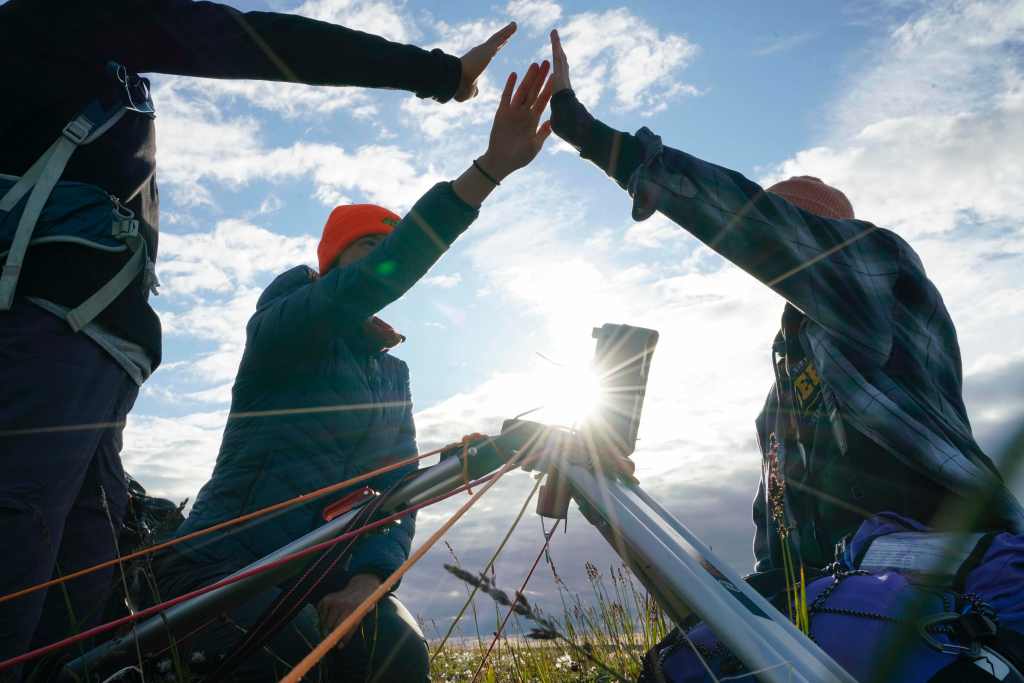
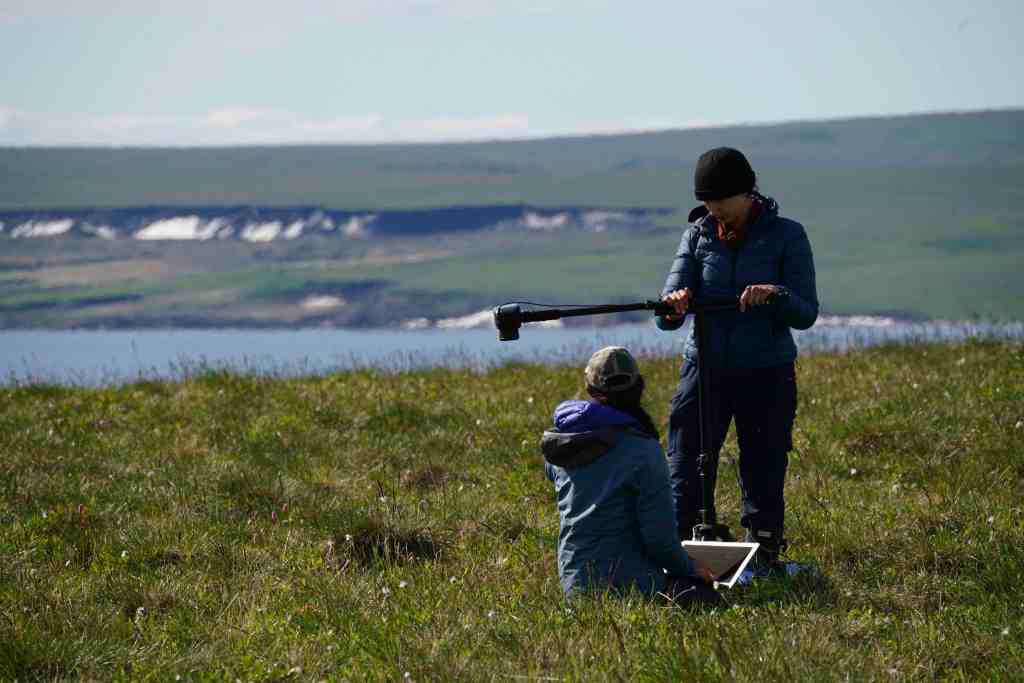
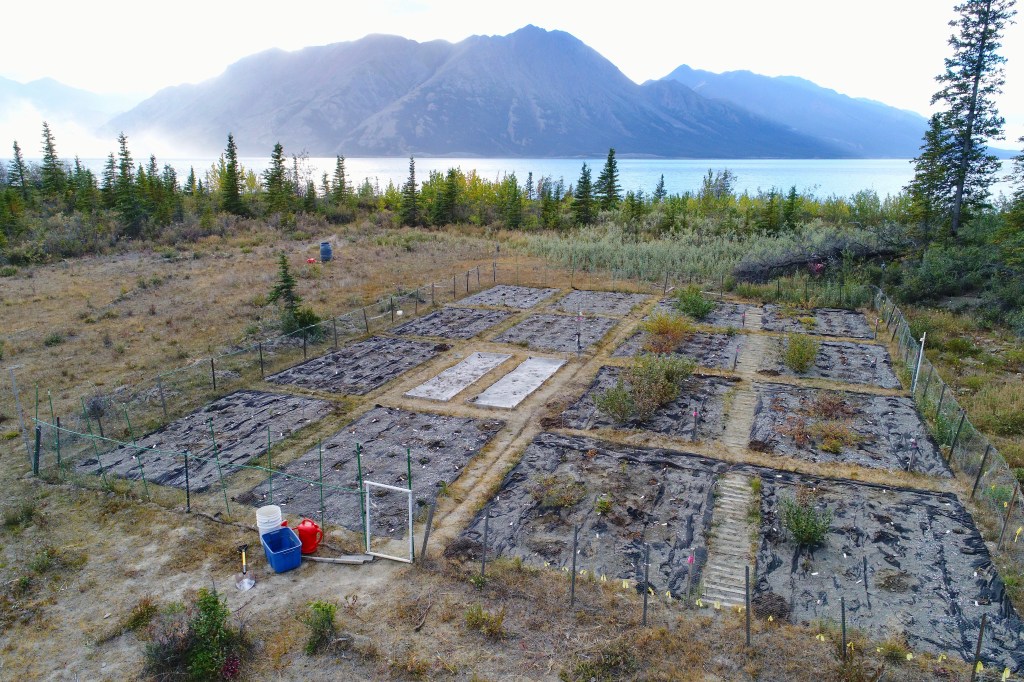
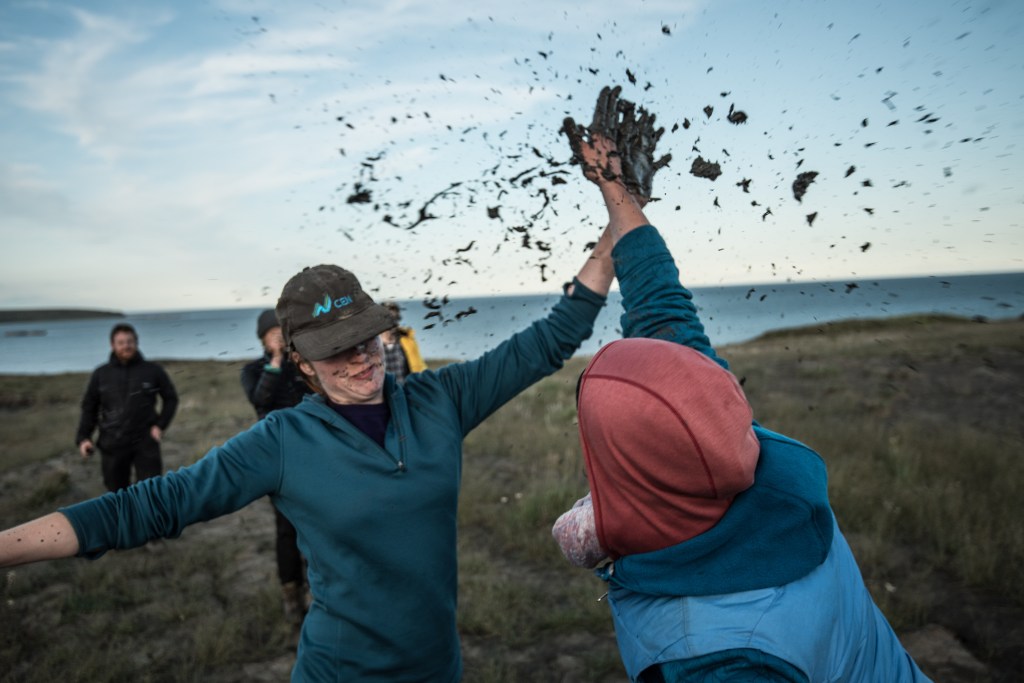

Fieldwork at our Kluane and Qikiqtaruk – Herschel Island field sites.
 Team Shrub