Willow Wishes

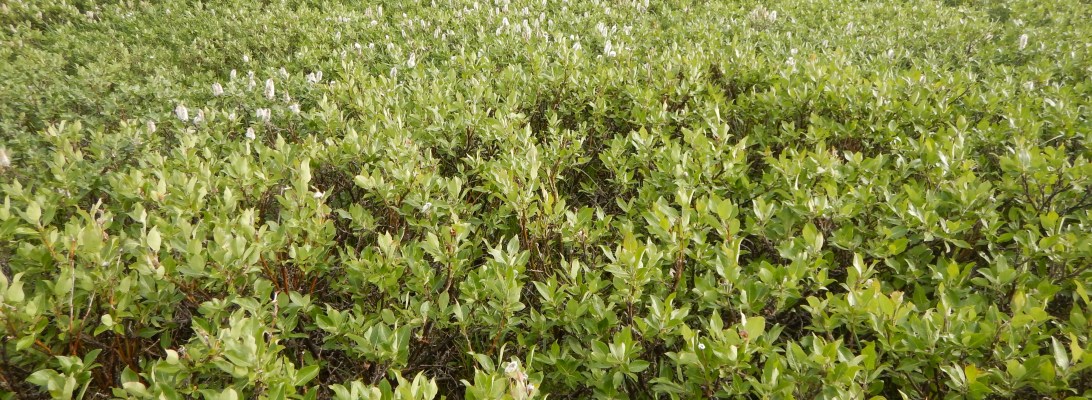
Even though it is only the middle of July and we have just passed our halfway point – one month on the island – the seasons are starting to turn. Each day it gets a little bit darker at night and now the sun dips below the hills north of Pauline Cove at around 2am. Some of the flowers are dropping their petals such as Dryas integrifolia (or the Arctic Avens) that has even started to produce the twisting filaments of its seeds. And, the Salix richardsonii (or Richard’s Willow) is starting to release its fluffy seed on the wind. If you pick a Salix richardsonii catkin and blow on it, like a dandelion, you can make a wish – a willow wish.

This blog post is devoted to our list of willow wishes for the coming weeks…

DSCN4852.jpg
The Salix richardsonii flowers releasing their seed on the flood plain.


DSCN5023.jpg
The twisting of filaments in the phenology plots.

This slideshow requires JavaScript.

Our willow wishes:

  1. Please can at least one of our drones start working again. We have had some major mechanical problems and both drones are grounded. We are hoping that Shrubcopter will be airborne again soon though… and a fixed wing, some kites and a new drone are on their way to the island.
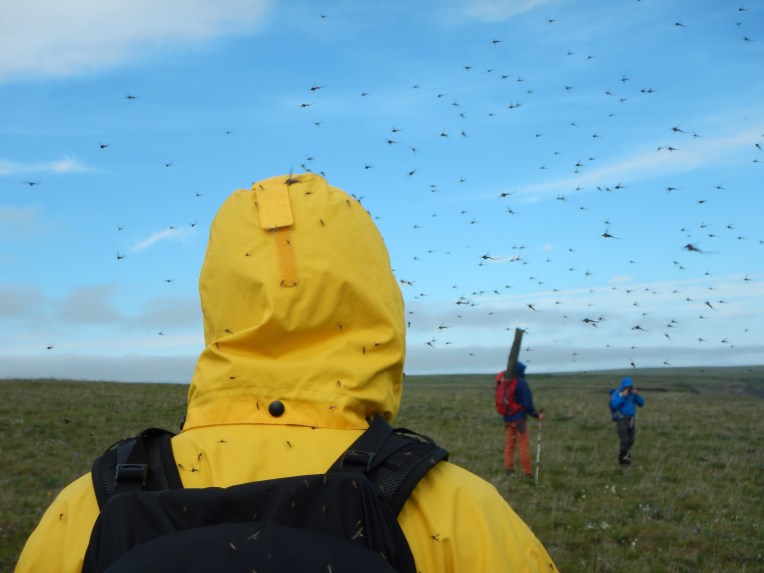
  1. Please can the wind stay brisk to keep away the clouds of mosquitoes, so that we are not driven crazy by the incessant droning, biting and itching. The mosquitos are at their peak now. We try to wait for the wind to pick up in the afternoons before going out, so that it isn’t so bad. The last few days the wind has been so brisk that there haven’t been hardly any bugs at all!
DSCN4789.jpg
The clouds of mosquitoes that are our constant friends on the tundra now.

3. Please can the Muskoxen stop knocking down our phenocams – time lapse cameras pointed at the tundra – so that we can get record of the changing season of the tundra plants. We have repaired the third knock down so far and are anticipating more… but recently the muskox have moved away from our side of the island for a bit.

4. Please can the remainder of our field crew make it out very efficiently to us this week when the two halves of TeamShrub will be reunited after a month or more apart. It has been a long time since we have seen our team shrub friends, and we are very excited to see them again soon! It seems strange to be emailing back and forth with them when they are only an hour flight away in Inuvik!

5. Please can all sorts of really delicious (mamaqtuq in Inuvialutun) fresh fruits and vegetables come out with Team Kluane so that we can feast! We have finished pretty much all of our fresh food and are having the last of the potatoes tonight, so we are very excited that Team Kluane is bringing us exciting delights from Whitehorse and Inuvik for our final month on the island.

6. Jakob wishes he wasn’t after Isla’s cooking in the chores schedule, because Isla makes too many dishes dirty (even though she cooks delicious desserts)! It is going to be a lot more work cooking and cleaning for 9 people instead of 4, but on the other hand our cooking, washing up and lunches days won’t come around quite so often any more.

7. Please when we return to the city, can the pound be worth a normal amount so that we can go to a shop and buy things like normal people. We have occasionally been getting updates on all of the world events going on out there and the Arctic seems like the place to be even if our salary might be half what it once was.

8. Please can Otto the Walrus come back to visit us again! We miss you Otto. It was so awesome to see you for the first time, we want to see you again!

9. Please can we gain magical powers to both ward of mosquitoes and know where and when all the really cool wildlife are near us. Santo and I were passing the time on a hike out to the field discussing the magical power we would most want and we couldn’t decide between these two.

DSCN4980.jpg
Amazing photo taken by Isla of the recent sighting of beluga whales. If only we had a wildlife 6th sense we would have seen these whales much closer when they were swimming around the point.
DSCN4845.jpg
The Rough-legged hawk or qilriq, trying to scare away Santo and Isla from its nest.
IMG_5722.jpg
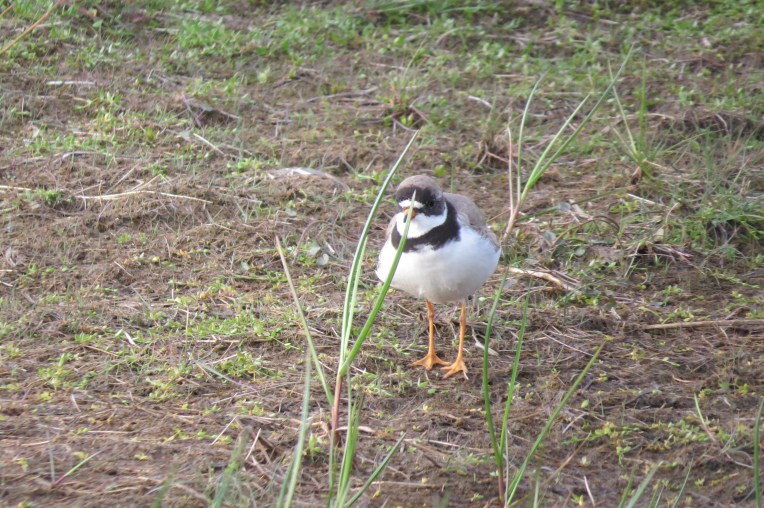
A semipalmated plover or talutaaq.

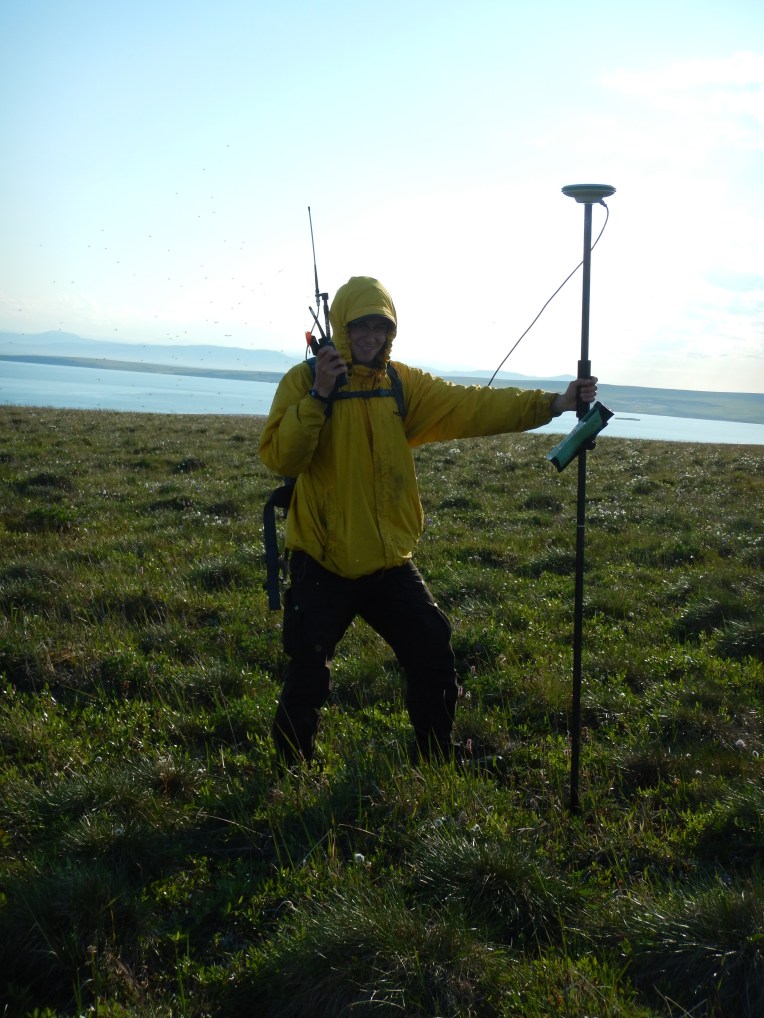
While we wait for all those willow wishes to come true, I can update you a bit on the goings on of Qikiqtaruk. Jakob and Andy have been spending a fair bit of time in the “Drone Lab” trying to repair the broken drones. Meanwhile Santo and Isla (sometimes accompanied by Andy) have been heading out into the field to do phenology measurements, taking precision GPS measurements of the ground control markers and taking multispectral measurements from a pole. Those sequoia sensors are really cool, but can be frustrating when you try to power them using a very long USB cable that doesn’t always work.
DSCN4937.jpg
Santo dGPSing using our Leica sensor from the NERC Geophysical Equipment Facility in Edinburgh. Thanks GEF, the dGPS system is working great! We are in range of the base-station at all of our sites.

Yesterday, we were out at plot 4, working away, when the wind started to build and build – this was great because it meant that the bugs disappeared, but it kept getting windier and windier. We were almost getting blown over it was so windy. On the way back to camp we were throwing sticks into the air and they would come right back to us like a boomerang in the wind!

DSCN5055.jpg
Boomerangs in the wind.

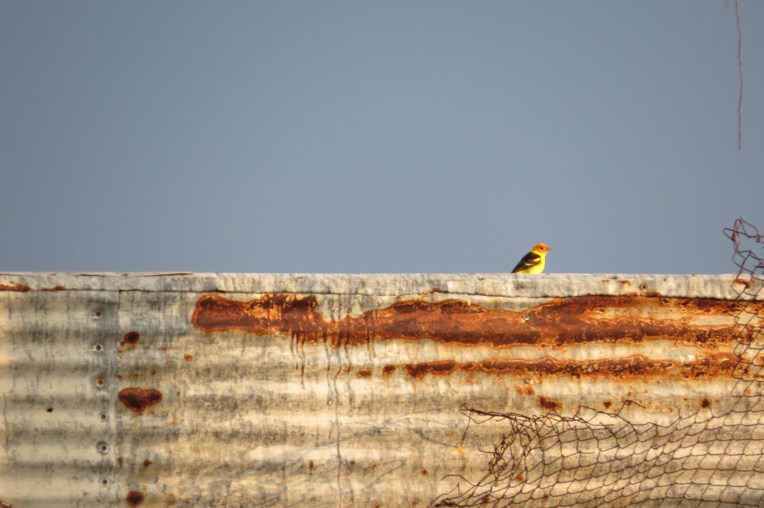
Then a small storm blew in, bringing some rain, so we stuck to camp and worked on drones, building structure-for-motion models of shrub canopies, and giving a talk on the science that we are up to on the Island to the visiting birders, the rangers, and Yukon Government employees. It was a jolly evening and now the sun is back and a lovely yellow and orange Western Tanager blown in on the wind has joined us at Pauline Cove. Cameron Eckert – parks biologist and ornithologist will be jealous of our yellow bird photos!!!
IMG_5709.jpg
The Western Tanager – this bird is normally found more than 1000 km south of Qikiqtaruk.

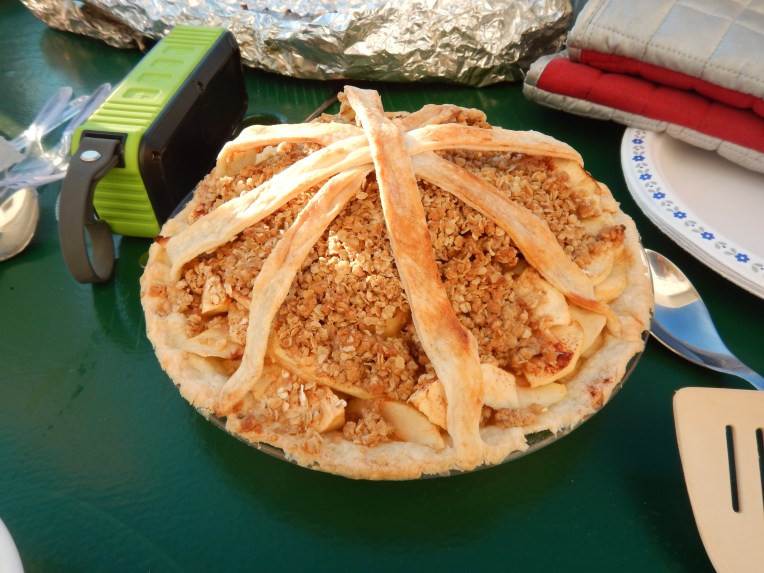
The most recent folks to leave the island were the crew from Heritage – Brent, Gisli and Jerry. Before their departure we had a heritage feast replete with an apple pie. Great work guys on levelling the Trapper’s cabin, lifting up the warehouses and fixing up the door to the ice house! Such an efficient team and so much heritage restored! Congrats to Brent on his 30-year anniversary of working here on the island!
DSCN4925.jpg
Delicious apple pie.

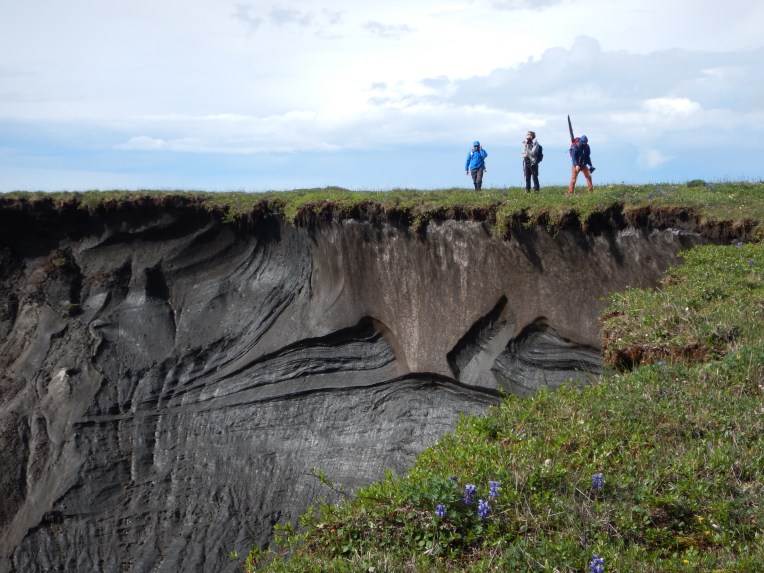
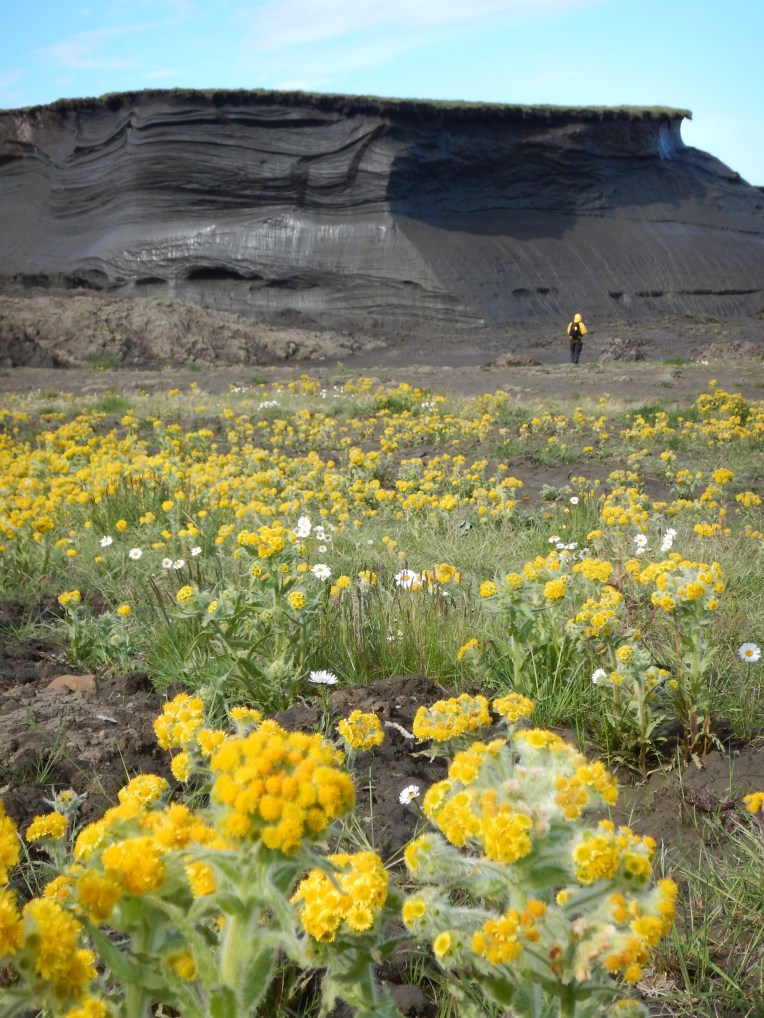
About a week ago TeamDrone took a day off and got a boat ride out to Slump D – perhaps the second biggest retrogressive thaw slump in the North American Arctic! We saw some pretty cool features like this hole down into the permafrost where a stream was dripping off of the head wall. We saw some caribou running around in the slump too!

DSCN4686.jpg
The hole, not quite as impressive as the bottomless pit George and I found in 2013, but still quite impressive.
DSCN4741.jpg
Santo and the mastodon flowers in the basin of slump D.
DSCN4698.jpg
Slump D and us walking over an ice wedge.
DSCN4652.jpg
The boat ride with Sam and Paden to Slump D. Thanks guys for the drop off and pick up! We did manage to walk half of each way, but the bugs were pretty bad so it was awesome to have the bugs blown off by the wind of the boat!


DSCN4648.jpg
Caribou at Slump D.

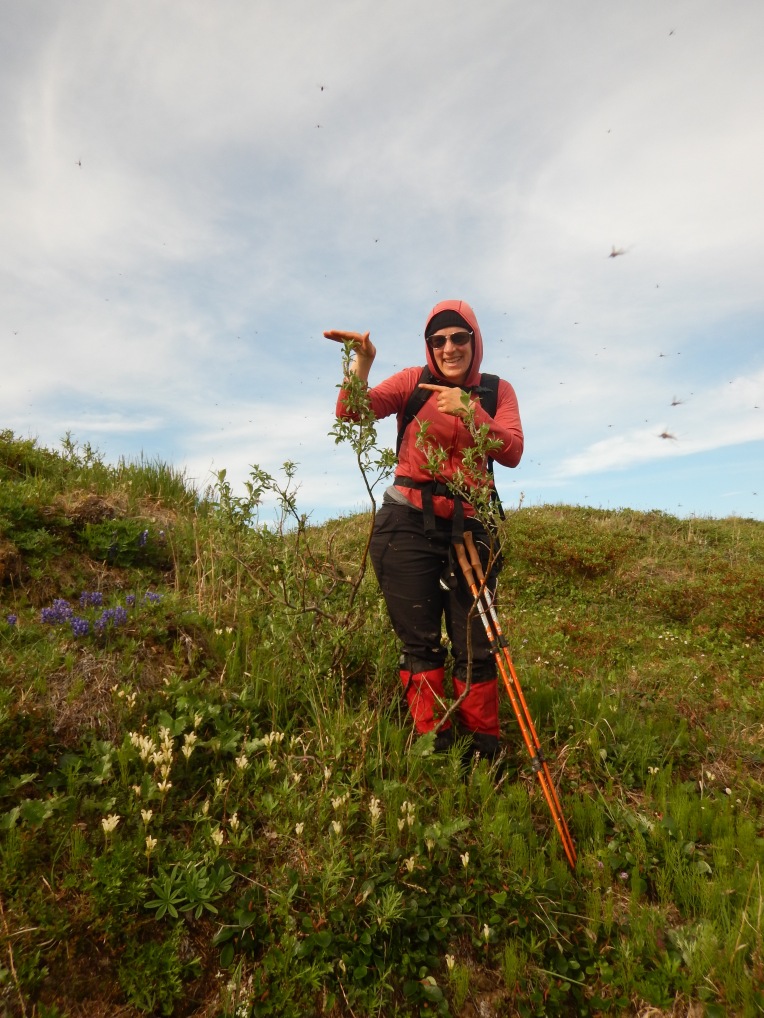
On the hike back from Slump D we found what might be the new tallest shrub on Qikiqtaruk – Tina. She is growing close to Tina slump and is a Salix alaxensis – the potentially up to 4 m tall willow species that we just discovered on the island last year! Look how tall she is! I haven’t measured yet, because we didn’t have measuring tape with us, but I have her height marked on my walking poll, we shall see if she can beat the height of Bjørn from last year.
DSCN4807.jpg
Tina the shrub, perhaps the tallest shrub on Qikiqtaruk?

To finish off here are are some pretty flower photos, and a very old plant…
DSCN4615.jpg
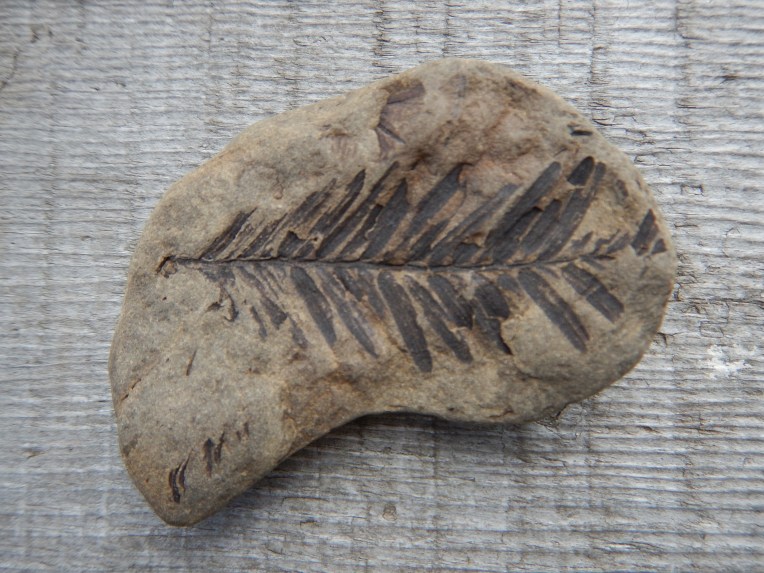
A fossil plant found by Liz the fossil lady on the beach. Is it a conifer or some other kind of plant? We weren’t totally sure.


Can’t wait to be one big TeamShrub again in about a day or so!


Three Weekiversary – it takes a whole team

It is our three weekiversary on the island today*.  It is hard to believe, but we have been living on our remote Arctic Island for three whole weeks now.  So much has happened since our Twin Otter flights dropped us off on these shores.
.
1. We set up and explored our little island home seeing wildlife, beautiful flowers and epic vistas.
 Here is a video of Otto the Walrus – the first walrus spotted on Qikiqtarȓuk since 1991:
 
.

The beginning and end of what was once a 4-foot-high and 20-foot-long snow patch beside our cabin.


Spring flowers on Qikiqtarȓuk
.
2. We started to collect our data as the season started to change.  Check out the video of one of the phenocams as the flowers bloom over the past three weeks and the drone videos and imagery below.
 .
The timelapse video of phenocam 2 from the phenology transects.  Watch the opening of all the Dryas (avens) and lupine flowers:
 .
 .
.
shrubs_from_air
An aerial photo of Bjørn (right) – the tallest shrub on Qikiqtarȓuk from the air collected by Andy and Droney MacDroneface the drone.
Our new and fancy Sequoia sensor is working out really well so far collecting us awesome spectrally precise data on the greenness of the tundra taking into account the incoming solar radiation.
air_control_points
“Air control points” as we like to call them, which are like ground control points, but in the air that will be used to test whether our structure-for-motion data can capture tennis ball-sized objects – actual tennis balls – when suspended in space.
.
.
.
3. We setup, have flown and then have had to rebuild our drones.  Though, at points we have been foiled by technical difficulties, we faced the technical challenges head-on, and we hope we have come out victorious!
.
drone_flying.jpg
Jakob flying the drone Shrubcopter – a successful test flight!
Setting up for the test flight – the funky music was not actually playing in the field.  Look closely for Santo’s time-lapse dance in the middle at second 11 – that took about a minute or more in reality to film even if if it only lasts for milliseconds in the video:
.
.
Jakob_GCPs
Setting up ground control points in the drone plots. Those black and white crosses will mark where precise coordinates will be collected with our differential GPS system which will allow us to compute our orthomosaic and structure-for-motion reconstructions – the 3D models – with our imagery.
So here is to more successful drone flying in future and to fewer technical difficulties!  May the data roll in and the science roll on smoothly.
 .
At the end of this blog post, I would like to take this time to give a shout out to the logistical team supporting all of our efforts:
 .
On the island:
The Rangers Edward, Ricky, Paden and Sam help make this research possible by supporting our day-to-day lives on the island maintaining our fieldwork safety, collecting key phenology data that our project will use, providing drinking and washing water, wood for the stoves, giving us sage advice on why our generator isn’t running smoothly for example (it wasn’t level), bringing us delicious fresh vegetables and fruits – thanks for the resupply of freshies Ricky!, saving the day by bringing in a missing driver for our telemetry and also showing us the sights of the island – thanks for the file and boat ride Edward!
 .
The freshies feast provided by Ricky from Inuvik.  The best tasting fruit and veggies available (except for those harvested off of the land of course!).  Check out the time-lapse video that Santo made of the feast:
.
 .
In the North:
Richard Gordon head Ranger with Herschel Island – Qikiqtaruk Territorial Park and Cameron Eckert Yukon Parks Biologist help support our research efforts by supporting the permitting process, providing key logistical support and by running the ecological monitoring program that provides key data on which our project depends.  It will be exciting to team up with the rangers and Ecological monitoring team to put together the manuscript of the changes that we have been observing over the last 15 years of ecological monitoring.
 .
In Edinburgh:
Tom – head of AirBorne GeoSciences at the University of Edinburgh, pilot and drone research coordinator extraordinaire has been the main point person for all of our drone logistics and the main point of contact for all of our drone troubles.  Thanks Tom for your calm, cool, collected and very informative emails and extremely efficient spare parts ordering.  We feel in such good hands out here with you keeping us on track.
 .
Simon – PhD student at Scotland’s Rural College, drone expert and key facilitator of all our drone efforts.  When things go wrong a brief chime in to the sat phone email thread from Simon can set you right.  Your contributions Simon to our work out here in the Arctic have been immense and we look forward to showing all the imagery and data with you on our return.
 .
Callum – Our trusty robotics intern who developed and 3D printed our amazing gimbal camera mounts and who sends us daily weather updates!  Your gimbal mounts and set up have worked great so far and seeing those e-mails from you with the marine weather reports along the coast here helps to add more certainty into the uncertainty of weather prediction in this part of the world.  Today your weather forecasts forecasted cloud, fog, sprinkles and moderate wind – and outside that is the exact weather!  Here is hoping the improved weather conditions predicted for tomorrow hold true.
.
In Kluane and Elsewhere:
The rest of TeamShrub has been supporting us too while doing their own fieldwork.  The Kluane Crew and visiting researcher Jeff Kerby will be joining us on the 18th of July for two and a bit weeks and are now working away on our detailed and demanding resupply list: we want spare drone parts – some of which are quite difficult to source, practical things like tools and electrical tape, delicious fresh foods and news from the outside world.  Thanks guys for agreeing to cater to our somewhat demanding desires.  We can’t wait to see you all again very soon – and your guys’ presences on the island is the most important thing on the resupply list.
.
Then there is postdoc Anne who is working away on the non-fieldwork side of science running tundra trait Bayesian models on a high-powered computing cluster in Germany and progressing away towards big discoveries on our behalf as we work away on getting the raw data for the next set of fancy hierarchical models down the road and helping with blog post updates.
 ..
And Meagan working on boreal shrub-related manuscripts and helping with our Yukon logistics and questions like where do you find aluminum plant tags in Whitehorse…
 .
And of course there is the rest of team shrub and our supporters including family, friends and you guys reading this blog who cheer us on from afar!
 .
Thanks guys!  They say it takes a whole village to raise one child – and that may be true, but it is definitely true that it takes a whole team to raise one or two drones into the sky to collect some data, we wouldn’t be able to be doing what we are without you!!!
 .
P.S. And we need to make a final shout out to Allen the pilot from Aklak Air for bringing us the latest version of the firmware for our Pixhawk flight controllers.  You have saved the day with the drones – and all for a cup of coffee!
 .
P.P.S. Another thanks to Ed for taking this blog post, the photos and all of the video off of the island and to the internet for posting to the team shrub blog.  We owe you yet again!
 .
By Isla
 .
*Sorry everyone, this blog post got a bit lost. They’ve been on the Island over a month now!

Plat-Oh Look It’s A Bear

Sandra left her zoom lens behind so we were bound so see some wildlife.

We passed by the bald eagle sitting in a tree above us, passed by the spruce grouse perched on a log by the path, passed by the three ptarmigan chicks pretending to be rocks, but we did have to stop for the two bears fighting it out on the horizon. Reared to full height, clawing and jawing each other, we almost didn’t notice the third bear just below them watching with some bemusement. And we definitely didn’t notice the fourth one that we walked into thinking it was just a hungry hummock of tundra. Thankfully it was too busy being hungry to give us much thought so we skirted around it filled with that strange mixture of fear and awe. After it eventually spotted us, looked us over as if to say “where did these odd creatures spring from?” and shuffled off awkwardly to look for some roots in an altogether less noisy part of the tundra, we all agreed that bears were really rather cute, though that we hoped not to see one again that day.

This was our third time on the Kluane Plateau that week. Our legs were by now starting to feel much better about the four hour hike up 1000m of hill. Our boots were not. Sandra had reverted to wellies. Nevertheless, the quest for knowledge is a noble goal and worse things than walking boots have fallen apart in its pursuit.

A brief description here if you are lost (as we tend to become whenever we try to tackle the tall shrub without a GPS). The Kluane Plateau rises to the south of the Kluane Lake Research Station, home of the Arctic Institute of North America. 60° north of the equator and 1800m above sea level, the mountain ceases to rise for a short period and flattens out, giving us a stretch of unbroken tundra before the slope picks up again and breaks apart into snow packs and loose rocks. Here plants burst into their short existence between sunrise and snowfall, between the spring and the all too soon oncoming winter, coursing with life under a midnight sun. The hike “upstairs” passes through sun-lanced spruce forest in a haze of sweat before the trees thin and sharp, leaf bound branches claw at our arms, before clouds of blue, purple and yellow flowers spill around our holey boots, before the canopy and the hillslope rise to meet each other in the squishy, mossy, unbroken green sea of tundra. By that time out feet hurt a lot so we tend to lie down in a lump and eat some peanuts.

SAB-0856

That day there would be less lumping because we didn’t want to be mistaken for the ursine equivalent of peanuts by Claire the bear. There was also little time to finish our more important tasks. We sampled willow stems for the common garden to compare how fast and how tall shrubs from different parts of the Arctic can grow in a common, and altogether warmer, environment. We measured plant traits – their characteristics (height, leaf size and thickness, woodiness etc) – to help determine how they interact with their environment.  We monitored soil moisture around buried and half-rotten teabags, not yesterday’s lunch but part of an experiment to find out how important moisture is for decomposition in temperature-limited places like the tundra. And we collected the leaves of a small shrub called Rhododendron groenlandicum because stewed in hot water they make a delicious tea.

The clouds were playing games with us a little (jumpers on everyone. Wait…who has the suncream? Damn, unpack the waterproofs!) and despite clambering up and down a mountainside looking for a species of willow only 7cm tall and “definitely around here somewhere” we got all the work done in good time. Walking downhill is always more enjoyable I find, particularly when the tundra sponge add the impression of walking down the side of a slightly deflated bouncy castle.

Down into the shrub line, only getting lost once. Down into the tall shrubs, scratching open our scratches with their branches. Down into the forest where the air is dense and the paths try to slip and trip you at the same time. Down into the fresh air of the canyon edge where the light changes and the water rushes and the breeze starts to fumble again with your backpack, and where John fell and twisted his ankle only twenty minutes from the bottom of the hill.

Not the end any of us were expecting.

Post script 1

We all wrote Haikus for the bears.

Fighting silhouettes.
Teeth bared, claws raised, poised for strike.
This female is mine.

Hello lady bear.
I’ll fight for your…argh my face!
I might just leg it.

Foraging flowers.
Macho displays on the ridge.
I prefer tussocks.

Unwary hiker,
Look sharp! See that golden fur?
Let sleeping bears lie.

Post script 2

John is fine by the way.

SAB-0214

Arctic Notes

Another blog post from Isla and crew that got partially lost in the satellite phone ether, now recovered!

Arctic Notes: a few short notes about some memorable experiences from our time in the Arctic so far…

DSCN4105
Sunday 26 June 2016 – Bowheads breaching
We were out setting up a plot on what is now known as Bowhead Ridge and were looking out towards the North across the water and we saw Bowhead whales breaching!  Jumping in the air as high as they could go and falling back on the water in a splash.  We also saw them hitting the water with their tail flukes.  We had to share around the binoculars – two breaches per person and then we switched. We also saw lots of beluga whales from a far up on the hill with the binoculars.  Three were even swimming past camp – sigh – if only we were on the beach at the time to get a closer view.  It was all pretty magical.

Sunday 26 June 2016 – Thunder storms
It was a mostly sunny day, but with towering cumulous thunder clouds over the British mountains.  There were some particularly large clouds that made their way out towards the island.  Imposing skies were to be seen all day and it was quite warm for the Arctic.  In the evening the storms arrived on the Island and there were strikes of lightning, thunder and heavy rain.  There aren’t usually thunderstorms here, so it was quite something to see.

Monday 27 June 2016 – A bear on the horizon
It was wet and grey, but we went to set up another plot and on the way back I saw a black dot on the horizon.  It looked like Mansa the camp dog, but he doesn’t go out on his own.  So we took a look with binos and low and behold it was a dark chocolatey brown grizzly bear.  He/she surveyed us for a while as we did she/he, and then lumbered off in the other direction.  We have named her/him Brunhilde – because she/he was brown.

Friday 1 July 2016 – Sweet memories of Cebu
One of our favourite island snacks – so addictive – is Philippine Brand dried mango.  It is just like eating mangoes fresh off of the tree – well as close as we can get here in the Arctic, now that the freshies – all the fresh veggies and fruit – are almost gone apart from the root vegetables, apples and oranges.  Goodbye lettuce, cucumber, non-UHT dairy products, and all those fresh items that we will have to live without until the Kluane Crew arrives in the end of July to resupply us!

Monday 4 July 2016 – Aivikamik tautuktunga – “I saw a walrus” in Inuvialuktun! (or something similar to that – we had to piece that together with the dictionary, app from the iPhone and some guessing and checking with the rangers)

We woke up to the news to a radio message from Edward the ranger that there was a walrus in the cove and we all jumped out of bed and headed outside to see a walrus swimming by to the boat dock.  It checked us out for a while and then swam around the point and then beached it’s self on the other side of the point.  I saw it a bit later out there and we tried to sneak up on it to get a bit of a closer look, but I think we scared it back into the ocean and it swam off to the East. Maybe it will come back to visit?  I hope so…

By Isla

Remote Arctic Fails

We think that this blog post may have gotten lost in the satellite phone email ether and the email carrying the original text might currently be headed out of our solar system off into the outer Milky Way galaxy.  On 20 June, after being on the island for five days, we penned this blog post focussing on the failures and successes of our early days on the island.

Remote Arctic Fails:

Wet boot fail: Decide to ignore warnings on stream depth and test it out to double check. Proceed to get trousers, water bottle aaall muddy and yucky. And a superbly wet boot.

Drinking water fail: Have a complex system of jugs, pots, pans and various other chalices to keep track on what is snow water for washing and what is lake water for drinking. Proceed to drink a lot of snow melt water, and with it plant bits and grit, over the first five days on the island.

Google Drive Fail: Spend hours on beautiful spreadsheets; including schedules, inventories and other lists. Fail to double check Drive syncing, offline read-mode and saving as .xlsx. Proceed to rip out hair on Qikiqtaryuk when many of the documents refuse to open.

GoPro Fail: Take GoPro out on the field, and set it up beautifully to film an amazing muskoxen encounter. Get incredibly lucky and catch a head-butt-display by two ma-huussive young rams; just after switching GoPro to 4K Ultra HD Mega-rad Money-shot mode. Get home and proceed to bury face into hands, after realizing there’s a huge raindrop bang in the middle of the lens; blocking the muskox completely…

Wiring fail: Use banana-plugs that were accidentally soldered in reverse leading to a short circuit and a melted battery cable.  Oh dear.

Tool kit fail: Totally lose the tools including four secateurs/clippers, needle nose pliers, screw drivers, volt meters and all sorts of useful general tools – not in Kluane, not in Inuvik, not on Qikiqtaryuk as far as well can tell.  Kluane Crew can you look out for them for us, and bring them to the island if you find the missing tools???  Don’t worry though, the Drone Kits and the rangers have lots of tools too, so we are still able to work away here.

Vihta: Get very specific instructions from the Finish member of your team on how to collect birch stems for using in the sauna, get the clippers ready to go collect them, but leave it to the last minute and get the call that your charter flight is going to go ahead, so you don’t have the time to collect them after all.

Drivers fail: Make sure to download all of the latest software to our new Windows 10 operating system and then find out that the telemetry software has an out of date certificate and gets blocked by Windows.  Edward saved the day by bringing the updated drivers via memory key to the island… thanks a million Ed!

Freshies fail: Be super optimistic and purchase loads of fresh mushrooms, lettuce and peppers and then watch them turn to mold right before our very eyes, while there is still plenty space in the fridge where they could have happily lasted another week.

Coffee press fail: Keep your coffee press right next to the hot flame on the stove melting the plastic down one side.  It is still mostly functional, but not so elegant anymore.
Field book computer fail: Bring your brand new Macbook Air to the field to set up the phenocams in a light rain and manage to cause thankfully temporarily water damage with funky colour patterns along the edges of the screen.  Even the technology rice didn’t solve the problem right away.
Texting while hiking fail: Texting while hiking using your In Reach and then accidentally dropping your iPhone into the Arctic Ocean.  That’s all you Paden – we don’t even have an In Reach.
Aȓaa, qanurviitchuq! – Oh bother, too bad/It can’t be helped

“Remote Arctic Wins”:

Charter wins: Fly to a remote arctic Island for two months will all of our equipment, food and gear – though not all of our water and fuel on two well packed Twin Otter flights.  Thanks Alkak!  The rest of the stuff will come on a future flight.

Swimming wins: First dips in the Arctic Ocean! It isn’t so cold after all, especially after a nice warm sauna.

Dog wins: Hang out with the really cool dog Mansa.  Paden’s dog is a jolly companion for everyone in Pauline Cove.

Catch wins: Games of catch with well-inflated balls around camp (inflated using our new pump from Northmart).

Phenocam Win: Set up phenocams on lovely tripods at the phenology transects, plant composition plots and at the shrub repeat photo site.  Data collection underway!

Plot set up win: Set out ground control points on two drone plots.  Check!

Drone wins: Build LiPo charging station, assemble drones, fix wiring issues for now, etc.  Check!

Cooking wins: Make some delicious meals including veggie lasagna, pasta bakes, thai curry, char, etc.  Check!

Birding wins: See some pretty sweet birds with Cameron Eckert, parks biologist including the common loon (tuullik), common (qaigavik) and king eider (qingalik), sandhill cranes (tatiȓgaq), brant (Nirlirnaq), lapland longspur (putukiluk), snow bunting (amauligauȓaq), northern harrier, rough-legged hawk (qilgiq), semipalmated plover (taluyaaq), semipalmated sandpiper (livalivauȓaq), balck guillemot (inagiq), common raven (tulugaq) and more… Check out the really cool book Tingmiluit – A guide to the birds of the North Slope book by Maria Leung, Pam Sinclair and Cameron Eckert that has been our picture and inuvialuktun guide to the birds we have been seeing (add link to book here).

Wildlife wins: Seen caribou, muskox, belugas, seals, toe eaters (large and scary marine isopods that live in the Cove – up to 15 cms long!!!)

Kikiagaa! – Nailed it!

Happy Solstice everyone!  We will be celebrating in style at our solstice potluck feast on a windy and rainy day with the midnight sun out there behind the low clouds and fog.  We will also be putting the seven flowers under our pillows tonight to find out our future following the Finnish tradition.

Hyvää Juhannusta!

By Santo, Isla and Team Drone

The mighty birch – An elegy

Missing, presumed dead.
So the leaves were declared.
All on the grey branches
Not a green bud appeared.

DSCN0070

From fine tundra rising,
The sunlight to scatter
Those canopies green
Now just sticks of brown matter.

DSCN0071

But you shout “Are they shy?
Hiding? Just late arrivers?”
No. I’m sad to announce
That there are no survivors.

DSCN0072

I am sorry to announce that none of the birches that were propagated last year have made it through the winter.

Thankfully many of the willows are growing rather astoundingly well, especially those from around Kluane lake. The Qikiqtaruk willows seem a little more hardy – far fewer have died than their southern counterparts – but also far more humble in stature. It therefore seems likely that the northern willows are adapted to their cold, harsh environment and may not be able to grow as tall as the same species down south.

Does this mean that local genes may prevent shrubs growing taller even as the climate warms? Now that’s a question…

By Haydn

An Arctic (G)love Story

For a vast and flat landscape with wide horizons and short vegetation it is surprisingly easy to lose stuff in the tundra. Tussocks, willows and permafrost erosion create the perfect environment for anything dropped to be lost permanently.

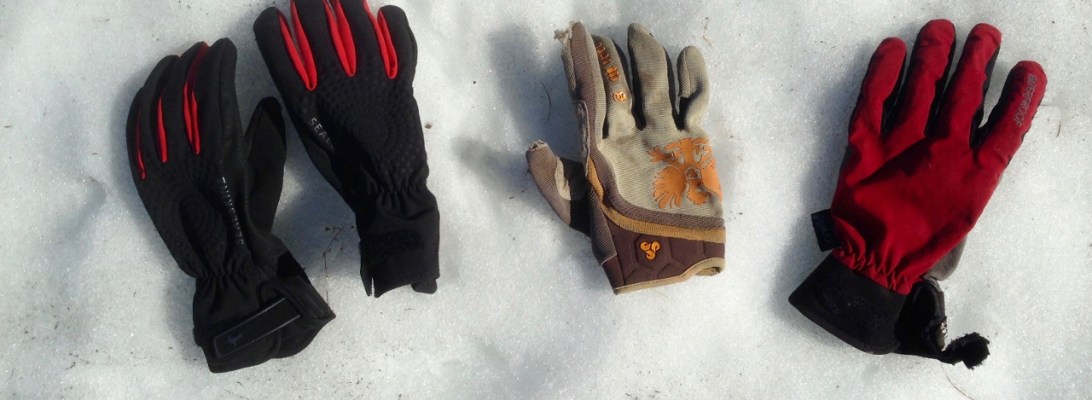
Last year we spend hours looking for lost handheld radios, a compass, drone bits and … gloves! Two of those were mine (and of different pairs). 10 months ago I left the island thinking that they were gone for good.

But as much of a black hole the tundra is, it occasionally regurgitates a lost item. This year it turned out to be three:

On our first visit to Collinson Head where we are setting up our some of our drone field sites, Isla suddenly shouts out, bends down and picks up the brown working glove I lost last year. What a surprise!

Full of joy, we head on to our next plot, till I suddenly realised that I lost one of the new pair of gloves that I bought this year. Backtracking for a kilometre, I am about to accept my karma – a glove lost for one gained – when I spot a red and black patch on between the cotton grass. There is my second glove.

The following day I am rummaging around the rangers’ workshop looking for a pair of clippers to cut tin sheet, when I spot a too familiar looking red glove sitting on the shelf: Indeed, the last one of my lost gloves from last year, found by the rangers in spring and kindly brought back to camp.

Lost Glove (1280x911).jpg

Three gloves lost and three gloves found, one pair united and two still waiting for to meet their partners upon our return to Edinburgh. Together with the beluga whales, bears and musk ox, such little things provide us joy and make working in the cold and wet of the tundra worthwhile.

The Glovers (1280x960).jpg

By Jakob

Drones airborne and data beginning to roll in

We have been on Qikiqtarȓuk (Ummmarmuit spelling of Qikiqtaruk/Qikiqtaryuk – the local Yukon Coast/Aklavik dialect of Inuvialuktun) for two weeks!  I can’t believe it.  It seems like we just arrived yesterday.

We have also finally managed to collect drone data with both of our two machines, Shrubcopter and Droney McDroneface.  Yay!  Finally.  There are still some kinks to be worked out.  Drones!  For everything that goes according to plan, there is always something else that goes wrong!!!  But rather than bore you with the technological details, I will inspire you with the science.

DSCN4159

This summer we are trying to answer two big picture questions with our research. We want to know 1) how tundra plant phenology, biomass and carbon storage are changing over space and time as tundra plant communities shift in response to warming, and 2) how the greening of tundra ecosystems as observed by satellites matches up with the observations we are making on the ground of phenology and vegetation change.

In order to answer these questions, we are combing 15 years of ecological monitoring data with imagery collected with our drones.  We are then analysing this imagery to make indices of the greenness of the tundra landscape (vegetation indices such as NDVI – the normalized difference vegetation index) and structural models of tundra plant canopies and the ground surface.

Here is what we know already about vegetation change on Qikiqtarȓuk. These are the summarised observations that we and the Yukon Parks Ecological Monitoring Team (see Meagan’s post from last year) have made about the vegetation changes over the past 15 years on the island:

1)    Shrub cover is increasing in the floodplain vegetation (Myers-Smith et al. Ambio 2011)

2)    Canopy heights and the cover of plants are increasing and bare ground is decreasing in the upland vegetation (manuscript in prep.)

QHI_CanopyHeight3)    The green up and flowering of some of the monitored species are occurring earlier over time particularly in early snow melt years (manuscript in prep.).

We are putting together a manuscript summarizing these findings at the moment in collaboration with the Yukon Park rangers and Parks Biologist Cameron Eckert.  Stay tuned for more info on this manuscript in the coming months.

This summer, we want to add in drone data to bridge the gap between the ecological changes that we are observing on the ground across the landscape and compare with what satellites are observing from space.

Our four specific questions with our drone research include:

1)    Do drone data capture on-the-ground plant phenological changes over time more precisely than coarse spatial and temporal resolution satellite data?

2)    Can we observe particular phenological events such as flowering across the landscape (drone data) to compare to on-the-ground phenology measurements and phenology change over time (ecological monitoring)?

3)    Do the larger biomass/biovolume parts of the landscape (e.g., tall shrubs and tussocks) have the greatest rates of increasing size across the landscape?

4)    Are the species that are showing greater change in cover and “biomass” over time on the island (ecological monitoring data) the same species that show the greatest increases in size over the growing season (drone data)?

So, now that we are up and running – for the most part – with drone data collection we can start to gather together the necessary data to test these questions.  Exciting times.  Thus far we have only really looked at some pretty and very high resolution pictures of shrubs, tussocks and tundra from our various sensors including our new Sequoia multispectral sensors.  But hopefully over the coming weeks the preliminary analyses will start rolling in and we can share some of our initial findings from this summer’s research.

To date the Qikiqtarȓuk scientific discoveries include:

1)    Variable active layer depths – The depth to frozen ground is greatest in the wet areas where the dense shrubs are located and less in the uplands and shallowest in the tussock tundra. Currently on the floodplain the active layer is greater than 50 cm depth, around 20 – 30 cm in the grass and flower dominated Komakuk vegetation type and a bit shallower around 10 – 20 cm in the tussock tundra.

2)    It’s an early year – It is a relatively early flowering year for the tundra plants such as Dryas integrifolia (Arctic avens), though not as early as last year.  It is now day 180 of the year (29 June 2016) and the Dryas flowers are starting to come out across our side of the island.

3)    Shrubby diversity – Though the floodplain is dominated by mostly Salix richardsonii growing up to over a metre and a half tall, there are some other willow species in there too, such as the odd Salix pulchra individual and a few Salix alexensis, which are very rare on the island and identified for the first time by us last year in this same area. In warmer places such as Kluane, Salix alexensis can grow to be up to four metres tall!  I wonder if they will ever get that tall up here on Qikiqtarȓuk?

Stay tuned for more scientific discoveries as they role in and more updates on our adventures.

From a steely grey and totally calm midnight Arctic where you can’t tell where the ocean ends and the sky begins.

By Isla


A week in the wild

We are back at Base after a week in Pika Camp. Last Sunday saw us depart with almost surprising punctuality as we hitched a ride with our new friends Scott and Cole (U. of Alberta), who were on a mission to check the bear-beaten weather stations that dot Pika Valley (final score was bear: 3 / stations: 4).

SAB-0763
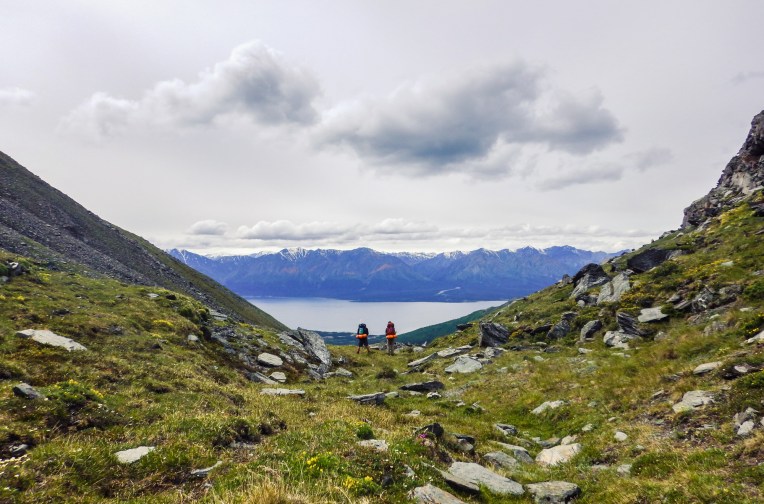
Haydn and John in Printer’s Pass

The long hike with our heavily loaded packs was like a snail race up the hill, following the tracks of bears and moose and wishing we were as agile as them. In the end we all made it across the ridge, and seeing the familiar little white igloo down in the valley heartened us as we hurried towards it to set up camp.

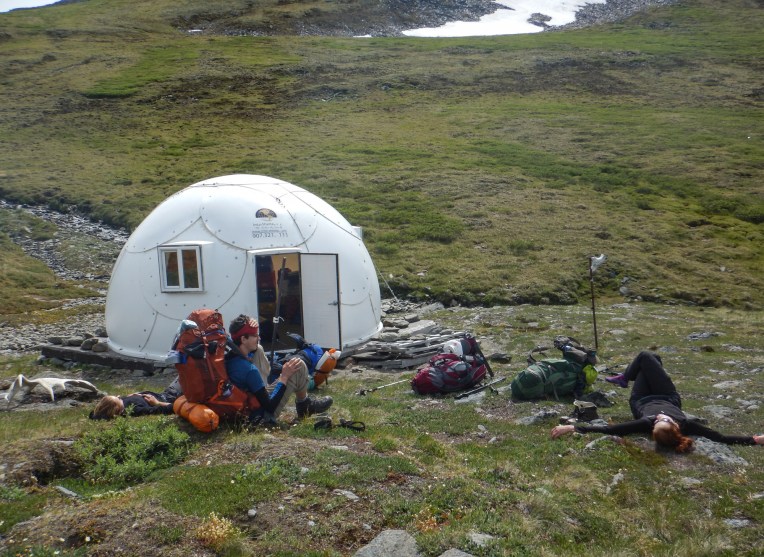
SAB-0453
A knackered Team Shrub resting before setting up camp around the Pod

The strenuous walking was far from being over, as John and I spent the next two days trudging up and down a 700 m elevation gradient to set up and monitor a herbivory experiment. Luckily, we were rewarded with sightings of porcupines, marmots, pikas, ground squirrels and ptarmigans, and the view from the top of East Peak was in itself largely worth the effort.

Meanwhile, Haydn and Eleanor were so busy collecting traits and litter samples that they would forget to have lunch, and then make up for it by ransacking our supplies of snacks and Country Time.

On the third day our spirits were – quite literally – dampened as a stormy front settled over the valley. After a morning of cold, wet and not particularly efficient fieldwork, we all retreated to the Pod for a lengthy lunch break. The lack of external forms of entertainment or mental stimulation were first felt when Haydn had the brilliant idea of naming each of this year’s cohort of 300 willows in the common garden with a name beginning with D, which led us to brainstorm 78 of them (suggestions anyone?). One thing leading to another, John was next challenging Haydn and I to name over a hundred Harry Potter characters. (We managed 216, can you do better? – or you could just do like Eleanor and go for a nap.)

After this cheerful nerdy break, we went out again for more sampling and before we knew it, we were all sitting in front of our last meal in Pika Camp. This was the perfect opportunity to celebrate John’s graduation from his Ecological and Environmental Sciences degree, which was officially taking place in Edinburgh last weekend. We all solemnly applauded as he put on his robe (made of a garbage bag lined with duct tape and flagging tape and complete with a toilet paper faux-fur collar), got hit on the head by Haydn’s beanie (for those familiar with Edinburgh graduation customs, the beanie got to the top of East Peak, which is as close as we could get it to space) and received a hand-made certificate signed by all of us. Congratulations John!

SAB-0827
Goodbye Pika Camp

We made good time on the way down the following morning, fuelled by the promise of hot showers, cold beers and snug cabins waiting for us at Base. With two hours to spare before our agreed pick-up time (yes, we were that excited), we engaged in a heated pétanque match on the sandy roadside. It is now time to get back to work as there are dozens of willows to be rooted and hundreds of seeds to be germinated. Stay tuned for scientific discoveries!

By Sandra