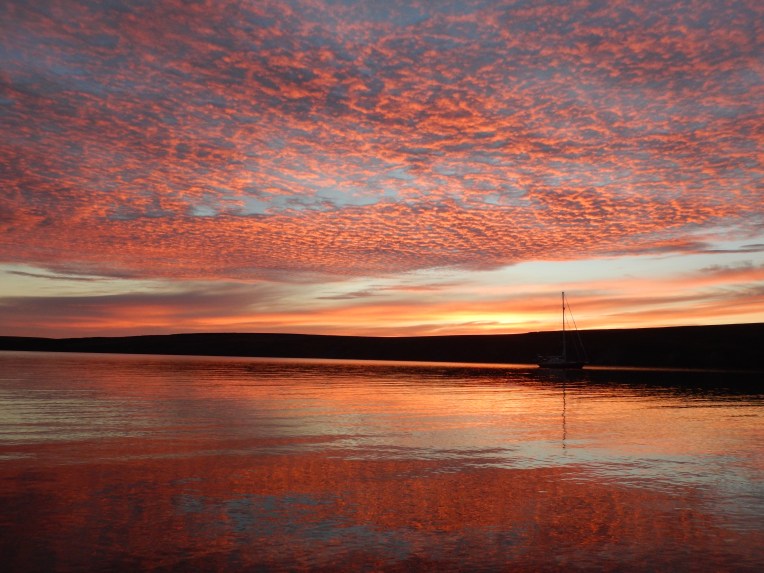
A quick glance across the landscape on Qikiqtaruk reveals many beautiful views – hills that are getting greener and greener every day, calm waters reflecting golden rays of light and sea ice flowing in front of the distant silhouette of the British Mountains.
Sea ice and fog along the Arctic coast with the British Mountains in the background.
Beauty here, however, stretches beyond what the eyes can see. In fact, if you close your eyes and imagine you are with us, the soundscape of Qikiqtaruk is as magical as the landscape!
Ice crystals in a silent sea
A diversity of bird songs. First, crane calls. We often hear the cranes before we’ve seen them – there are a few pairs on the island and it’s always a joy to know they are nearby! Then there are the waders – semipalmated plovers and sandpipers dashing across the mud spits and occasionally warning us with their alarm calls that we are close to their nests. The call of a Wilson’s snipe, a unique melody coming from the air passing through their tail feathers whilst in flight, is the usual soundtrack to our walk up to the field sites. We have also heard red-throated loons, but have yet to see them!
Peeping warnings
Winds of various speeds. From a gentle breeze rattling the seed pods of last year’s grass spikes to strong bursts of air blasting through camp and shaking the window shutters, listening out for the wind is often our first indication of what the weather is like outside.
The wind and the waves
Arctic bumblebees. Among all the new sounds for us here, one stood out with its familiarity. Could it be, we thought, a bumblebee? A bumblebee it was indeed (Bombus polaris), and the biggest bumbleebee I’ve ever seen nonetheless! As they hurry from flower to flower, their jolly buzzing merges with bird songs, reminding us that soon summer will be in full swing.
The hum of oncoming summer (Ok, not a bee)
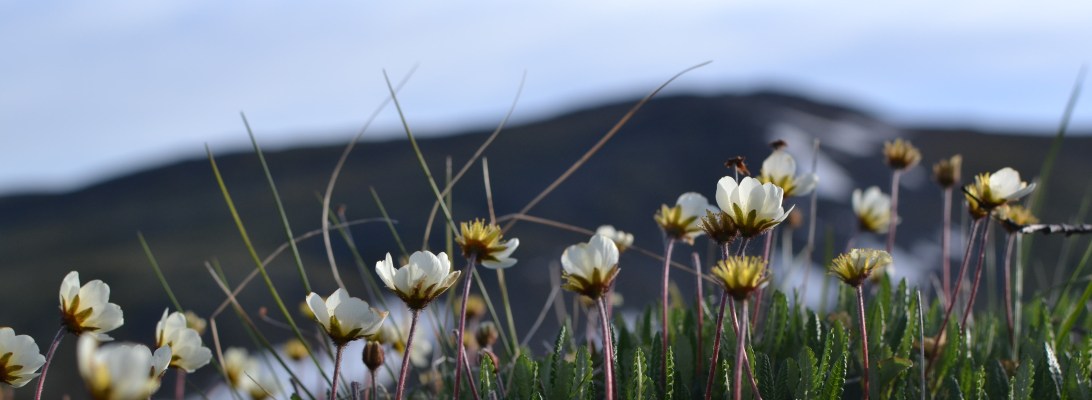
Dryas integrifolia (Arctic avens)) flowers in bloom
Salix arctica (Arctic willow) flowers blooming
Silence. Finally, the quietness. All the sounds here are so much more distinct because usually it is so quiet – even a gentle wing flap by the nearby pair of tundra swans resonates through the air. We have all enjoyed taking quiet walks after a day of fieldwork – a time to look, listen and take it all in. Even after just a few days on the island, we can all feel the landscape change – we can see it, we can hear it, and thanks to all the data we’re collecting, we can study it, too!
It was little more than a flash in the willows, just for an instant and then vanishing, but one that stopped me in my tracks. Could that have been a hummingbird?
Qikiqtaruk is rapidly changing, and nowhere is that more evident than in the vegetation that thinly covers the island. A warming climate has brought earlier green-up, shifts in plant composition, and the expansion of shrubs. Perhaps the question I’m asked most often is how are these changes affecting the bird populations? Many bird species thrive in shrubs, so could more willows be good news? Well, it’s not that simple. Other bird species, such as American Golden-Plover and Ruddy Turnstone, prefer sparse vegetation and bare ground – and these Arctic nesting shorebirds, which face stressors throughout their ranges, have declined sharply in recent decades. Still I’m intrigued by the influence that shrub expansion may be having on Herschel Island’s bird diversity. To explore this question, I now bird the willows along east Ice Creek as part of my regular morning surveys.
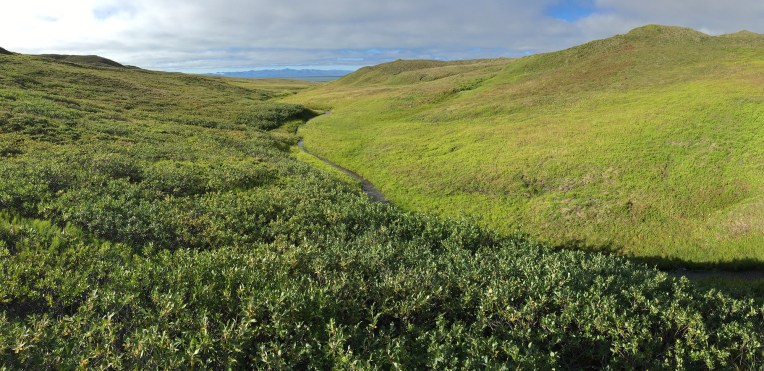
A lush expanse of Salix richardsonii along east Ice Creek on 5 August 2016. Photo C. Eckert.
Ice Creek, on the northeast corner of Herschel Island-Qikiqtaruk Territorial Park off the Yukon’s Arctic coast, flows with melting snow and ice from the surrounding rolling tundra through an alluvial fan at the base of Simpson Point, and into Pauline Cove on the Beaufort Sea. The east tributary of Ice Creek features some of the island’s biggest patches of willow (Salix richardsonii) – mostly below knee height and sparse enough that I can easily walk through the willows along the creek. Green-up in mid-June rapidly transforms this brown tundra valley into a beautiful green world of willows and wildflowers. And there are birds.
The White-crowned Sparrow, an uncommon breeder on the island, is the species expected to be most responsive to willow expansion. Their clear and distinctive song makes them easy to detect, and this past June I observed two pairs nesting along east Ice Creek, with another singing on west Ice Creek, and one more on the alluvial fan. However, it’s not clear if the population here has changed – it was known to be uncommon in the mid-1980s, though long-term breeding bird surveys conducted by Park Rangers on Simpson Point hint at an upward trend.
A male White-crowned Sparrow in full song on the alluvial fan, 18 June 2016. Photo C. Eckert.
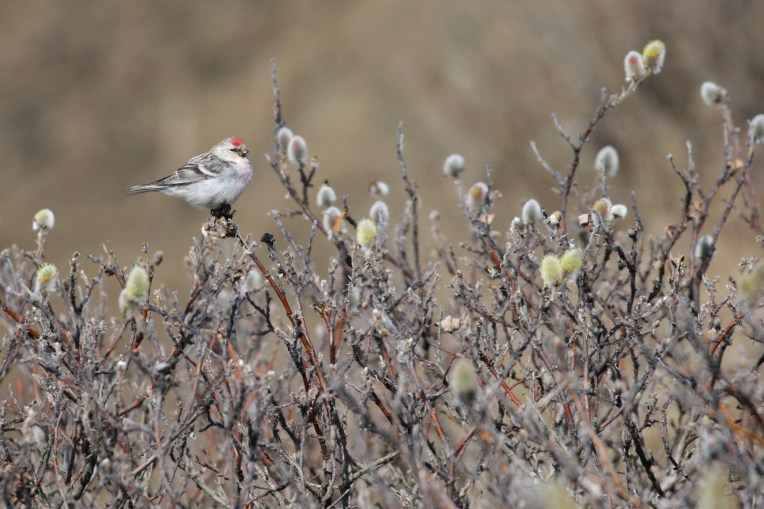
Common and Hoary redpolls are also common in the willows along east Ice Creek. Typical of finches, their numbers are highly variable from year to year. Here they’re not dependent on shrubs for breeding, and I’ve found a few nests in drift logs along the beach at Simpson Point. This past June, a pair of Hoary Redpolls greeted me on almost every hike up east Ice Creek. Their chittering songs and calls, and habit of collecting bits of fluff were signs of pair-bonding and nesting building.
A male Hoary Redpoll surveys its breeding territory along east Ice Creek on 10 June 2017. Photo C. Eckert.
My forays through the shrubs have yielded surprises. I’ve come across small numbers of Yellow Warblers and Yellow-rumped Warblers – common breeders on the North Slope mainland, but very rare on Qikiqtaruk. I’ve never heard one singing, and they seem fully occupied with feeding – wanderers to the island, but not breeders. In June I also spotted a female Varied Thrush, just the third island record, feeding along east Ice Creek; as well as an American Robin which is rare but regular on the island.
Female Yellow Warbler, a rare visitor to Herschel Island, feeding among the willows along east Ice Creek on 17 June 2017. Photo C. Eckert.
It was last year, on 19 June 2016, that I found the bird which would firmly enshrine east Ice Creek in my daily routine. Walking through willows along the creek, I flushed a warbler that flashed bright yellow undersides, an olive-green back, and dark grey hood. This was an Oporonis-type warbler, and the three possible species would all be an extreme rarity here; so when it landed I focused on its face to check for white eye crescents or lack thereof to confirm which species. It perched low in the willows for just a few seconds and I could see bright white crescents above and below the eye. The first MacGillivray’s Warbler for Herschel Island – 1000 km north of its breeding grounds.
A male MacGillivray’s Warbler, 1000 km north of its range, deep in the willows along east Ice Creek on 19 June 2016. Inset shows close-up of the skulking warbler. Photo C. Eckert.
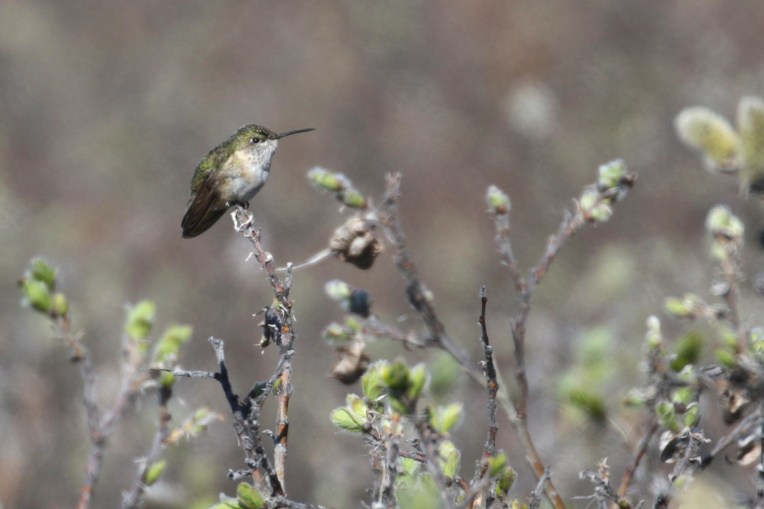
Exactly a year later, on 19 June 2017, I was again walking through the willows along east Ice Creek. Watching, listening, and totally focused, when a tiny greenish flash caught my eye. It darted low to the ground along the edge of the willows. A hummingbird? Inconceivable! Over the next 15 minutes I saw the bird just three times and only for a few seconds, but it’s extremely small size (even for a hummer) and colouration (green back, pale buffy front) immediately brought to mind Calliope Hummingbird. It flew low to the ground, and was extremely hard to spot in the myriad willows. I decided to run back to camp and get my hummingbird feeder (yes, I brought a hummingbird feeder to the Arctic).
I was back and had the feeder set up in the willows within 35 minutes. I sat quietly and waited. Then by chance I looked over my shoulder and saw the hummer perched about 25 metres away. I got a great view and snapped my first photo. Then miraculously, the hummer did a fly by, circled around, and perched in the open on top of a nearby willow. I got great views in full sunlight, and much better photos. It vanished again into the willows. I carefully scanned the foliage, and there it was, just two metres away, but well hidden. I lined up a view through the branches and took a few more photos. Moments later, it flew again and appeared to be feeding on willow flowers. Then it disappeared. That was my last view of the hummer, and it never went to the feeder. My initial impression was confirmed – this was an adult female Calliope Hummingbird, the first for the Yukon and the Arctic. A staggering 1,800 km north of its breeding range.
Herschel Island is well-known for rare birds, but still, this adult female Calliope Hummingbird, 1,800 km north of its breeding range, along east Ice Creek on 19 June 2017 was a total shocker. Photo C. Eckert.And there she was was – the Calliope Hummingbird perched just two metres away, but well-hidden in the willows along east Ice Creek. 19 June 2017. Photo C. Eckert.
It would be simplistic to dismiss such rarities as inconsequential, as their occurrences may well be early indicators of changing bird populations. Over time these well-documented records can reveal unexpected patterns. I’ll continue exploring Ice Creek, tallying the familiar birds, and carefully watching for the next surprise visitor to Herschel Island.
Cameron Eckert is an ecologist who has studied the birds, wildlife, and ecosystems of the Yukon’s North Slope and Herschel Island for the past 25 years. As Conservation Biologist with Yukon Parks, he works with Qikiqtaruk Park Rangers to coordinate the island’s ecological monitoring program.
Herschel Island bird observations can be viewed or downloaded at www.ebird.org.
Last week saw a delegation of Team Shrub travel all the way up north to Aberdeen – shamefully a first visit for many of us who clearly spend too much time in Edinburgh!
A regular selfie…
The jumping selfie, our new favourite type of photo, when you don’t have someone else there to take your jumping photo!
Three of us gave presentations that were very well received and praised for their graphic design – “visually stunning” as Gergana has a habit of saying.
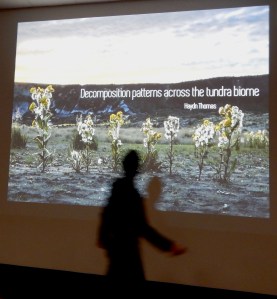
Haydn Thomas – Decomposition patterns across the tundra biome: litters substrate explains more than environment. Haydn presented results from the Tundra Teabag Experiment, demonstrating how the quality of litter inputs influences decomposition rates a lot more than site conditions like temperature or moisture.
Gergana Daskalova – Are rare species more likely to be declining than common species? A common assumption, but the answer is nope! At least, not in the UK. Gergana showed that common metrics of rarity like habitat specificity are not linked to steeper slopes of population change, and that there is not even a declining trend for UK vertebrate populations: a lot of populations are also increasing or remaining stable. Gergana’s excellent talk was highly commended by the jury!
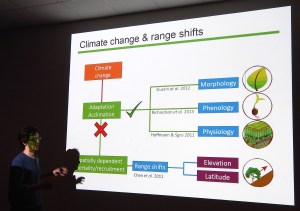
John Godlee – How do competitive interactions affect elevational range shifts of neotropical trees? John presented exciting results from his Honours dissertation, demonstrating that tree seedlings are negatively impacted by root competition from mature trees, but that the canopy of the latter might reduce plant stress in those same seedlings. Fascinating parallels with the stress-gradient hypothesis, a favourite topic of mine – and of the jury apparently, as John won first prize for the best talk presented at the conference! Congratulations John!
Our Team Shrub poster presenting some of our current research interests
After mingling at the poster session, everyone went to the pub for more mingling, and Isla persuaded the staff to put on University Challenge on the big screen so we could watch the Edinburgh team play their last match: a sad outcome, but we are super proud of our very own Edinburgh Boyle (captain) and the rest of the team for an enthralling and edifying season!
Sad faces after the loss
Watching university challenge at the pub
The second day of the conference was full of excellent student talks on subjects as diverse as food preferences in hummingbirds, mysterious lichen taxonomy (baffling indeed), and sustainable management of tropical ecosystems, and everything in between. There was also a panel discussion on applying ecological science to conservation and environmental policy. The panelists were adamant that research is impactful and valuable to policy. As Georgina Mace put it, “the key is to find a question that is answerable, interesting and worthy”. Anne Glover emphasised the importance of timely thinking: “It’s incredibly important to communicate your science at the right time, not when the train has already left the station – look at which policies are coming up, which ones are due to be revised.”
Other words by Anne Glover resonated with us: “You can’t generate knowledge and not find a home for it. A home with just other scientists is not good enough”. This applies to policy, but I felt it also relates a lot to the many outreach events we have on at the moment with the Edinburgh International Science Festival. There is definitely much to be gained by sharing perspectives and opening up to new ideas.
Thanks to the organisers for putting together such an exciting programme. We are already looking forward to next year’s edition of SEECC!
I am on the train zooming up the East Coast from London to Edinburgh. It’s a cold and crisp November day and it really doesn’t feel like we’re in the warmest year since records began, but still my mind is busy thinking about Climate Change. Last night I attended the Carbon Trust’s Annual Innovation lecture by Professor Lord Stern from the London School of Economics. Professor Stern will be known to many of you for the Stern Review on the economics of climate change published in 2006. In the report, he discusses climate change as the largest market failure that the world has ever seen, mainly because we’re not accounting for the environmental costs of burning fossil fuels.
Ten years later and having just returned from the COP22 in Marrakesh, Prof Lord Stern presented a refined and updated summary of his analysis of the economics of climate change. The messages where clear: If we want to tackle climate change, we need to tackle world poverty as we can’t separate one from the other. Innovation is key, but not just restricted to technology, we also need to be innovative in our policies, our economies and our ways of living. We need to correct for the market failures associated with not having to pay for the environmental costs of fossil fuels, otherwise we will create extraordinary costs in the future, threatening us and future generations. Economically speaking, it simply makes sense to invest now.
The solutions that Professor Stern suggested were familiar: apply a carbon tax, promote innovation in sustainable infrastructure, tackle energy efficiency etc. But what really struck me was that again and again he highlighted the urgency at which we will have to implement these solutions. The policy decisions of the next 10 years will determine what kind of climate we will be living in in the future. If we get it wrong now, it is unlikely that we will be able to correct for it afterwards and the associated human and economic costs will be incredibly high. This is something that many of us global change scientists have been worried about for a long time and the gloomy mood that settles over the coffee room after someone mentions the speed of climate change is too familiar to many of us.
Professor Stern was clear that this is one of the biggest failures of the discourse so far: We haven’t managed to communicate the urgency of climate change well enough! And here is where I see us global change scientists come in. We might not be able to advise on detailed policies, innovation strategies and market economies, but we can do much better at communicating the changes that we observe and the consequences that they might have in the long run. This is something that we at Team Shrub feel quite passionate about, but I think we have a lot to improve and often I find myself wondering how to best go about it. Isla discussed this very nicely at the end of her Our Changing World lecture at the beginning of the month.
I think it is easy to forget the power of storytelling and personal connections when we’re under the pressure of scientific publication high up on our ivory tower. Many times, I have been surprised by the amount of interest and the positive responses that we receive when speaking to strangers about our work in the Arctic, be it a member of the Carbon Trust at the canapés after the lecture or a mining engineer on holiday in Alaska. We can connect to people and we do have to make more of that!
In that sense, I would like to finish on a positive note and quote Professor Lord Stern who, after highlighting the positive developments of the recent years including the fast ratification of the Paris agreement and China’s commitment to tackling climate change, contemplated about the future environmental policy of America’s increasingly mellowing president-elect: “I do not know… we do not know… and probably he doesn’t know”. So let’s be open and optimistic!
By Jakob
I would like to thank the NERC E3 Innovation Programme for funding my travels to London; Susan Davies and Laura Scotland from the ECCI for organising it all and Zack, Emil, Richard and Sophie for all the great discussions around it.
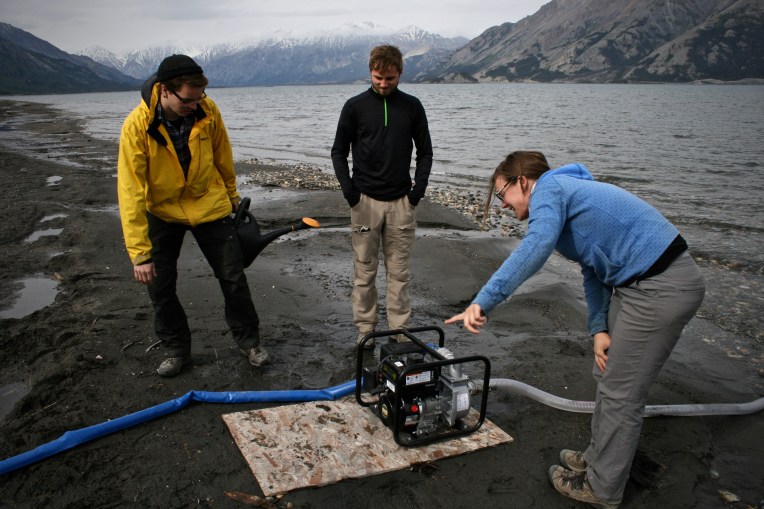
I’m reminded of this XKCD comic when I think of our tribulations with the Tony Gabowski Common Garden water pump. Countless hours have been spent getting this purported timesaver to work properly, although hopefully it will save time in future years, maybe … I hope.
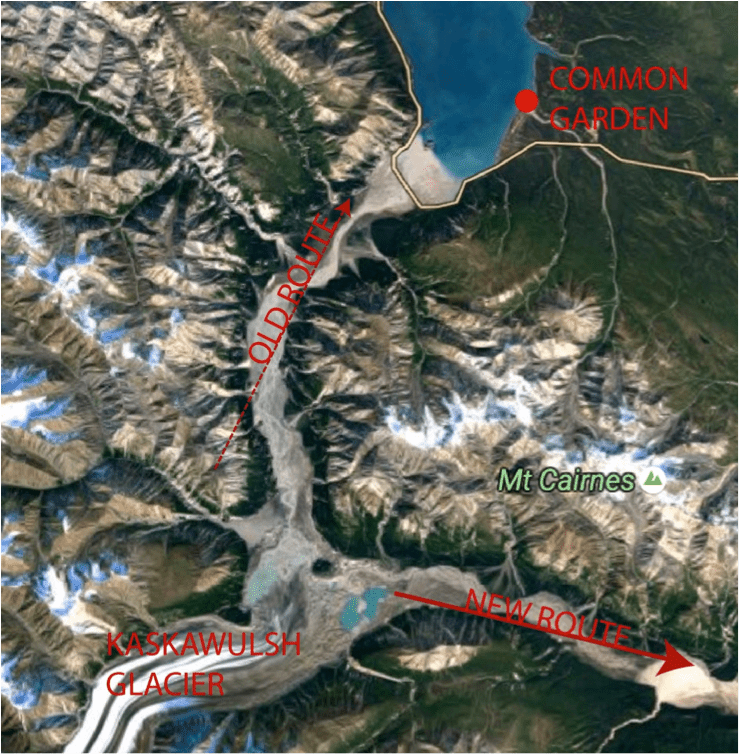
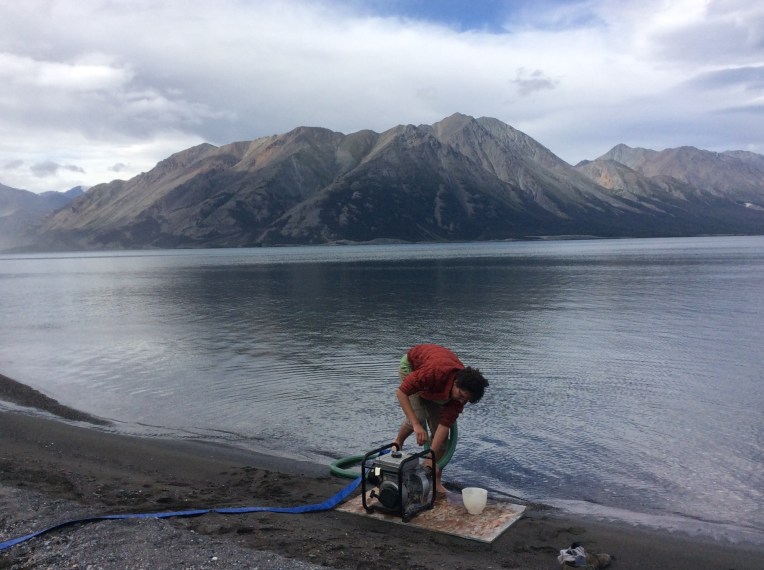
The water level of Kluane Lake has dropped by over a metre this year, the result of glacial retreat and rapid spring melting (Figure 1). Until recently, we had been collecting water in buckets from the lake to feed to our experimental willows in the Common Garden, but this will become harder if the lake level continues to drop. So, as a slightly hypocritical response to our climate change woes, we bought a petrol-driven pump and loads of plastic piping to carry water up to the garden.
Getting the pump to work was easy. Jakob ordered everything back in Edinburgh and the whole lot was waiting for us when Team Drone rolled up in Kluane. Like that Pulp song, the whole thing was assembled quickly, and with a whoosh the lake water raced from lake to barrels, and a summer of barrel rolling and bucket carrying was saved.
Pump the first
Of course, if that was the end, this would be a rather boring saga. Instead, the pump never turned on a second time. In fact, it took around six weeks to get the right adaptors and figure out how the pump actually functioned.
The first pump broke. Like a car from the ’90s, something inside it just gave up. We returned the pump to a full refund and a sense of defeat.
But all was saved! Tony Grabowski, of Yukon and taxidermy fame, knew someone who had won a pump but it was broken. They were happy to give it to us; all we needed to do was repair it. No problem. So Team Kluane arrived on the scene to a high quality, fully functioning pump, and a simple instruction from Jakob: you probably need to buy some more hose.
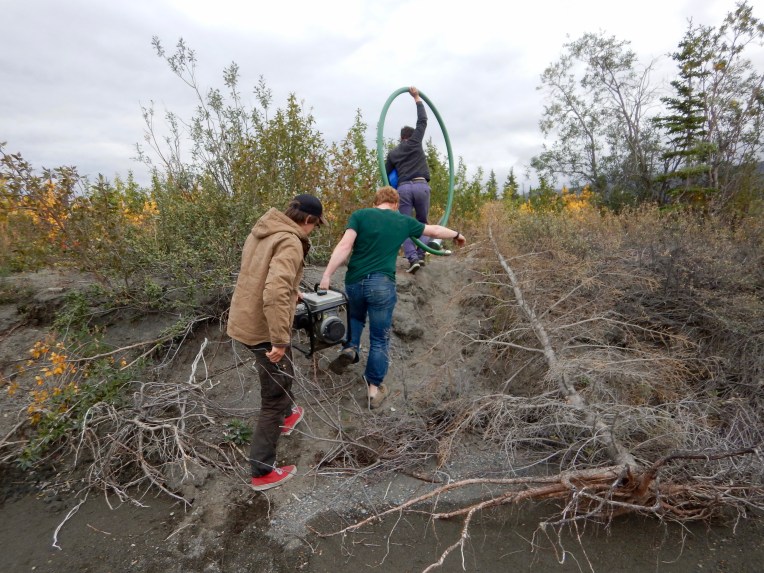
Feeling confident with such a shining specimen of a pump, plus a brand spanking new intake hose, Team Kluane strode down to the common garden with an unusual sense of purpose. Only to find out hose was not nearly long enough. Damn.
Still you know what they say, if at first your hoses are too short, find some more hose. Lance, lord of the rugby field, to the rescue! With hose lying around a’plenty, we soon borrowed enough to make twice the distance from the lake to the pump. Surely this time!Except the hoses didn’t actually connected to the pump. Or each other. Another defeat.
Lots of internet research followed by complicated diagrams and reciting product numbers in phonetic alphabet to Yukon Pump (You KAN Pump!) provided us with all the right equipment and enough hose to futureproof the pump if the lake level drops even further. Sure, we were now going up to Qikiqtaruk, so the middle month of the summer required water hauling, but when we got back all would be well.We got back and all was well. The custom made hose and parts were once more waiting for us, and on our first try we eagerly set everything up. This time!
Only to realise that we didn’t actually know how to turn the pump on, forgetting that we were researchers and not very practically minded.
John struggling with the pump
A brief lesson on priming from Lance and this time the pump stuttered into life. With a cheer, John and Sandra made clear that water was rushing through the hoses up from the lake to the barrels, clear and cold and fresh, and…not coming out the other end. Confused stood I, holding the dry end of the hose and wondering if it might have anything to do with that new water feature over there in the bushes.It turned out that a hungry ground squirrel had chewed through the hose in our absence. So off we went back to the workshop to fix it. I say we. You can probably guess who actually fixed it (his name begins with L).
Finally, YES!! On our sixth try the pump worked, filling the water barrels in minutes. SUCCESS!
Unfortunately by this time the field season was over and we didn’t need to water any more. And since this get rather cold in the winter up there we couldn’t leave water in the barrels lest they freeze and split.
And so our saga must end: with barrels of water being poured away at one end of the Common Garden. A time saver indeed.
There’s always next year!
Table 1 – Cost-benefit analysis for the pump.
Pros
Cons
A pump means you don’t have to walk buckets of water from the lake
Canadians can’t understand British people on the phone
A pump can be used in a water fight to great effect
Using a pump may speed up climate change
Pump piping is a great source of nutrients for ground squirrels
Not knowing how to turn on the pump made us feel really stupid
Getting the pump to work provides a source of entertainment for bored researchers that have finished all their fieldwork.
Dear Reader, I invite you — if you are of the age and comfortably seated — to draw yourself a wee dram of a lovely single malt (or even a high-quality blend); to marinate yourself into the appropriate mindset, and brace yourself for the lengthy read (sry..).
A merry company raises their goblets and their multi-dialected voices in a cheerful ‘Och Aye!’ to mark the first of many cheers of the evening of the 2016 Qikiqtaryuk Scottish Feast. *Editor’s note: ‘Och Aye!’ or ‘Ahoy!’ is a Qikiqtaryuk cheers adopted in the 2015 Feast through a mix of fortunate misunderstandings on the intricacies of the Scots’ languages – just as the Gaelic ’sláinte’ turned to ‘sshhllllnn..?’*.
The 2016 Scottish Feast was definitely that of Downright Majestic speech, toast, poem, ode and song. Everyone took their allocated titles (the 2016 Feast schedule found below), with great dedication and pride. After the night’s Chairman (author) warmly welcomed everyone to shut up and listen; the Selkirk Grace was recited – by the night’s Clergyman John Godlee himself.
Some hae meat an canna eat, And some wad eat that want it; But we hae meat, and we can eat, And sae let the Lord be thankit
The Haggis and other local delectable foodstuffs were then piped in by an impressive a cappella pipe-band consisting of the entirety of the Qikiqtarmiut (‘people of the island’), this year with a rendition of ‘Scotland the Brave’. At this hour, the party people were already drooling over their plates, with their eyes busily indulging upon the many delicacies perched on the table. However, there were formalities yet. Marek (from AWI’s Polish Reinforcements Division) made a great speech in appreciation of the Haggis and it’s Polish equivalent, the Kaszanka, borrowing selectively from the ‘To a Haggis’ by Rabbie Burns. Before the Qikiqtarmiut were unleashed upon the Feast, England’s own Andrew Cunliffe was invited to deliver ‘The Loyal Toast’ in respect of the Queen, her supreme rule in the Commonwealth (which even Qikiqtaryuk is a part of), and her Fertile German Blood (in celebration of the new Royal Baby, Charlotte).
The spread across the table was splendid and abundant indeed. Among the many scrumptious dishes were sauerkraut, stovies, neeps, tatties, roasted parsnip and carrot, green long beans, scones, buttered peas and local game followed by apple crumble, Hugues’ ‘twice-cooked cake’ and Ricky Joe’s famous lemon meringue pie. Hands were flitting around the table in attempt to secure the juiciest pieces and freshest of green leaves, all the while making sure everyone got their fair share (which ended up being quite a pointless endeavour, as left overs fed Team Shrub for the coming two days).
The Qikiqtaryuk – Herschel Island Scottish Feast is also often referred to as Qikiqtaryuk Burn’s Supper, as the greatest Scottish gathering in the Calendar Year is the Robert Burn’s Dinner. In the Motherland this takes place on Robert Burn’s Day (25th of January), and usually exactly a 6-month after on the island. Our feast took place but a week after the 220th anniversary of Burn’s death (21st of July 1796). Thusly, in the Immortal Memory of Rabbie Burns, the Principal Speaker, Hughes Lantuit (head of the Alfred Wegener Institute crew) gave his respects to this great hero and invited him to bless us with great strength and fortune; including a wish for shrubs to grow fists to help us fight Climate Change. *Editor’s note: the first Robert Burns’ Supper was held on the Anniversary of his death by his friends, and not his birth, as it is currently celebrated*. In return, Team Shrub’s own token German, Jakob Assmann, eloquently and in great rhymes complimented the Principal Speaker, and then gave way for Edward the Ranger to Toast the Wildlife that had given their life to be served on our table that night.
Many people went to great lengths to deliver a memorable oration at each of their turns, but perhaps the most successful at this was the Team Shrub Magnum P.I., Isla Myers-Smith, who had composed and written a song to be known as: ‘Whiskey it is a Superior Drink’. The chorus echoed for days in the many nooks and cupboards within the Community house and likewise within the corners our minds…
Oh, whiskey it s a superior drink, It is golden as the day is lang, With a dram in your hand you can sip and think, Smooth, peaty or terrible strang
*Editor’s note: lang = long, and strang = strong, the length of day in the song refers to the length of an Arctic summer’s day, 24h*
After the final clash of cup on cup and fainting away of laughter, Samuel stepped up to toast the Lassies (the QikiqtarMEOWt). With his eloquent delivery, minimal testiculation and glistening smile he not only moved the womenfolk to tears of absolute emotion, but found the feminine nuclei in all of us menfolk, and touched us all deeply. The Reply given by Sandra and Eleanor, in turn praised the island’s men. And though the compliments were not as readily available from the lyric of their salute as from Sammy’s, and the jibes and joshing were a bit more plentiful, the girls (in the end) did not fail to bring forth a sense of pride and delight in the muscly heads of us Lads.
After a moment of silence (of an efficient two seconds) for the fallen drones out there in the world, Julian read out loud his newest love letter addressed to the Arctic Turd (Jeff Kerby’s FX-61 Phantom fixed wing UAV), or as Julian would have named it: ‘The Polar Thunderbird’. As Ricky Joe had gone to sleep early that evening, instead of toasting the local fauna (as was allocated for Ricky), the company cheered his lemon meringue pie, and his superior traditional knowledge in his absence. Much stirred by the earlier confession of love toward his drone, Jeff performed a whimsical ode to our lavish outdoor gear, especially that of Fjällraven and Norrea, and the wonder of the G-1000 fabric (of which the cat’s pyjamas are surely made).
Sandra and John then took their turn to appreciate the glorious AWI flume, decorating West Ice Creek, and collecting all sorts of data (supposedly). The flume has lasted many climate event and season and was rightfully at the centre of all praise. However, equally tested in the climate and season are the point framers and other victims of the Qikiqtaryuk Ecological Monitoring Protocols, which were then oded by AWI’s superb (and only) lassie, Caro. *Editor’s note: the word ‘victim’ was used here simply to punctuate witty prose. Team Shrub loves ecological monitoring in all of its forms. The long-term data from these protocols is unparalleled in its statistical strength and value*. After the lengthy methodology back-patting was over, Eleanor called everyone to raise their cups in merit to the cooks and sous chefs, and in apology to the dish washers about to climb the Mt. Logan of dirty feast pots, plates and pans.
There was yet one speech, saved rightfully to last. Haydn had spent three days in preparation of this ode. The Ode to the Decomposing Glory of the Dead Beluga. At this moment it is hard to do the Ode justice in any other way than copying an excerpt of it here. *Editor’s note: this ode refers back to the exciting event about five days before, when a deceased beluga whale was found on the beach next to camp, and had to be dragged onto the other side of the island, to keep hungry bears away from camp. Edward the Ranger also removed the whale’s jaw to send it for analysis to the Department of Fisheries and Oceans, DFO. Additionally, Haydn had earlier, mistakenly, described the full-grown whale as being 36 inch (91 centimetres) long (136 in for reals)*:
…Thirty six inches long from your nose to your tail! Where there ‘ere such a beast! Where there ‘ere such a whale! Thirty six inches long from your tail to your nose! Or perhaps one three six. Ach I dinnae suppose You saw it! The sicht were a feast on the eye The monster of Herschel, beast of Qikiqtar-aye For a moment twas almost I knew, staring into your maw, As you smiled sweet torment. The Ed cut off yer jaw.
So over was the feast. But over was not the night. As the plates were gathered and hidden into the kitchen for later torture, the company gathered into the Community Hall inner museum. Here, Ed the Ranger, performed Inuvialuit Drum Dancing, impressing us all. These dances describe animals and activities, e.g. bathing water fowl, seal hide tanning and harpooning among others. After the applauses, breath-catching and filling of cups, the jolly assembly moved to the outside, to engage in Ceilidh dancing. Dancing to the instruction of Jakob and to the melody of Isla’s viola and Sammy’s guitar, everyone made brave attempts to dance correctly. A few correct steps were hit, and many spins spun, during the Gay Gordon’s. The ‘next level’ was reached during ‘Strip the Willow’, which highlighted some great G-force-16-spinning (in the hands of Andy and Marek) and bruised arms for some. Everyone survived the event with a smile on their face, however, only to be forced to wipe it off; as it was time for Animal Muk. Animal Muk is a traditional Inuvialuit game where the crowd forms a circle, and one person in the middle tries to personify an Arctic animal (for example the Collapsing Polar Shark, reincarnated by Hugues), and make attempts to make others in the circle laugh. The one who ‘cracks’ takes the spot in the middle to summon further creature spirits. The grand finale of the evening was a magnificent bellowing of ‘Auld Lang Syne’, completed with the proper crushing circle dance… But.. the eve was merely half-way… (hopefully this blog text however is already 80 percent done…phew..)
Most of the people hurried to the improvised volleyball court between the Bone House and the Mackenzie Cabin, some playing ball, with some music playing in the background and chatting lively on the sidelines. At this point, the midnight sun on the sky deceived most, and before anyone realised, the clock had hit 4am… The music jam went on for a little while longer, while some people dragged themselves to their tents and beds for a well-deserved rest. A small congregation found their way to the front of Community House, for some quality 4am to 6am log-sitting, chinwagging and scallywaging. Many great games were conjured and concocted, among them ‘Hatty Head’ and ‘Lighter Hand’. Finally, the eye-lids of even the most determined stayer-uppers and night owls started to weight them down, and reluctantly we had to call the end to the grand evening.
To those who have made it to the end of this monstrously long blog post, (I ask forgiveness for my habit to push the limits a sensible word count), I have this gift for you: a painstakingly edited version of what I’ve tried to describe above. Perhaps in this day of YouTube, Vine (still a thing?), Micky Mouse and TLDR, we at Team Shrub ought to only reach out to you, our trusty fan base (hi mom!), in the form of video. Enjoy and keep following us, not much longer to go with this year’s field season, but the blog posts will keep coming until we have run out of stories to tell! *Editor’s note: due to time and disk space constraints, the fully epic video has not made its way on the blog yet. Instead enjoy the pretty pictures, and the feast time-lapse.*
We’re back! After two months in the remote Arctic, we are reintegrating back into life in the outside world. Sorry to be slow to get in touch with all of you out there on the interwebs – we have a lot of adjusting to do before we can get back to our former lives. Here are the top 10 things that we find weird and why:
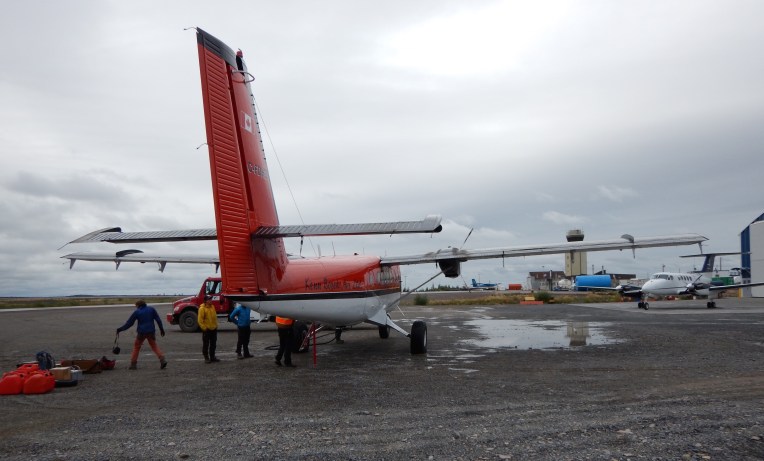
Our arrival at the Inuvik Mike Zubko Airport and unloading the plane in the rain.
Trees – or shall we call them really big shrubs. What are these tall plants that go above waist height and block the view to the horizon? They are green, way too tall and we don’t like them (well some of us say they do, but I am writing this blog post). Take us back to the beautiful tundra where our view is unobscured. Haydn pined for pines when he was in the Arctic – but he wasn’t there for as long as we were and thus his view of reality is really not relevant here.
Trees – aka tall shrubs – definitely block the view.
Darkness – aka night. What is this period of the no longer day where the sun disappears and it gets super dark for a while? We have heard about these things called stars and northern lights – which are some sort of lightness during the dark, but we haven’t seen any because it has been cloudy every time it gets dark. The darkness is awkward because you can’t find anything without using some sort of portable lighting device and it is a bit scary because you can’t see if there is a bear behind that shrub over there, or is that a shrub behind that bear over there. I prefer the way things were back up in the Arctic with light all the time, though even up there we heard that the darkness was coming.
Darkness is coming, even in the Arctic.
Running water – taps. To have water come out of a tap on demand when you turn the handle and flow into a sink is something amazing. You can do dishes, you can wash your hands, you can fill your water bottles and kettles, you can splash yourself or your friends/enemies with water. What is also amazing is that unlike in the Arctic you don’t have to decide whether the water coming out of a tap is drinkable or not – “Is this sauna water, Inuvik water, ice water, snow water or sea water? Perhaps I will taste it to try to find out.”
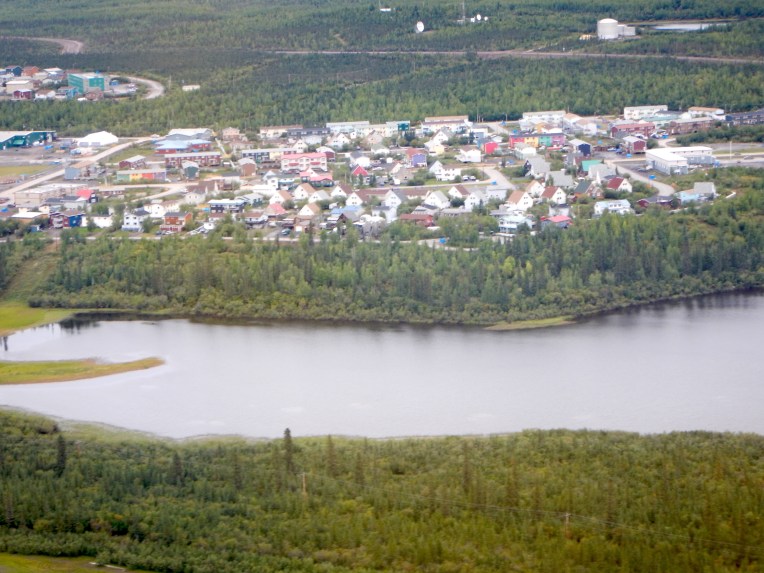
The town of Inuvik from the Twin Otter flight back.
Draining water – sinks without slop buckets. It is really something else to be able to use a sink and not to have to check under the counter to see if the bucket is going to over flow. And then to find out that you should have checked before your poured and that now the slop bucket is perilously full and you have to walk with it all the way to the slop pit without spilling the grossest of water all over yourself. Drains are the best!
Washing with ease – showers and laundry. Up on Qikiqtaqruk, it is a bit of an effort to stay clean and to wash your clothes. Here, on the outside, you can turn on a tap and then wash yourself with water that is the perfect temperature and get clean without having to warm yourself in a sauna for an hour or brave the chilly chilly water of the Arctic ocean. And more amazingly you can put your dirty clothes in these machines with some soap and just press a button and after a period of noisiness your clothes are clean and then into another machine, press the button and after much tumbling and more noise, your clothes are dry. Crazy!
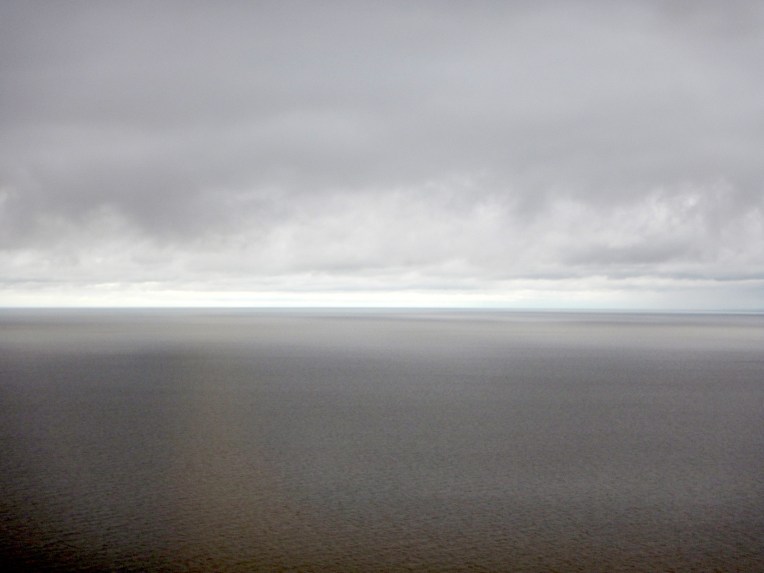
Our last view of the Arctic Ocean as we flew southeast to Inuvik on the Twin Otter.
No radios – out of contact. How do you communicate with each other when you are in different places without channel 69, “the pleasure channel” – no joke, it is the pleasure craft channel in Canada. How can you let everyone on the island know that for example you are going to watch the Princess Bride on your computer in the Trappers cabin? “Qikiqtaqruk, Qikiqtaqruk, this is the Trappers. We are watching the best movie ever – The Princess Bride – do you want to join?” We hear there are these things called cell phones or mobile phones, but we haven’t got back to that kind of advanced technology yet. Instead we are just relying on yelling, which works okay in relatively close proximity. We are yet to test it in cities. We assume it will be fine.
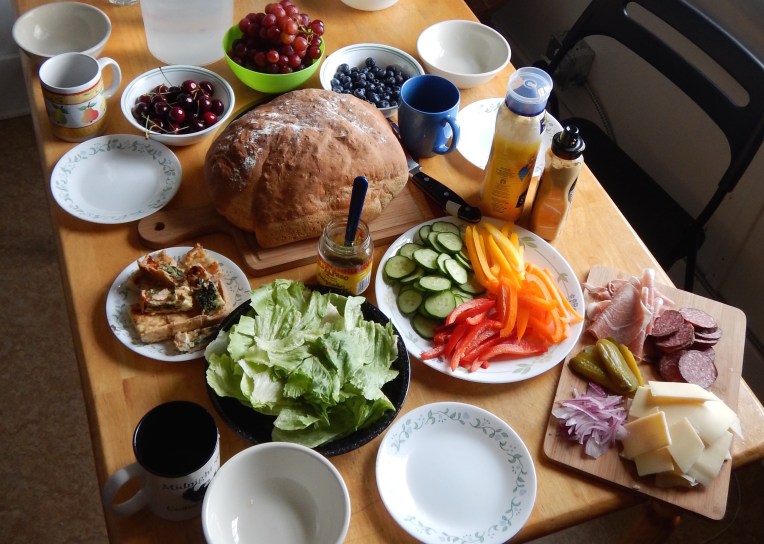
Trust worthy vegetables – no more rotting food. Not having to smell every freshies item and frozen-ish food to find out if it has gone off or not is a great luxury. Back on Qikiqtaruk our abundant food was everywhere: in “the store” in the warehouse, in a freezer that is turned off, in the propane fridge, in the Rangers’ freezer, in the ice house down in the permafrost. You had to always be thinking where your food was going to come from for each meal and whether it was okay to eat or not. But, at least all that food was “free” once on the island! Unlike here where you have to pay with this thing called money that mostly seems to be on these plastic cards with pin codes, that you can’t remember anymore, so you can’t actually pay, which is very awkward.
Memories of back when the freshies were fresh on Qikiqtaqruk.
Now we can talk to anyone in the world – people here, people there, people via the “internet”. Life used to be very safe, we only had the people on the island and our satellite phone e-mail to communicate. Here any stranger can just show up where ever you are and surprise you: “Hey, I just drove here with my car.” “Hey, I just swam here from over there.” “Hey, I am just calling you on Skype.” Back on the island, you could always hear the plane coming – forewarning you and thus keeping you safe from surprises. Though, those sailing boats were pretty stressfully surprising when they would just show up in the cove in the middle of the “night”.
The surprising arrival of the Top-to-Top sailboat, see the “last two weeks blog post” about our sailing adventures.
Electricity without noise. It is pretty crazy to have unlimited electricity without the noise of a generator growling in the background ruining the Arctic silence. Here you can just plug your technology into the wall or flip a switch and a light comes on – lights they are weird too, I miss good old candles when the light was a bit dimmer. Here, you don’t have to fill up with gas/petrol to get the electrons flowing, you don’t have to get the power chords all sorted and make sure the radios, drone batteries and computers are all charging when the genny is on. Electricity is almost as cool as running water.
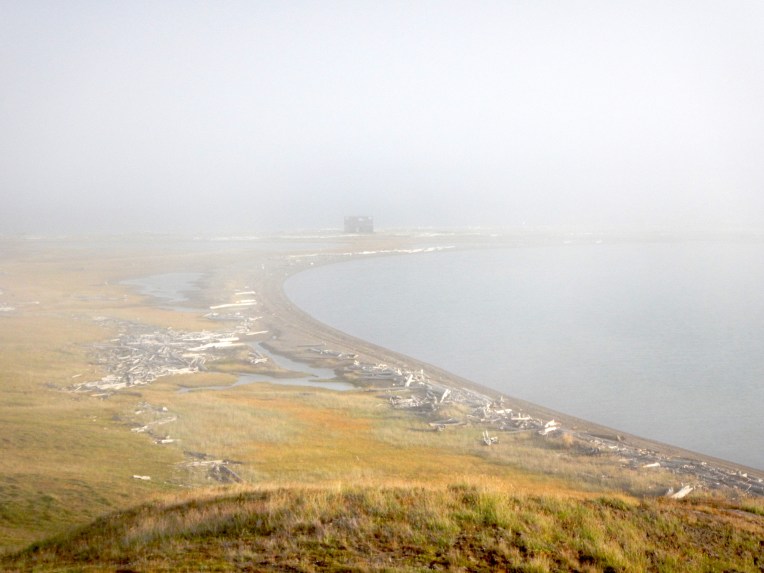
The silent Arctic in the fog of our last week on the island with the hum of generators running in the background.
And finally, the internet! Writing this blog post and posting it ourselves without having to send it out via satellite phone to someone on the “outside” who can post it for us, not being able to add in the actual photos, and then not be able to see the final product. In general, the internet is very weird. We even found that this “Google” guy who knows things better than even Isla (or so Santo says).
So, after long weighing and careful consideration, we have decided that we can stay on the outside for now, and that the good things balance out the weird and scary. It is going to be an effort trying to understand this vast modern world with its many demands: Pokemon Go, fast cars, software updates and social media… Luckily, on our return, we have found that our friends and family are still around, and have waited for our return for all of this time. This support from our loved ones continues to make this transition back to our long-lost lives more than bearable. We are glad to be back with all of you beautiful humans and your crazy technology!
Not long after TeamKluane left this island another of our island friends returned, Cameron Eckert, Yukon Parks Biologist, carrying with him a special package all wrapped up in a yellow manila envelope addressed to TeamShrub.
This special delivery was an amazing care package sent us by our new Qikiqtaruk friend Gillian also from Yukon Parks who is leading the consultation and writing of the 10-year management plan. We unwrapped the present with holiday-like excitement – wow!!! What will be inside?
A pirate puzzle – to while away the hours of waiting for the fog to clear so we can fly our drones. We passed on this puzzle to a new friend of ours Noé from the Top-to-Top expedition with a few other presents for his birthday party!
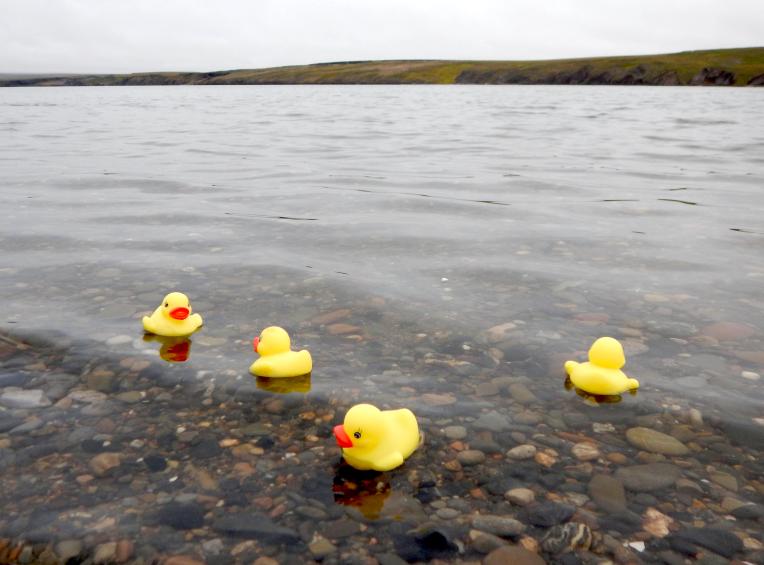
Four rubber ducks – for our dips in the Arctic Ocean
The rubber ducks taking to the Arctic Ocean for the first time.
Yukon gold bubble gum – what a treasure
Fancy Denman Island chocolate – much more delicious than our other field chocolate – mmm mamaqtuq!
Poppers – a great way to annoy your boss when she is trying hard to concentrate – those poppers really stress her out!
Four parachutes to attach to our drones for safety
An air freshener – we don’t smell that bad do we?
Super cool multicoloured “I love Yukon Parks” stickers. There may or may not have been a fight over the particularly cool golden sticker – currently in my possession, but if I die, I have bequeathed the sticker to Santo in my will.
I’m into Yukon Parks for sure!
An intellectual magazine – the Orion
A drone magazine for our reading pleasure!! No we can never get sick of drones!!! And who wouldn’t want to read about Mr. Steele the FPV (first person view) racing drone pilot
And our new TeamShrub mascot – a stuffed version of Otto the walrus – that we shall forever treasure!
Thanks Gillian for providing hours worth of entertainment for TeamShrub, getting us through the last couple of weeks on the island. We don’t think we were going crazy… but then maybe in retrospect we were starting to lose it. But your package kept us entertained and a bit more sane – or perhaps pushed us over the edge when we had our rubber duck race while swimming in the frigid ocean waters and had to resort to significant cheating to get out of the water before we froze to death.
See, we’re not going crazy! Not at all!
We are now packing up all of our stuff and getting ready to leave the island in just a few more days. The fall weather has arrived on the island and the Arctic fog has rolled in, so there hasn’t been as much drone flying of late – but we are very hopeful that the fog will clear and we will be able get our last data collect in tomorrow… fingers crossed… here’s hoping!
Oh sigh… the hoping was in vane, but more on our last two weeks on the Island in future blog post.
Now that we (Team Kluane) are back at Kluane and ploughing through our work schedule, I (John) feel it is time to reminisce about a little experiment we completed earlier in the season, which investigated how herbivory patterns change with elevation.
We carried out the experiment for Dr. Anna Hargreaves as one of those favours that I’m told academics do for each other from time to time. Anna has orchestrated a whole suite of these experiments from as far South as Ecuador right the way up the North American continent to the Yukon, where we are.
Anna Hargreaves seed herbivory transect. Kluane is the northern most site!
At Pika Camp, while Haydn and El collected even more plant trait data, Sandra and I tromped off down into the valley, sunflower seeds in hand, to try and entice all sorts of animals out for a feast. Then we tromped all the way back up the valley, laying out caches of seeds as we traversed a roughly 1km elevation range.
The next day, after more tromping, we found that many of the seeds had been nibbled on and some had been eaten entirely. But what was possibly even more interesting, is how much the little rodents loved flagging tape and popsicle sticks! Probably it was marmots, they’ll eat anything I reckon.
A sunflower seed cache.
Mangled flagging tape.
Highlights of our epic hike around Pika Camp include wading across glacial runoff streams, climbing to the summit of East Peak, and seeing a porcupine!!!
We had so much fun we decided to do the whole thing again back on the Kluane Plateau.




















 Team Shrub