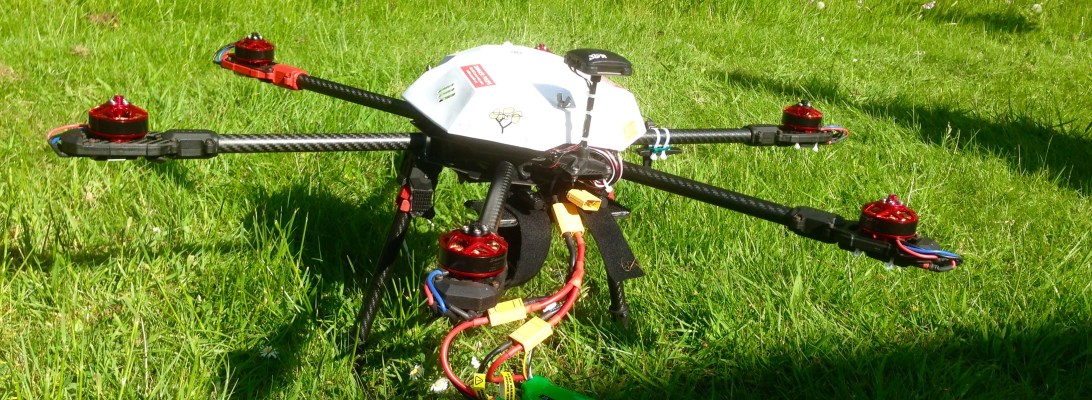
Our drone family has grown and now we need your help to finda a name for ShrubCopter’s new twin!
Cool and Arctic or shrubby and silly, be creative or let us know which one you like best.
To vote click here. Polls will close on Friday the 20th at midnight; the highest ranking name will win!
And yes, the ShrubTundra project is funded by NERC. 🙂
If there is anything that springs to mind at the word ‘tundra’, it is probably something cold.
Not always it turns out. And definitely not in Australia.
The Australian Alps in summer
Qiqiktaruk in winter
Spot the difference between Australia and my usual field site in December
This December I found myself, somewhat to my surprise, burying tea bags at the top of the Australian Alps. This arose almost entirely due to the enthusiasm and generosity of Susanna Venn, one of the tundra tea bag experiment team members based at Australia National University. Though of course, no trip to anywhere is complete without fitting in a little research!
We set out on the long drive to the mountains with an enviable research team spread out across the three cars. Two university researchers, three PhD students, two Honours students, two very enthusiastic boys and 150 tea bags.
Although perhaps a little unexpected given the thirty-something degree heat, the Alps were indeed very similar to the tundra environments I was more used to working in. Low shrubs, grasses and alpine flowers, their whites and yellows just beginning to fade. Snow patch communities emerging from recently melted snows. Frost hollows marking out a very different landscape from the recovering snow gums lining the slopes below. All in all a perfect environment to test our hypotheses.
The main aim of the tundra tea bag experiment is to see whether variation in decomposition across tundra environments is greater than variation explained by differences in tea type. Where better then, than a completely different site on the other side of the world. Here, summers are longer and hotter (a lot hotter). The vegetation is completely different, so may be soil nutrients, and potentially moisture is a more critical factor to decomposition rate. Time will tell!
An abundance of enthusiasm for burying tea!
After digging in the tea we took the time to do a little exploring, admiring the views and getting more than a little sunburnt, then back to the cabin for a cuppa.
Thanks all involved and I look forward the results!
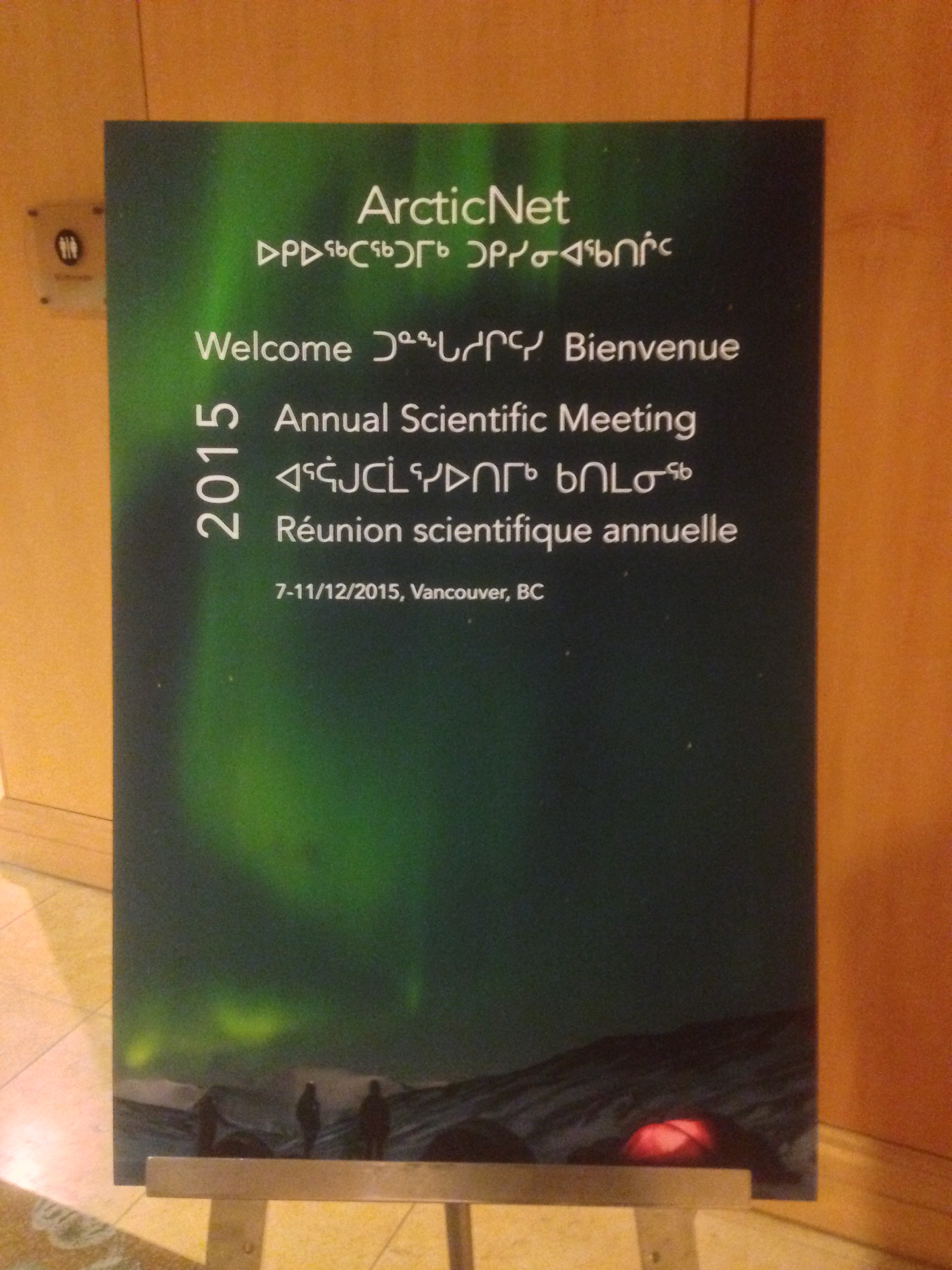
Half way between the field seasons of 2015 an 2016 we’re back in Canada. This time not to conduct research, but for the ArcticNet Annual Scientific Meeting.
Set in the beautiful backdrop of Isla’s home town Vancouver, we’re meeting many old friends from our past adventures and make new ones, while hearing about the exciting science that is currently done in the Canadian Arctic.
Spanning the whole spectrum from natural to social sciences, the rapidly changing Arctic environment is forming the backbone of the conference.
This year Team Shrub is represented in four ways: Isla and Megan are giving presentations about plant traits and boreal shrub increase; Megan and the Quikiqtaruk Monitoring Team are presenting a poster on the phenology monitoring on Quikiqtaruk – Herschel Island, and Jakob presents a poster on our work linking satellite observed greening to vegetation change on the ground with emergent drone technologies.
Come check out our presentations if you’re in Vancouver, follow the conference on Twitter at #ASM2015 and keep an eye on our blog for the occasional update!
If you have been an ardent follower of our Arctic escapades, you may have picked up on a strange sounding experiment we are carrying out across the tundra: the tundra tea bag experiment!
The view from one of our tea bag sites
This is an international effort looking at how decomposition rates might change in a warming world.
We bury two types of tea (Green and Rooibos) at sites across the tundra biome – the cold environments found in the Arctic or the tops of mountains. After a few months we dig up the tea and look at how much it has decomposed. This helps us understand how rapidly it has broken down – and how fast the carbon and nutrients it contains move into the soils and air.
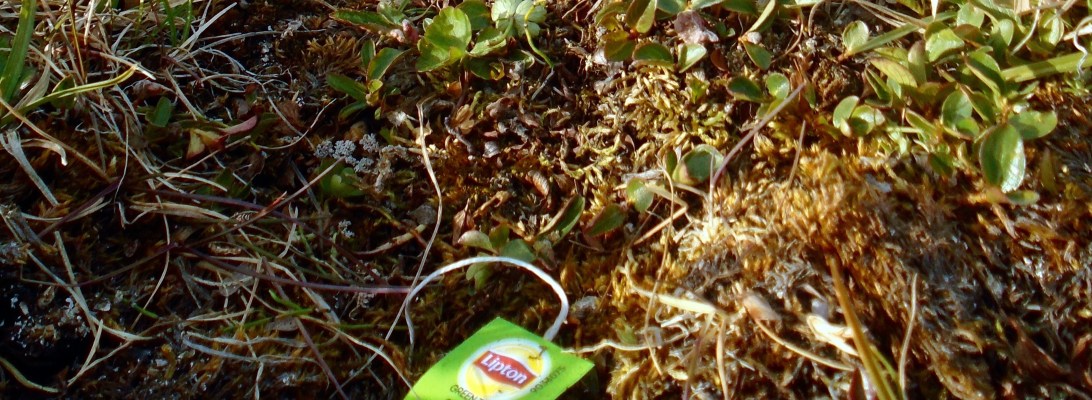
Burying tea to investigate tundra carbon cycling
Normally when we look at decomposition we have to consider both what it is (how fast does it break down) and where it is (where does it break down fastest). But because all the tea we use is the same, we can be more confident that any differences are due to site conditions. This means we can look at how things like temperature, moisture and vegetation cover affect decomposition – which helps us make predictions about the future.
As the Arctic heats up, all the plant matter stored in cold and frozen soils will start to rot, releasing carbon to the atmosphere and speeding up global warming. This could cause a runaway positive feedback affecting the earth as a whole. The tundra tea bag experiment helps us understand if this will happen, and if so, how fast. It is one of many ways we can look at this, and we are working with scientists around the world – from Alaska to Australia, Sweden to Switzerland – to try to get as much data as we can. Similar experiments are also taking place all around the world, spearheaded by the dECOlab in Urtrecht in the Netherlands (http://www.decolab.org/tbi/).
A huge amount of carbon is stored in the litter and soils of the tundra
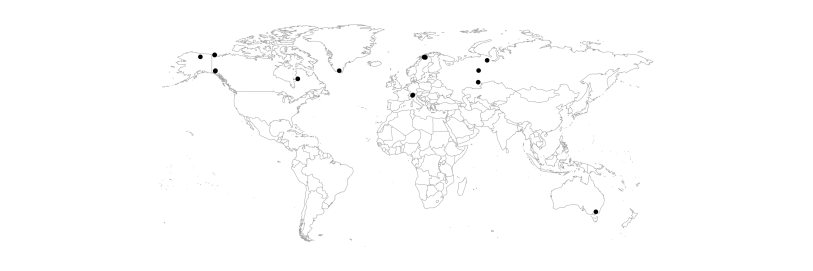
And now the first results are now starting to come in! So far we have data for three-month burials from 14 sites, with more expected to come in over the next couple of months (see the map).
Location of tundra tea bag experiment sites
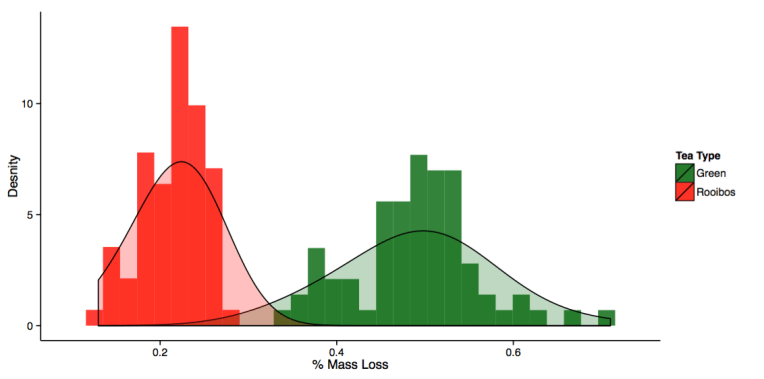
Initial results represent a gradient from European alpine to northern Arctic sites. As expected, there are large variations in decomposition rate (mass loss of tea bags) over the three-month period (see the figure below). This is more pronounced for Green tea than for Rooibos tea. However, the two types of tea display highly distinct decomposition rates despite the range of sites covered, with no overlap in distributions. This supports previous work suggesting that litter characteristics assert more influence over decomposition rate than site characteristics. The initial results are really exciting for our work looking at vegetation change and litter decomposition, as it greatly supports the idea that changes to plant traits and community composition are critical to understanding future rates of decomposition in tundra ecosystems.
Mass loss (%) of green and rooibos tea over three months from 14 sites across the tundra biome
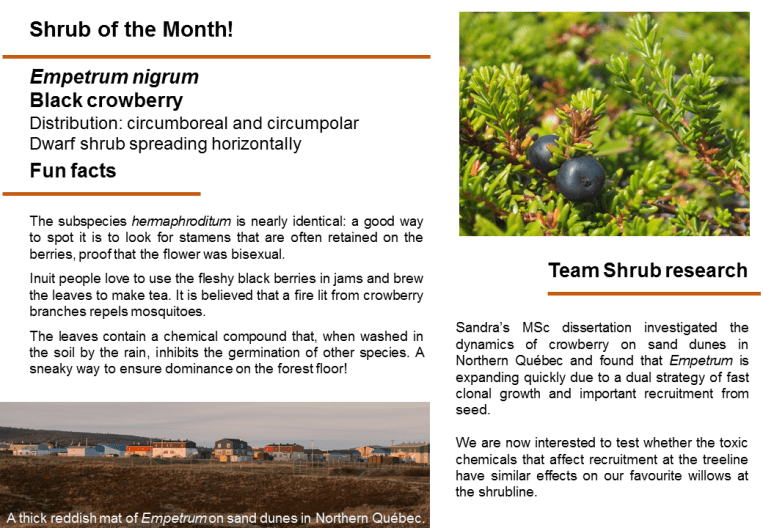
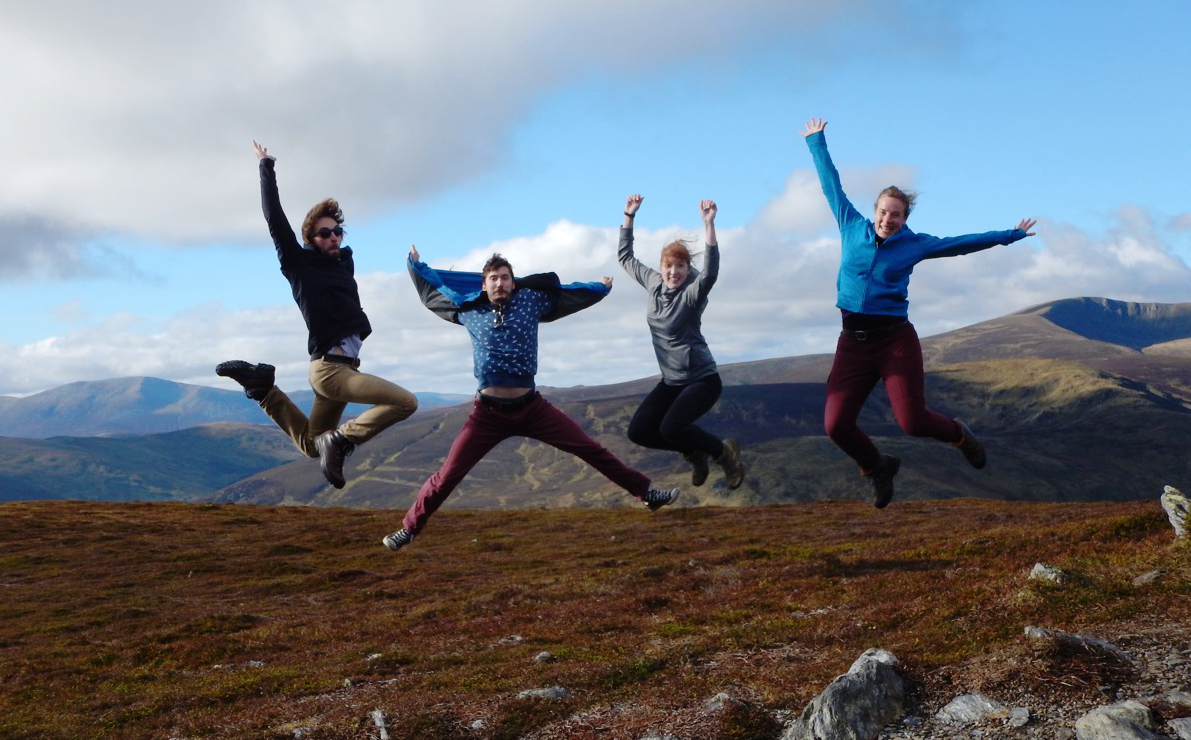
Today was the final day of the Perth Mountain Meeting and after the close of the conference, TeamShrub drove to the hills to summit a mountain and check out the alpine diversity. The peak was so diverse with red deer, grouse, mountain hare, and one of our favourite shrubs Empetrum (crowberry) that we had to jump for joy!
On top of a mountain
It was a great week! TeamShrub was representing with talks by Sandra and Anne and a poster by Haydn. We also met up with friends and collaborators from through out the years, including the crew from the WSL in Davos and my own PhD advisor David Hik.
The major take-home messages of the conference for us were:
Alpine tundra is likely warming and changing just as fast as Arctic tundra, though some factors such as day length, snow conditions, and distance to treeline plant communities differ. Thus, somewhat different future trajectories can be expected for plant communities on the mountainous versus high-latitude sides of the tundra biome.
Microclimate matters. So, if you are a plant, it might be just as easy to move around a mountain rather than just climb towards the summit to follow your thermal niche.
Plant diversity is increasing on alpine summits with warming, but the plants that come and go could just be “summit tourists” and might not be there to stay.
Treeline advance is likely controlled by a variety of factors besides just climate, such as plant competition and herbivory, such that warming won’t always result in trees moving into the tundra.
Check out our tweets for more info on the conference @TeamShrub.
Sandra gave her very first talk at an international conference entitled: “The influence of plant size on the climate sensitivity of tundra shrubs”. She told us all about her analysis of the climate sensitivity of tundra shrubs of different heights. Her hypothesis that taller shrubs are more climate sensitive because they should be better competitors and more linked to atmospheric conditions, was not supported by her analysis of the ShrubHub dataset. This finding leads on beautifully into the rest of her PhD research, where she will explicit test competition and shrub-shrub interactions using dendroecology in tundra ecosystems across the Yukon Territory and Northern Quebec (see details on field data collection in previous blog posts). Sandra did a fabulous job of presenting a complicated analysis on shrubs to an audience of treeline enthusiasts!
It was also an international conference first for Haydn with his poster entitled: “Arctic and alpine tundra vegetation change has no net impact on tundra litter decomposition rates”. Haydn pulled out all the stops putting together a poster that was a work of art, clearly communicated his scientific message, and even included take-away tea bag business cards. Haydn used plant traits to predict community-weighted decomposition. He found that although decomposition is greater at warmer sites around the tundra biome, with warming, plant composition changes. Over time, there is an increase in more decomposable species (e.g., deciduous versus evergreen shrubs) from less decomposable functional groups (e.g., shrubs). Thus, these two effects offset each other leading to no net change in tundra litter decomposition. This is a natural launching off point into other elements of Haydn’s PhD including the tundra teabag experiment initiative that he is leading.
Anne presented the talk: “From the top of the mountain to the top of the world: biogeographic patterns in plant functional traits across the tundra biome”. Anne has found very strong patterns of plant traits along tundra climate gradients. And, what is particularly exciting is that the changes in plant traits across space match up well with the changes in the same traits over time with warming. For example, Anne has looked at the patterns of specific leaf area (SLA), which describes leaf area and mass and is related to energy capture through photosynthesis, water-use efficiency and decomposability of plant leaves. At warmer sites, the community-weighted SLA is higher versus colder sites. And over time with warming, SLA is also increasing across the tundra biome. Anne’s analysis also demonstrates the importance of within versus between species variation in plant traits, such as for example with patterns of canopy height, which need to be incorporated into projections of tundra ecosystem function overtime.
Stay tuned to hear more about the developing manuscripts of these three exciting projects on TeamShrub…
The poster session
Haydn with his poster – check out the tea bags!
Anne presenting tundra trait biogeography
Sandra introducing her talk
The take-home message
Our week began and ended with climbing a mountain, which seems very appropriate for a conference all about mountains and a research team that loves summiting peaks, tundra (or pseudo-tundra like we have here in Scotland) and shrubs like this beautiful bell heather (Erica cinerea)!
By Isla
Heather, my middle name sake, has to be one of my other favourite shrubs
Next week TeamShrub will be attending the Perth Mountain Conference in lovely Perth, Scotland just up north from Edinburgh towards Scotland’s mountains! If you are at the meeting, come check out the following presentations.
In the session “Arctic and alpine: How do alpine regions differ from arctic regions?”:
15-3
From the top of the mountain to the top of the world: biogeographic patterns in plant functional traits across the tundra biome
Anne Bjorkman*1, Isla Myers-Smith2, Sarah Elmendorf3, Nadja Rüger1, Jens Kattge4, sTUNDRA Working Group1 1German Centre for Integrative Biodiversity Research, Germany, 2University of Edinburgh, UK, 3NEON Inc., USA, 4Max Planck Institute for Biogeochemistry, Germany
S2
Arctic and alpine tundra vegetation change has no net impact on tundra litter decomposition rates
Haydn Thomas*1, Anne Bjorkman2, Isla Myers-Smith1, Sarah Elmendorf3, Hans Cornelissen4, Daan Blok5, Jens Kattge6, Martin Hallinger7, Gabriela Schaepman-Strub8, Ken Tape9, Martin Wilmking10, sTUNDRA Working Group2 1University of Edinburgh, UK, 2German Centre for Integrative Biodiversity Research, Germany, 3Univerisity of Colorado Boulder, USA, 4VU University Amsterdam, The Netherlands, 5University of Copenhagen, Denmark, 6Max Planck Institute for Biogeochemistry, Germany, 7Swedish University of Agricultural Sciences, Sweden, 8University of Zurich, Switzerland, 9University of Alaska Fairbanks, USA, 10University of Greifswald, Germany
In the session “Mountain treeline ecotones; threshold dynamics and climatic relationships”:
31-2
The influence of plant size on the climate sensitivity of tundra shrubs
Sandra Angers-Blondin*1, Isla Myers-Smith1, Stéphane Boudreau2, Bruce C. Forbes3, Marc Macias-Fauria4, Noémie Boulanger-Lapointe5, Martin Hallinger6, Ken D. Tape7, Esther Lévesque8, Stef Weijers9, Daan Blok10, Trevor Lantz11, Rasmus Halfdan Jørgensen10, Andrew Trant11, Laura Siegwart Collier12, Luise Hermanutz12, James D. M. Speed13, Agata Buchwal14, Allan Buras6, Martin Wilmking6 1University of Edinburgh, UK, 2Université Laval, Canada, 3University of Lapland, Finland, 4University of Oxford, UK, 5University of British Columbia, Canada, 6Ernst-Moritz-Arndt University Greifswald, Germany, 7University of Alaska Fairbanks, USA, 8Université du Québec à Trois-Rivières, Canada, 9University of Bonn, Germany, 10University of Copenhagen, Denmark, 11University of Victoria, Canada, 12Memorial University, Canada, 13Norwegian University of Science and Technology, Norway, 14Adam Mickiewicz University, Poland











 Team Shrub